India is still largely an agrarian country in terms of its workforce. Of the three key sectors that the economy of a country is divided into - agriculture, industry and services - agriculture still employs the largest share of Indian workers. However, its contribution to the economy has been falling over time, while the share of services has risen significantly.
Structural transformations
Historically, as countries have industrialised, the contribution of agriculture to their economies has steadily fallen.
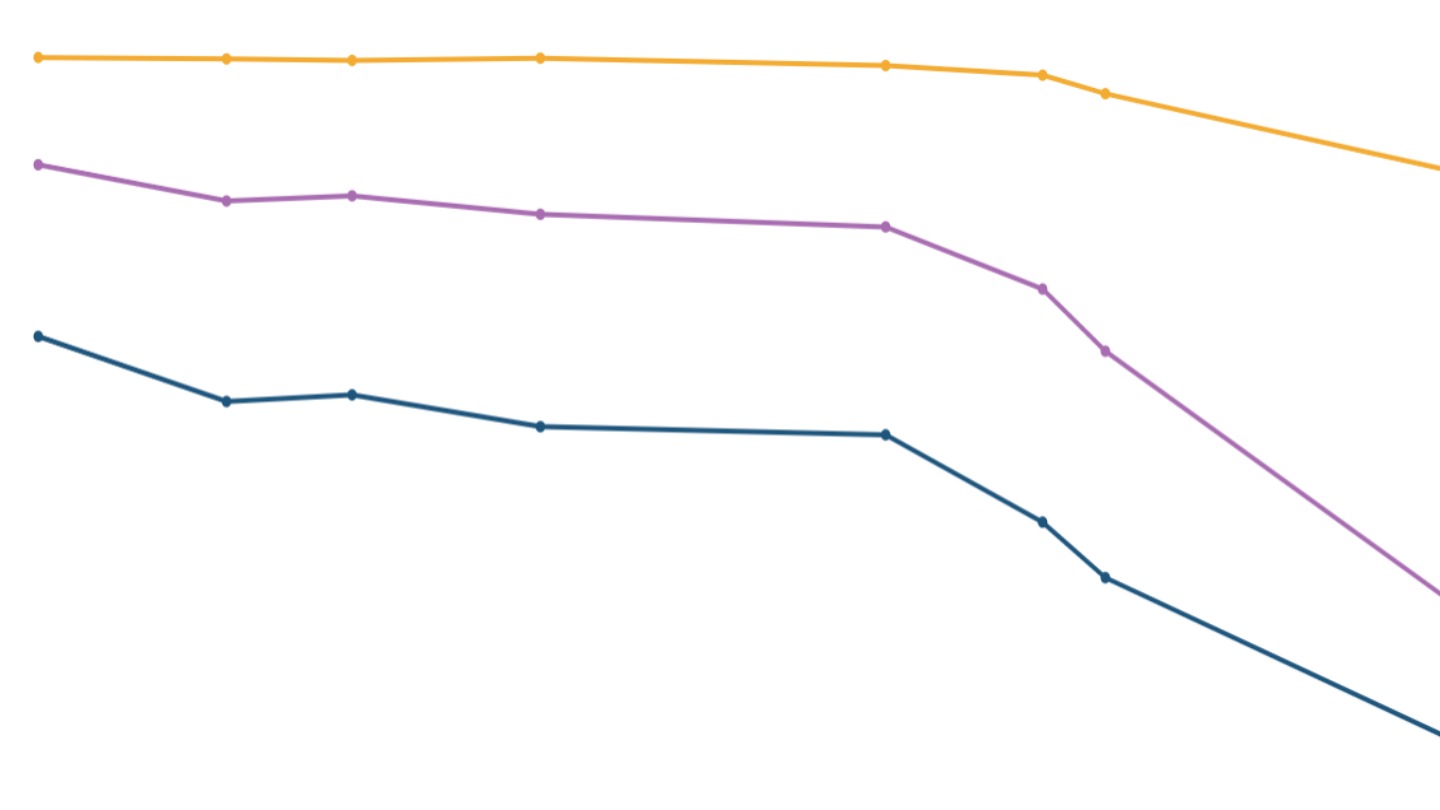
On this count, India is on a similar trajectory. In the 1980s, agriculture was the single biggest contributor to the Indian economy of the three sectors, accounting for more than a third of the national Gross Value Added.[1] By 2025, agriculture accounted for less than a fifth of India's economic size.
But the share of workers that agriculture employs still remains high. In the 1980s, about two-thirds of India's workers were engaged in agriculture. By 2025, the share of agriculture was down to less than half, smaller than fifty years ago, but still the highest among all major sectors.[2]
What this means is that India's economic transition has not yet resulted in a complete transformation in the sectoral distribution of the national workforce. This is particularly visible if we look at agriculture and services together. While half of India's workforce which is in agriculture generates only one-fifth of the value added in the economy, one-third of the workforce which is in services generates nearly half of national economic value.
The changing agricultural workforce
Agriculture dominates India's rural workforce. But here too, changes are apparent, particularly between the trajectories of male and female workers.
Rural men have steadily moved out of agriculture, and at a faster pace than rural women. Industry and services have both offered non-farm employment to rural men.
Rural female workers on the other hand remain primarily in agriculture. Rural female employment in agriculture fell gradually until 2018, but female workers from rural India have re-entered agriculture in substantial numbers.
Manufacturing stagnation
The paths that countries take once they industrialise are diverse. For the early industrialisers of Europe and North America, as well as Japan and some of the East Asian economies later, the path was of moving from an agrarian economy to one with a rising share of industry for a few decades, followed by a much later growth in services.
In India and some of its peers, on the other hand, that shift has come much earlier, with the contribution of manufacturing in particular peaking early.[3]
Since the 1970s, the share of industry in the economy has grown only slightly even while the share of the workforce that is employed by industry doubled.[4] Industry is composed chiefly of manufacturing and construction, with mining and utilities as its smaller components.
While manufacturing is the largest component of industry in India in terms of value added to the economy, it is now in decline, having hit its peak in the 1980s. This is substantially different from the trajectory of Bangladesh, for instance, where the manufacturing boom continues to drive growth.
The engine of employment growth within industry in India has not been manufacturing, but construction. The share of the construction industry in national gross value added has doubled in fifty years. The share of construction in employment, on the other hand, has grown six-fold. Construction added more than 60 million jobs in the last five decades. As of 2025, one in eight Indian workers was a construction worker.[5]
The services boom
The majority of the value added in the Indian economy now comes from the services sector, even as the sector employs less than a third of the workforce.
India's services boom was driven primarily by trade and hospitality from the 1980s to the 2000s. Within the services sector, two areas of the economy - trade and hotels (including repair services and restaurants), and transport and communications (including storage and broadcasting) - have a 17% share in both the economic value added and in the services workforce.
In recent decades, however, the services boom has been powered by services other than these two traditional services groups. Some of these services produce relatively few jobs but have a significant economic contribution
Real estate, finance, professional services and public administration, for instance, together employ only 6% of the national workforce, but contribute 28% to India's economy.[6]
Real estate, for instance, employs 0.2% ofIndia's workforce, but it contributes 7% of the gross value added in the economy. Financial services, which includes banking, insurance, and investment services, employ 1% of the workforce but contribute 6% to the economy.
The services boom of the last few years has been led, to a large extent, by professional services. These include information technology, legal and accounting services among others.
India in context
Similar to India, services contribute to around half of economic output in emerging economies like China, Bangladesh and Vietnam. However where they differ is in the relative contribution of agriculture and industry. China has been the fastest among these to reduce the imprint of agriculture on employment and the economy. The contribution of industry to India's economy, meanwhile, is relatively low.
[1] The Gross Value Added is the value of all goods and services produced in the country. To measure the GVA, a country must measure the volume of output in all sectors and sub-sectors and multiply it by prices to get the value added. The value of inputs and intermediate goods is subtracted.
[2] Data on employment comes from the Employment Unemployment Surveys (EUS) from 1983 to 2012 and the Periodic Labour Force Surveys (PLFS) from 2017 to 2025 from the National Sample Survey Office (NSSO).
Although there is a broad move away from agriculture to industry and services within India's workforce over the longer term, PLFS data shows that agricultural employment in India has increased in the last few years.
[3] The economist Dani Rodrik of Harvard University finds that countries like India are reaching peak industrialisation in terms of employment and output at much lower levels of income compared to the early industrialisers. Industrialisation peaked in Western European countries such as Britain, Sweden, and Italy at income levels of around $14,000 per capita (in 1990 dollars), while India and many Sub‐Saharan African countries appear to have already reached their peak manufacturing employment shares at income levels of $700 per capita. Rodrik called this "premature deindustrialisation" in his 2015 paper and suggests that it has potentially important economic and political implications.
[4] Gross Value Added, or GVA, is how the GDP is calculated using the production approach. Technically, GVA plus subsidies on products minus indirect taxes gives the GDP.
[5] Absolute estimates of the workforce are estimated using ratios from national surveys and population estimates from the official projections by the Registrar General and Census Commissioner of India.
[6] Data pertains to 2021-22. Economic contribution is obtained from detailed national accounts statistics, and employment from Periodic Labour Force Survey.