The big shift when it comes to drinking water in India is that most Indians now have access to safe and clean drinking water, as I found in my work for us. At the beginning of the 2000s, fewer than 80% of Indians had access to basic drinking water, while by 2022, 95% of Indian households had access to basic drinking water, a rate of progress that surpassed the world's on average.
But given that the definition of safe drinking water includes many different sources, I was quite surprised to see, when I broke it down by source, that despite growth, access to piped water in India remains limited, particularly in rural India. The most common source of drinking water in rural India remains the handpump or the tubewell.
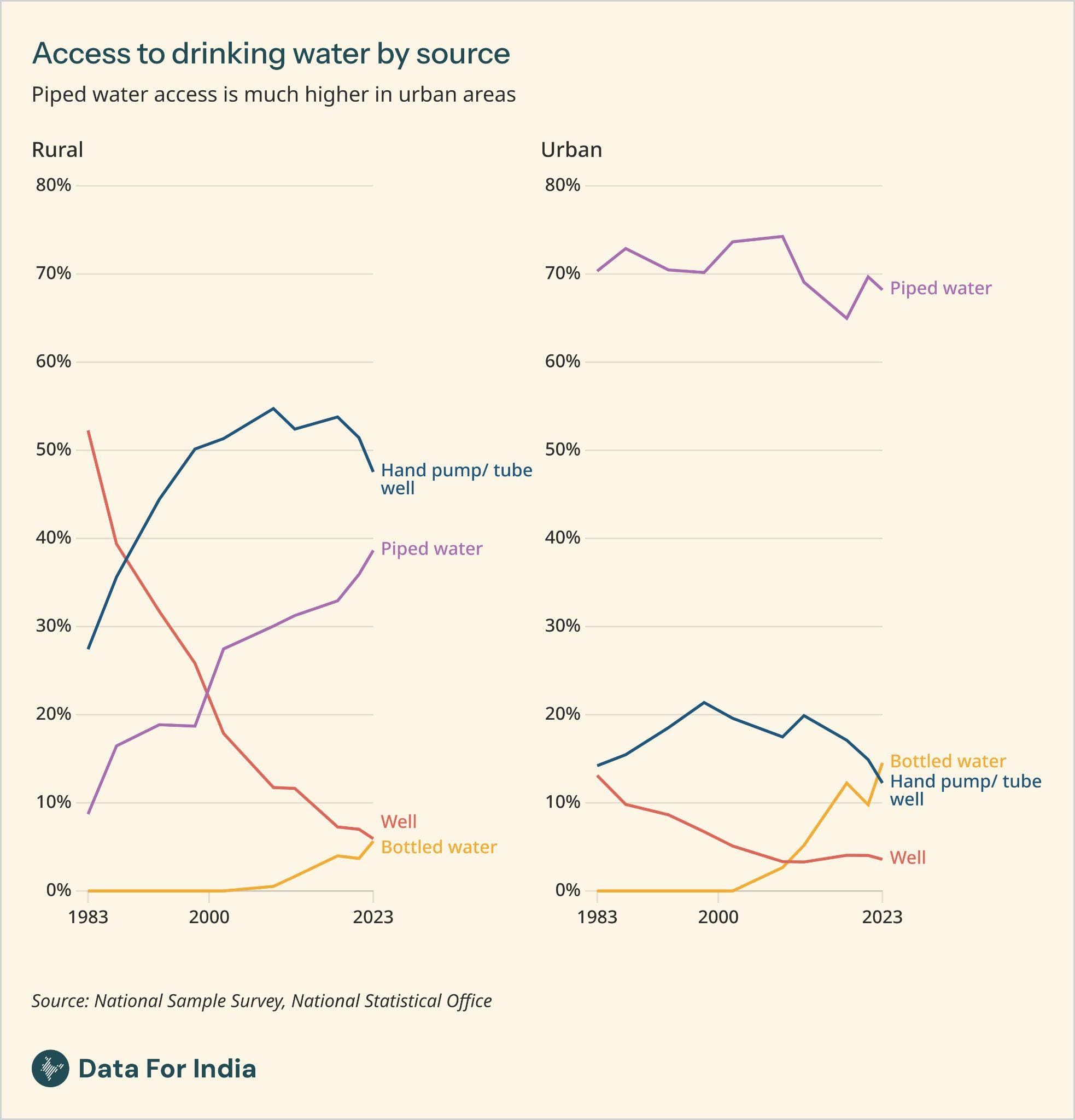
This data comes not from counting the number of taps or pipelines, but from the National Sample Survey's enumerators asking households what their principal source of drinking water (source from which they obtained drinking water for the majority of the previous year) was.
There is a strong regional element as well - handpumps or tubewells serve 95% of rural Uttar Pradesh households, over 85% of rural Bihar households and 75% of West Bengal's rural households. In contrast, just 2% of rural households in Karnataka and 5% of rural households in Tamil Nadu use handpumps or tubewells as their principal source of drinking water.
Although a safely managed handpump or tubewell is classified by the World Bank as an improved source of drinking water, handpumps require some amount of manual work, the water pumped typically needs to be safely stored, and if not dug deep enough can be a source of transmission of communicable diseases including diarrhoeal disease.
If you look at the trendline for handpumps, you can clearly see that it is on the decline in rural areas, while piped water supply is growing. Yet for nearly half of rural households to still be reliant on handpumps or tubewells came as a distinct surprise to me, no doubt as a result of my own location. When newer numbers are available, it will certainly be an indicator I'd hope has shifted further.