In an earlier edition of this newsletter, I mentioned my colleague Nileena Suresh's striking findings on the silent growth of 'custom tailoring' as a manufacturing activity in India, particularly that over a third of the new manufacturing jobs added over the last six years were in custom tailoring alone, meaning that one in six manufacturing workers is now a custom tailor.
Custom tailoring refers to tailoring work done for customers or businesses, and not for household self-use, where cloth fabric is transformed into finished garments.
In this edition, I wanted to talk about a further nuance within this - the rapid feminisation of custom tailoring.
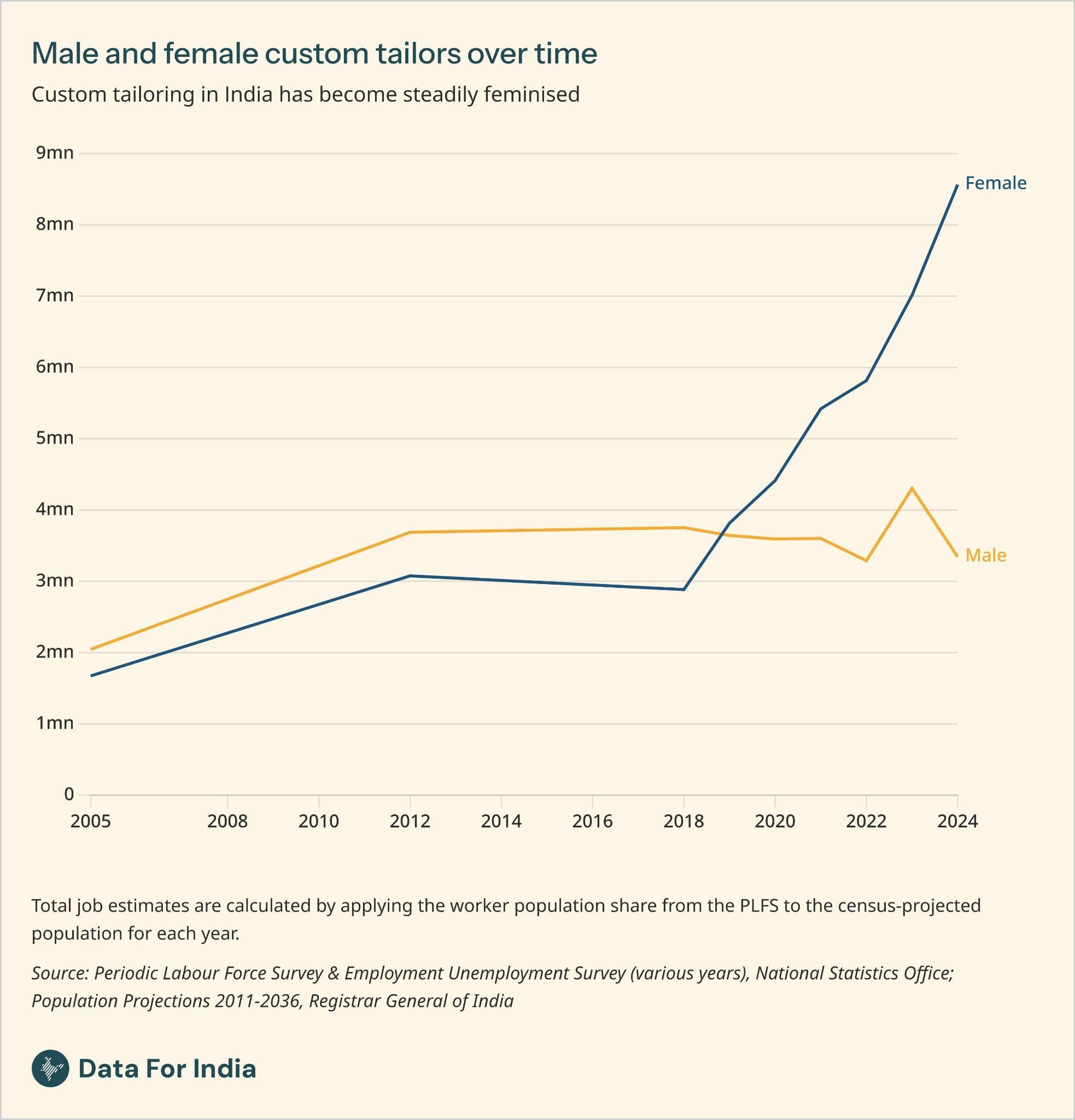
Nileena finds that 45% of custom tailors were women as of 2005. In two decades, this share had grown to 72%. Women now form the majority of this sector, with 8.5 million female tailors out of 12 million custom tailors in the country. In fact, one in three women working in manufacturing is a custom tailor.
But female and male custom tailors do not look the same, Nileena finds. Female custom tailors are much more likely to be self-employed, to be doing the work from their homes, and to be doing this as a part-time activity.
On the one hand, custom tailoring has clearly propelled the entry of women into the manufacturing workforce. On the other hand, these are not exactly the jobs I usually picture when I think of women in manufacturing - my mental image is of the women workers in the garment factories of Tiruppur and Ludhiana. It also adds up, then, that custom tailoring is currently counted in national accounts as a service and not a manufacturing activity, separate from labour statistics.
It's one of the biggest shifts we've seen in labour, manufacturing and women's work - but it may not look a lot like what you imagined.