Salaried employment is associated with higher wages, better job security and higher skilled work. However, salaried workers are a minority in India's workforce, and salaried employment in India does not look the same for all workers
Labour statistics define salaried employment or regular wage employment as the working arrangement in which employees who work in enterprises owned by others are paid their wages on a regular basis, generally from the same employer.[1] In regular wage or salaried work, the worker must complete either the mandated hours of work (time wage) or the intended volume of work (piece wage), but does not need to set up new contracts with employers for each new piece or day of work. This separates them from casual workers or the self-employed.
The salaried in India's workforce
Salaried workers are a minority in India's workforce, making up 23% of workers. In contrast, more than half of the global workforce is in salaried employment.[2]
As economies grow, the workforce tends to shift from agriculture to manufacturing and services, and alongside this, the share of salaried workers in the workforce grows. Almost all jobs in advanced economies are salaried jobs.
In many emerging market economies as well, the share of salaried workers in their national workforce is higher than in India, and has also grown faster over time. This is the case in both other lower-middle-income countries such as Viet Nam and Bangladesh, as well as in upper-middle-income countries such as China and Indonesia.
Within India as well, salaried jobs are more common in richer states, such as Haryana, Gujarat, Tamil Nadu and Maharashtra.
The share of salaried workers in India's workforce has grown only modestly over time. Between 2005 and 2018, India's workforce saw a substantial change in terms of the share of salaried jobs, but there has been little further growth since then.
Who are India's salaried employees?
In India, salaried employment is predominantly an urban phenomenon, partly owing to the primacy of agriculture as the employer in rural areas. Overall, one in five Indian workers, or roughly 130 million workers, are in regular wage work or salaried employment.[3] Three in five of them, or roughly 350 million are self-employed (including 120 million unpaid helpers), and the remaining fifth (120 million people) are engaged in casual work.
Salaried work is more common among men: one in four male workers is a salaried worker (25%), while only one in six women (16%) are in regular wage arrangement.
Having a higher education significantly raises the odds of having a salaried job. Among workers who were educated only up to the secondary level (Class 12), 28% were salaried workers, as against 57% among the higher educated workers (those with a graduate or postgraduate degree, or equivalent).
What do India's salaried workers do?
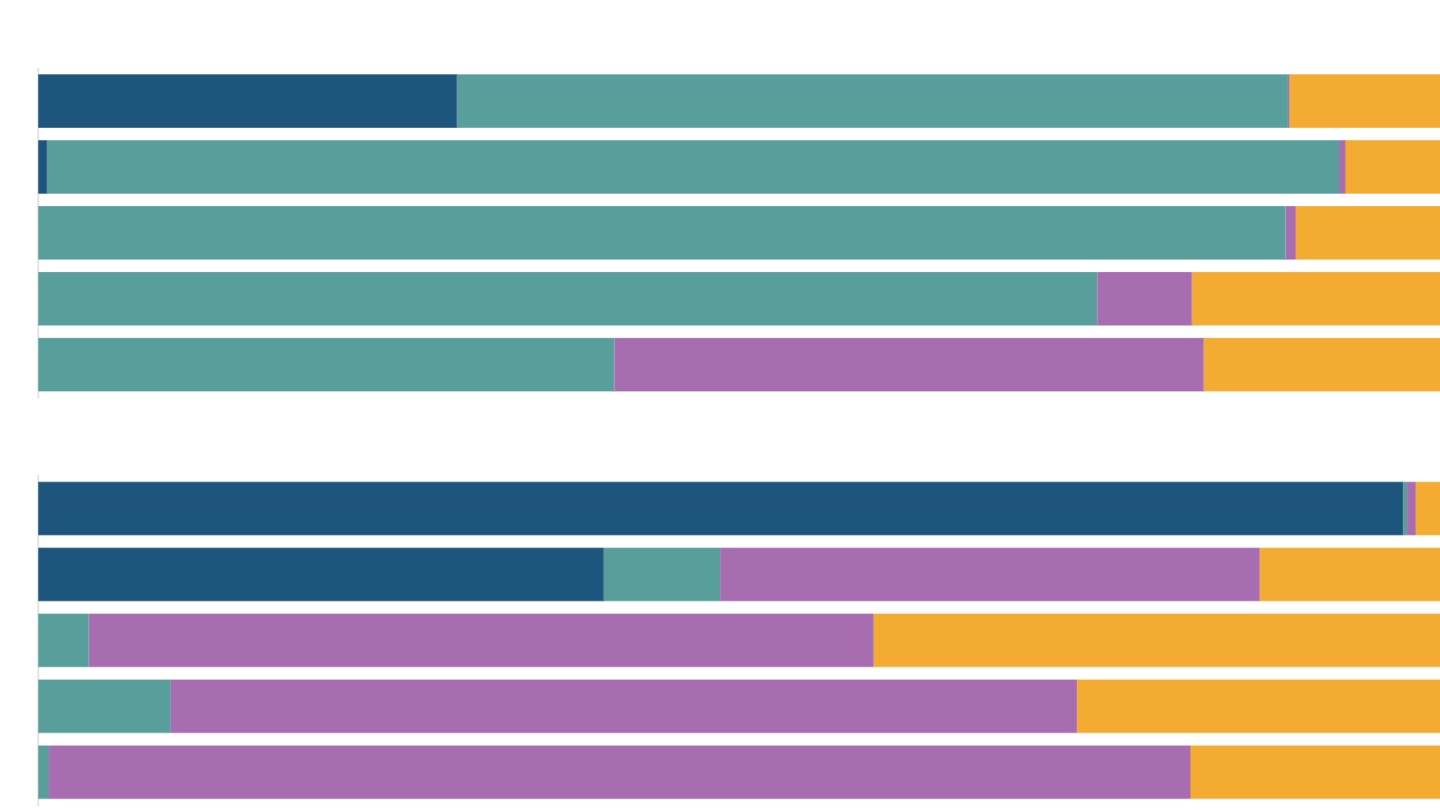
The economy is broadly divided into three sectors - agriculture, industry and services. Among economic sectors, the service sector is most likely to have salaried jobs, while casual jobs are more common in the manufacturing sectors. Self-employment and unpaid work, especially among women, is the mainstay in agriculture.
Under the services sector, most salaried jobs are in education, trade and transportation, while a large proportion of such jobs in manufacturing are in units that make textiles, apparel and food.
Most salaried jobs are not high-skilled.
The most common salaried occupation in India is working as salespersons in retail shops. Shop salespeople account for about 7% of salaried jobs in India, and they are those who run retail grocery stores, pharmaceutical and medicine shops, and clothing stores. Nine in ten shop salespersons who get regular wages are men.
The second most common occupation in regular/salaried wage work is the work of domestic servants such as cleaners and helpers in others' homes, offices or elsewhere. About 6% of salaried workers are cleaners and helpers in the domestic or office settings. Half of these regular wage workers work as housemaids or servants in households, while the majority of the remaining work as cleaners and helpers in institutional settings such as hospitals, hotels and schools. Almost all of the household servants are women, and the majority of the institutional cleaning workers are male.
More than 7% of regular wage workers are primary school, secondary school, and college teachers.
Wages
Salaried workers earn significantly more in wages every month than workers in self-employment and casual labour.
India's Periodic Labour Force Surveys record the earnings of all types of workers from the work activity in which they were engaged in during the week of the survey.[4][5]
In 2024, the average salaried worker earned close to Rs 21,000 per month, compared to Rs 13,200 earned by a self-employed person, and a median monthly income of Rs 9,000 per month for a casual worker.
Within salaried employment, there is a significant gender gap in wages. The average female salaried worker earns 25% less than the average male salaried worker in the country.
Although salaried work attracts higher wages compared to other arrangements of work, the average income from salaried work has declined over the last decade in real, or inflation-adjusted, terms.[6]
The monthly average salary in India increased by about 90% from 2012 to 2024, in nominal terms. But adjusting for inflation, the average income fell 4% over the period.[7]
Driving this fall was a decline in the inflation-adjusted wages of people in some occupations in particular. Among salaried workers employed in the most common occupations, high-skilled and high-earning workers appear to have experienced the sharpest declines in real incomes.
In fact, inflation-adjusted incomes of office clerks, drivers, domestic workers and garment workers actually grew slightly from 2012 to 2024. Software developers, college teachers, and protective services workers such as police personnel, on the other hand, saw their real incomes fall.
Social security benefits
Salaried jobs are considered to be relatively the most secure types of working arrangements since they provide a regular and stable income, and can have written contracts and employee benefits. Contrary to this commonly held belief, more than half of salaried workers in India (57%) do not have a written employment contract with the employer.
One in three salaried workers in the country have long-term contacts with their employers. These are what are also commonly referred to as permanent jobs. This means that only about 6-7% of workers in India are in permanent regular wage employment.
A minority of salaried workers receive social security benefits such as healthcare or maternity cover, provident fund or pension and gratuity.
Teachers, clerks, managers, technicians and government employees are more likely to have some social security.
[1] India's Periodic Labour Force Survey defines a regular wage/salaried employee as follows: Person working in other's farm or non-farm enterprises (both household and non-household) and in turn getting a salary or wage on a regular basis (and not on the basis of daily or periodic renewal of work contract). This category not only includes persons getting time wage but also persons receiving piece wage or salary and paid apprentices, both full-time and part-time.
[2] The International Labour Organization compiles labour market indicators of countries across the world using nationally conducted household labour force surveys. The ILO generates modeled estimates for countries for years for which survey data is not available, and also generates modeled labour market indicators for regions of the world such as South Asia, Latin America and the World.
[3] Estimation of absolute number of workers is done in two steps. First, we get the workforce participation rate from the Periodic Labour Force Survey for a year, and multiply it by the population estimate for that year, to get the absolute size of the workforce. Second, we get the relative shares of types of workers from the PLFS, and apply it to the absolute size of the workforce to get the number of workers in each type of working arrangement. Absolute numbers of workers are indicative in nature since India does not have official actual population data for years after 2011 - only the projections from the Registrar General and Census Commissioner of India are available. We derive the single-year population estimates for survey years using interpolation of the actual population data for 1991, 2001 and 2011 and the official population projections for the period 2012-2036, by applying the compounded annual growth rate (CAGR) between two available data points/years to each year in between. Absolute estimates of workers are only indicative due to the modeled nature of the population data, and they should be read with caution.
[4] The PLFS records monthly wage income of salaried workers for the last calendar month preceding the survey, daily wages of casual workers for the week preceding the survey, and gross earnings for self-employed workers in the 30 days preceding the survey, in their Current Weekly Status (CWS). For casual workers, daily wages are added to generate the weekly wage, which is then mathematically converted to monthly earnings using the factor (30/7). While we measure indicators such as the workforce and labour participation the Usual Status, labour incomes are measured in CWS.
[5] Monthly earnings of casual workers are computed in two steps: adding the daily wages earned to get the weekly wage, and then converting the weekly earnings to monthly earnings by using a multiplication factor of (30/7). This calculation assumes that casual workers work similarly over a time period of a month. The earnings of salaried workers are what they had earned in the calendar month preceding the survey. For self-employed workers, the earnings are the gross earnings of the enterprise minus the expenses. The calculation of median monthly income of self-employed workers excludes unpaid family helpers.
[6] Surveys measure earnings of workers in nominal terms, or at prices prevalent at the time of survey. If we are to compare the average incomes at two points in time, average earnings in nominal terms would give an incomplete comparison since prices of goods and services change over time. To compare them accurately, we remove the effect of inflation using the national Consumer Price Index.
[7] The calculation of real incomes has been done separately for rural and urban areas using the respective indices.
For the year 2012, the EUS survey was conducted between July 2011 and June 2012. To account for this, we take the simple average of the monthly consumer price indices in that period. Similarly for PLFS 2023-24, the CPI is the simple average of CPIs between July 2023 and June 2024. The current series of CPI (base 2012) begins in January 2013, but the back series is available from January 2011. We use the back series (base 2012) for the period from January 2011 to December 2012, and the current series (base 2012) for the period from January 2013 onwards.