One of the best parts of my job is when one of my colleagues shares something interesting that they’ve found in the data, something that feels like the germ of an idea. When my colleague Nileena Suresh was working on her piece on women in manufacturing, she flagged for me one such thing that she was seeing in the data - ‘custom tailors’. What she went on to find is fascinating and speaks of an unusual shift.
A little background: India's National Industrial Classification (NIC) is a system of codes to classify all economic activity in India. Activities are given five-digit codes, where the first two digits indicate the division, the third digit specifies the sub-group, and the full five-digit code identifies the exact economic activity. Looking at economic activities at the five-digit code level gives you the most granular sense of who does what work, and how it is growing, rather than large, broad categories like 'manufacturing' or 'financial services'.
One five-digit-coded economic activity stood out in the data on manufacturing employment - custom tailoring. This is tailoring work done for customers or businesses, and not for household self-use, where cloth fabric is transformed into finished garments.
Why should any of this matter? Because custom tailoring is taking over manufacturing.
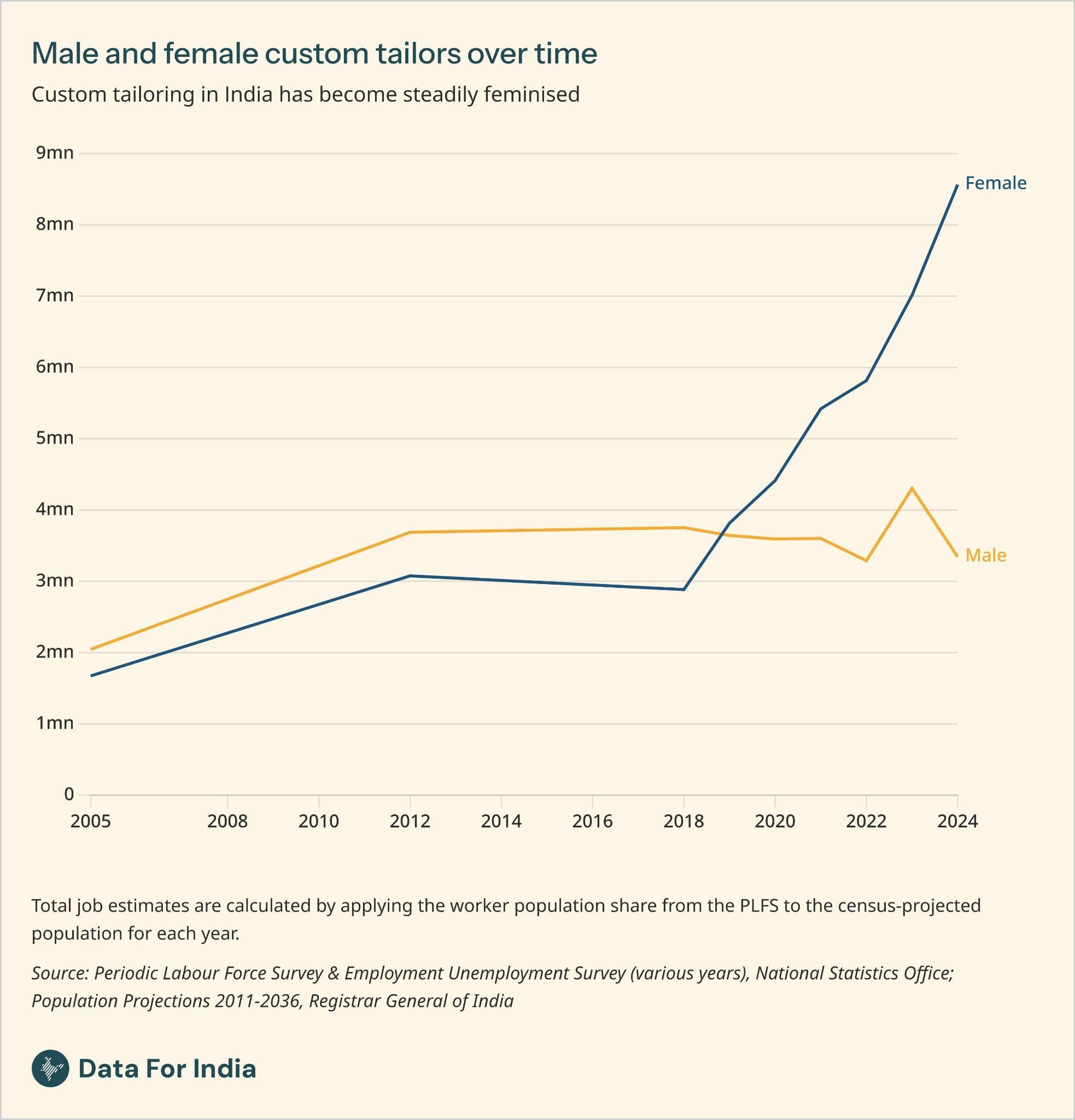
"As of 2024," Nileena writes in her piece on custom tailoring, "India has nearly 12 million custom tailors. About one in six manufacturing workers are custom tailors." And it's not just the magnitude of this one economic activity; it's also its growth.
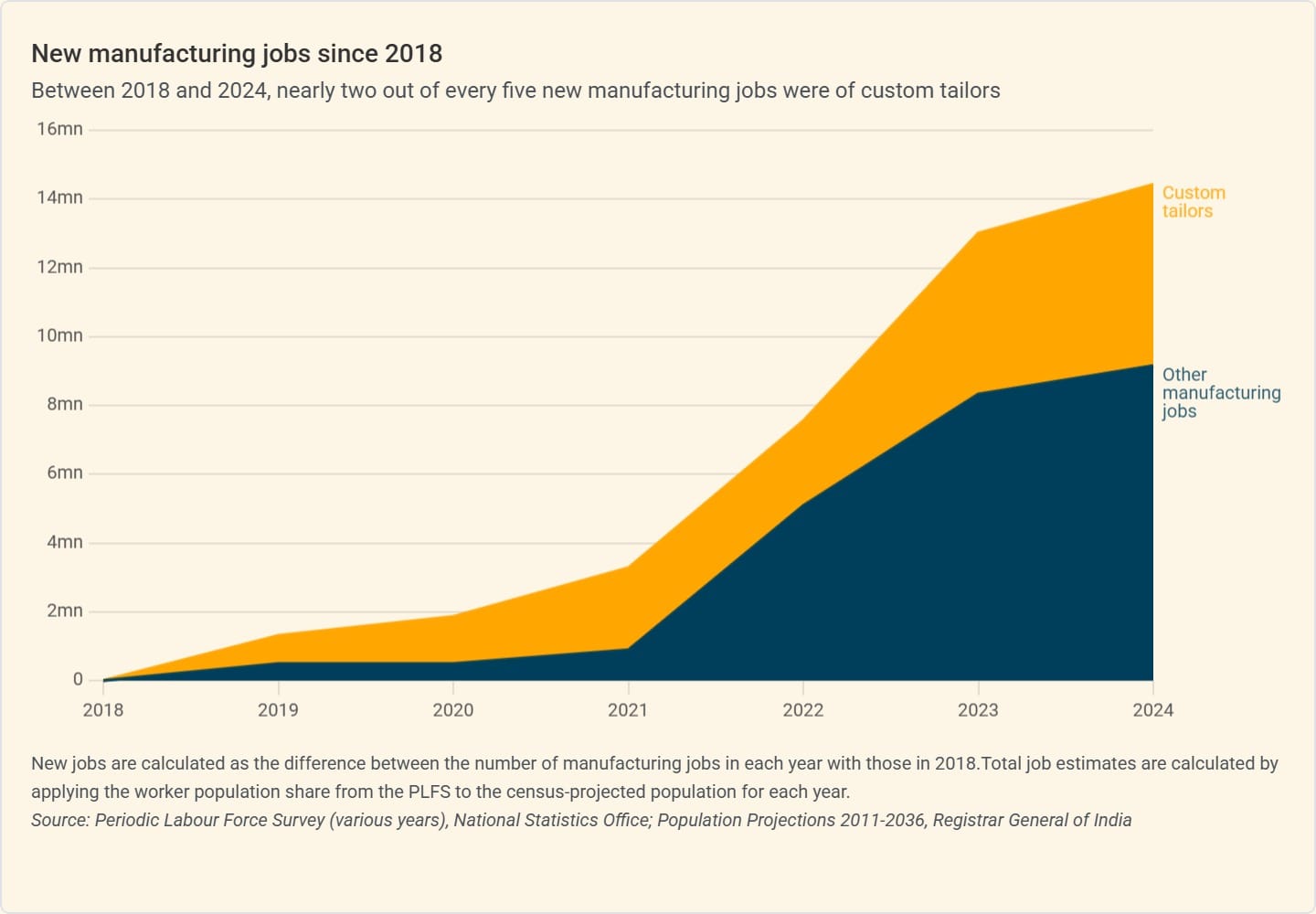
In 2005, there were less than 4 million custom tailors in India, and they made up just 7% of all manufacturing jobs. By 2024, there were 12 million custom tailors, and their share in the manufacturing workforce had climbed to 17%. Of the 14 million new manufacturing jobs added between 2018 and 2024, five million were in custom tailoring alone, Nileena finds.
Without custom tailoring, India's manufacturing story would look very different. This matters because of the nature of custom tailoring jobs, as well as their economic value - in India's national accounts, custom tailoring is seen as a service, and not a manufacturing activity.
It's certainly a big shift in terms of employment, but a complex and nuanced shift in terms of quality of work and contribution to the economy.