In conversations with people in the tech space, a question I often get asked is - where is the headroom? What they want to know is essentially this: where have the big shifts not happened, and where is there then the space for their products or services.
One of these absent big shifts that I have mentioned before is in the ownership of computers (which includes laptops and desktops). It's a particularly stark point when you look at it in this graph.
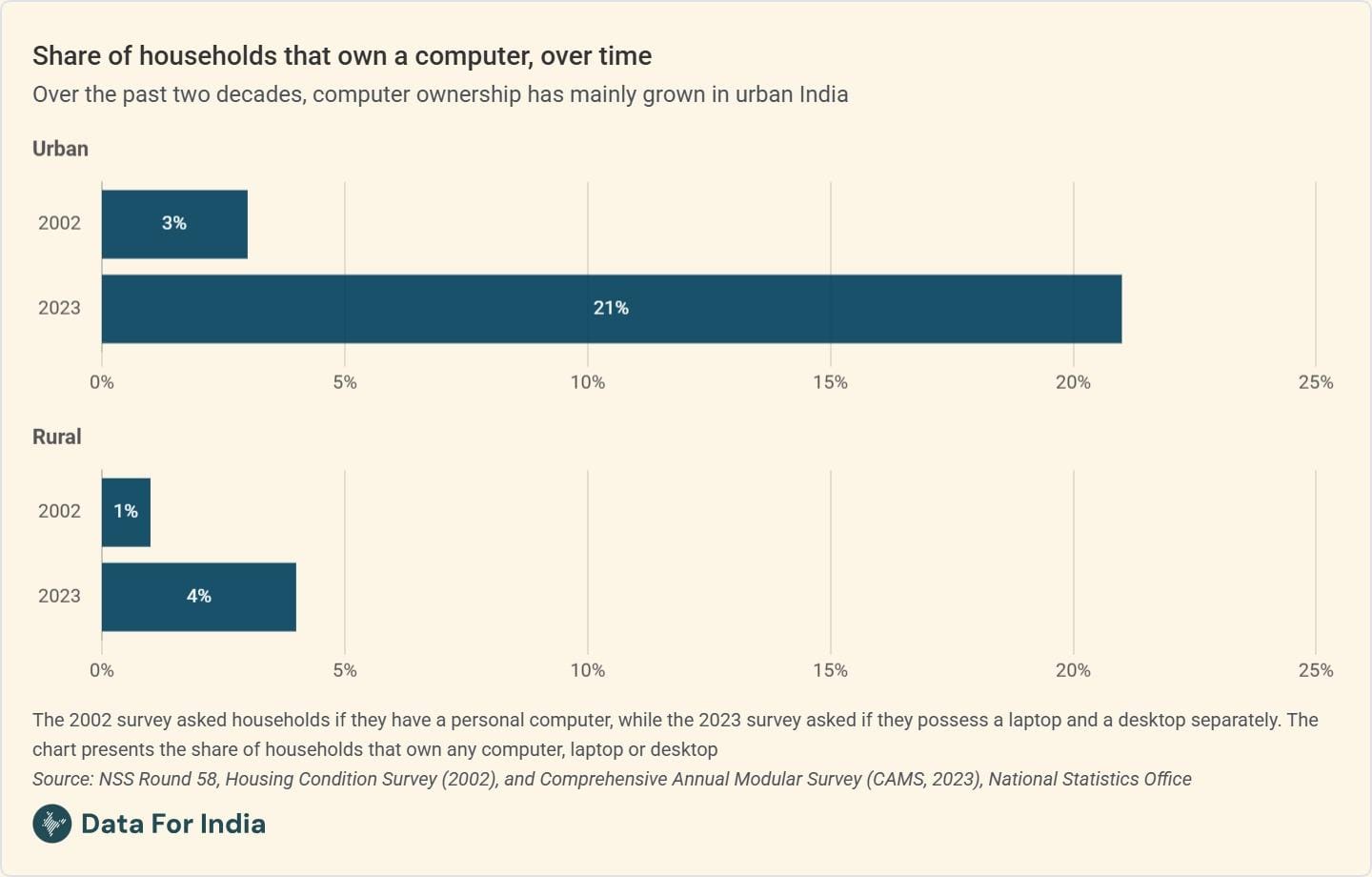
Over the last two decades, the share of households who own computers (which includes laptops) grew from just over 1% to just over 9%, with even lower numbers in rural areas.
As of 2024, 97% of Indian households reported that they owned a mobile phone, while just 7% reported owning a laptop or computer (source: the 2023-24 Household Consumption Expenditure survey). In rural areas, just 2% of households reported that they owned a laptop or computer.
Among the 30 million households in India that own a computer, 90% have a laptop, while 20% own a desktop. A little under 10% of those who own computers report having both a laptop and a desktop.
It's not just that very few own a laptop/computer, very few know how to use one at all - more than eight in ten Indian adults now use mobile phones, but only two in ten reported that they can use computers, Abhishek found.
The barrier to buying a laptop cannot be cost alone, since two-wheeler or AC or washing machine ownership is far higher. With high mobile phone ownership, high mobile internet usage, and now broadband internet spread, it does appear that home computers haven't yet made enough of a case for themselves in India. The share of households with a computer in Sri Lanka and Vietnam, meanwhile, is 25%, in Brazil it's 40%, and is much higher in the richest countries.
The headroom, then, it appears to me, cannot be for computer sales or broadband internet alone. Perhaps it is the very nature of study, skills and work in India that would need to change first. Not one big shift, then, but many.