For the most part, the big shifts in India have involved big changes in numbers - going from high infant mortality to low infant mortality, or going from low levels of electricity access to high levels of electricity access, This week's big shift is of a number that appears to change so little that when a small change occurs, it's a really big shift - the unemployment rate.
India has historically had a low rate of unemployment.
To fully understand what this really means, we're going to have to first look at where the data comes from, and how unemployment is calculated, which my colleague Abhishek does in this piece for our Measurement vertical.
India carries out large, nationally representative household surveys on labour every year. The key questions are open-ended, and trained enumerators convert their answers into a system of codes. This means that all work, including gig work, is covered. It also means that both formal and informal employment are covered. (The private Centre for the Monitoring of the Indian Economy [CMIE] also produces labour statistics, but at Data For India, we use public data only.)
In these statistics, there are two ways of measuring employment. Respondents are asked about their activities during the last 365 days or the last seven days.
When the reference period is one year, a person who worked for at least 30 days in the preceding 365 days is considered to be employed. This method produced an unemployment rate of 3.2% in 2022-23 among India's working age population.
When the reference period is one week, a person who worked for at least one hour on at least one day during the seven days preceding the survey is considered employed. This method produced an unemployment rate of 5.2% as of 2022-23.
The World Bank uses India's weekly data in the chart below.
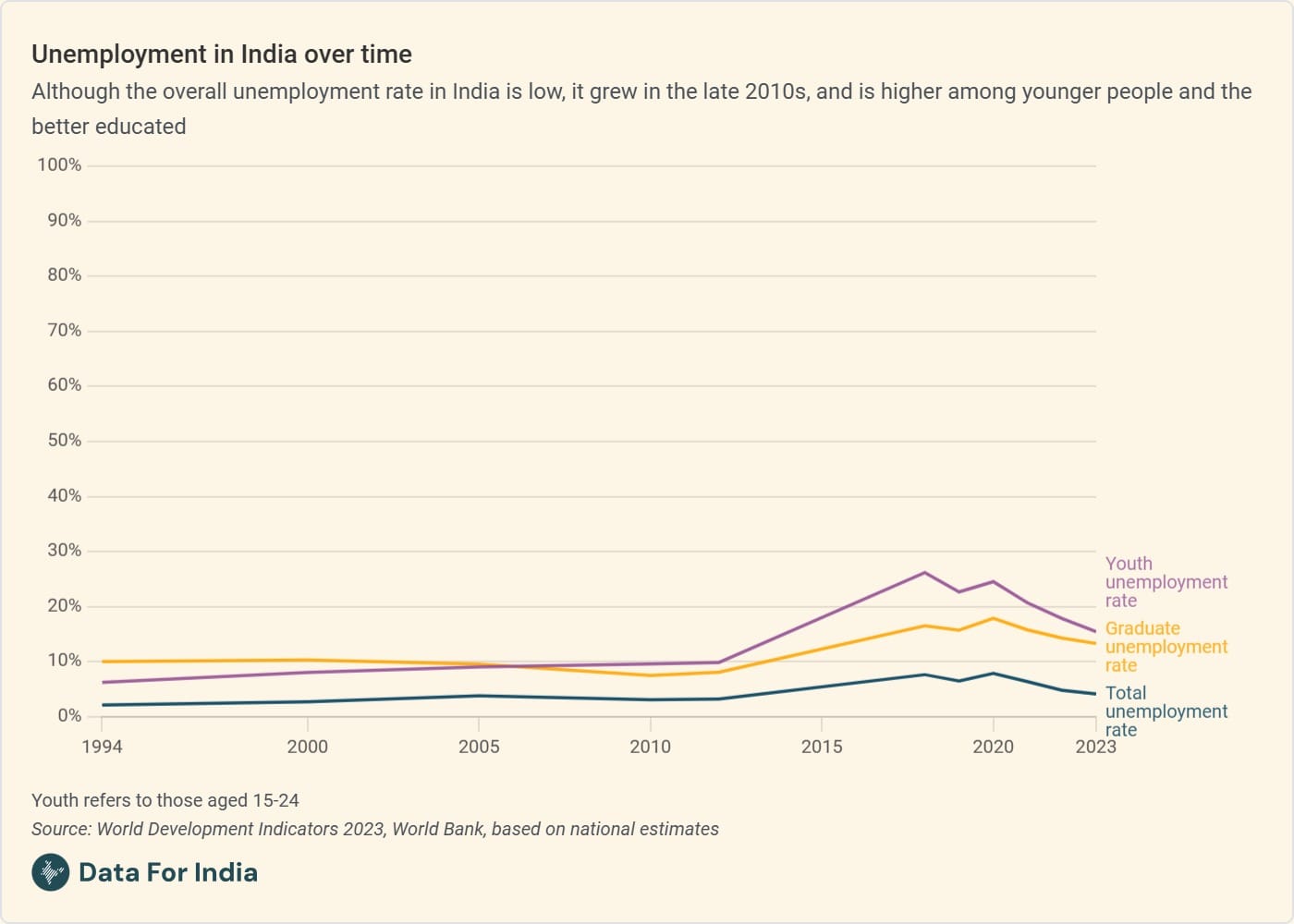
What's remarkable about this chart at first glance, really, is how unremarkable it is.
"While the unemployment rate is a crucial metric to understand economic trends in developed countries, it does not always fully capture the ability of developing countries to adequately employ most people. In the absence of unemployment insurance systems or social safety nets, most people of working age in poorer countries engage in some form of economic activity, even if it is inadequate," Abhishek writes in this piece on employment in India.
So what does become remarkable then, is when this number changes, or is higher or lower for specific groups - when there is what might seem like a small shift, but is a big one for an otherwise low and stable number.
For one, unemployment rose in India in the later 2010s, which, while still a low number, set off some alarm bells about jobs in India.
And then, unemployment, though low, is higher among certain groups, and that increase too was something more sharply seen in the late 2010s. Unemployment is higher among younger people. It is also higher among the better educated; "In low-income countries, skilled jobs may be scarce and there could be a mismatch between skills and jobs. In addition, the better educated can afford to stay unemployed for longer, and might hold out for a suitable job," Abhishek writes.
A seemingly small number, but one for which every small change is magnified, and has economy- and country-wide ramifications; the unemployment rate and its recent changes are this week's big shift.