India's low female labour force participation rate is something that we write about a fair amount, and almost every time we point out a key takeaway: women not in the workforce aren't not working - they're just working in ways that are not considered economically productive by statisticians. Most of these women who aren't in the workforce tell surveyors that they are "engaged in domestic duties" - meaning that they do the unpaid labour of cleaning, cooking and carework. This is such a key element of the Indian economy that when something changes, it becomes not just a big shift, but a monumental shift.
When an adult, male or female, is asked by India's key labour survey what they do most of their time, their options include reporting that they are working, or unemployed and looking for work - meaning that they are in the labour force - or that they are studying, engaged in domestic duties, or doing something else - meaning that they are out of the labour force. Historically most men have reported that they are working, and most women have reported that they are engaged in domestic work.
This may be changing.
After being worryingly lower than even its usually low levels, the share of women who report that they are working is now approaching its early 2000s levels, as my colleague Abhishek Waghmare outlines in this piece for us. Simultaneously, the share of women in higher education has also risen slightly. As a result, the share of women who report that their main activity was domestic duties has now fallen below 50% for the first time that we have data for.
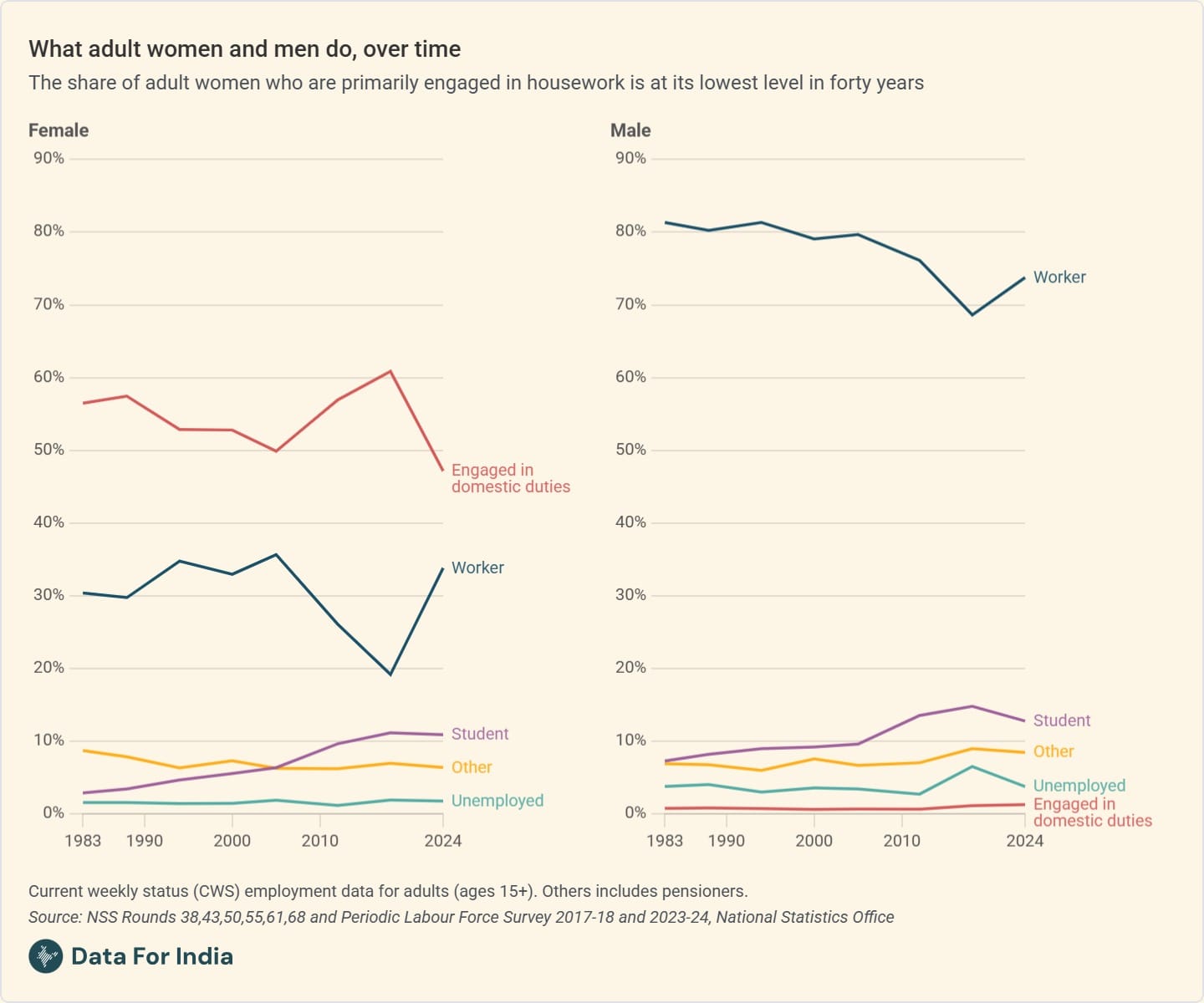
As you can see in the chart, women's labour force participation has witnessed some sharp increases and decreases, so I'd advise being cautious and not immediately suggesting that this shift is irreversible. This is especially because the share of women who report that their main activity was unpaid home labour is tightly tied to workforce participation - when women drop out of the workforce, they take care of the home.
With these cautions in mind, we're definitely noting a big moment here. Whether it becomes a big shift not just for women's labour but also the Indian economy will certainly require some more years of close watching.