For the most part, the changes that we look at in The Big Shift are long horizon - many time-series start in the 1950s, and some projections go up to the year 2100, so that's 150 years of change that we're often looking at. This time, we're looking at just three years - but what momentous three years they were.
Questions on mobile phone usage are relatively new to Indian household surveys. For his piece on access to phones and the internet in India, my colleague Abhishek Waghmare looked at data from two large, nationally representative household surveys that asked respondents in 2020 and 2023 whether they had used a mobile phone recently. (The precise question is whether the respondent has used a mobile telephone with an active sim card for any amount of time during the last three months.)
He found that in just the three years between 2020 and 2023, phone usage rose from 70% of adults to 85%. But the increase among children and teenagers was even sharper.
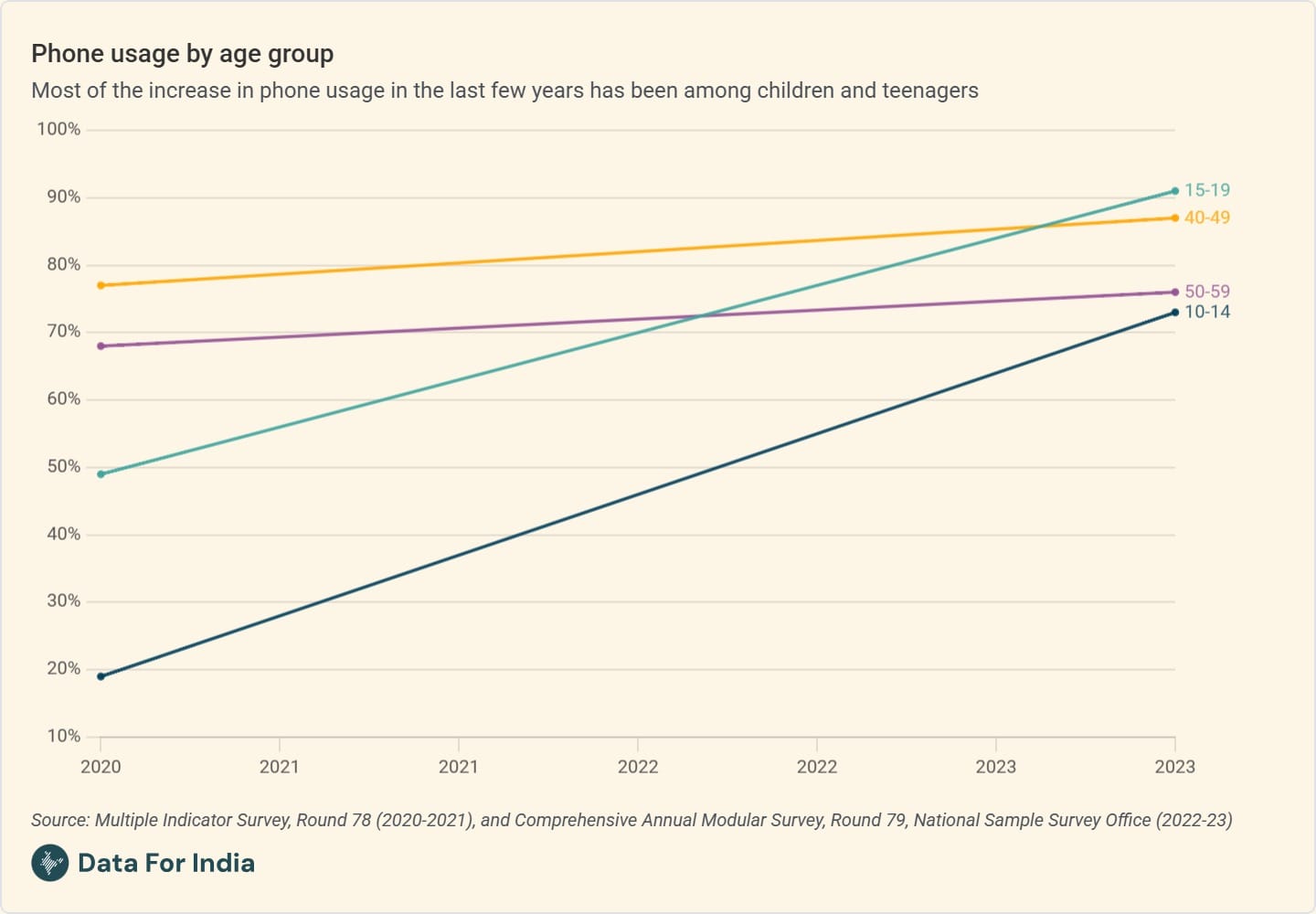
"Driving this dramatic increase in phone use is the uptake among children and teenagers," Abhishek wrote. "Among children between the ages 5 and 14, one in six had recently used a mobile phone in 2020, but by 2023, this had risen to nearly four in six children." Teenagers are also now more likely to have used the internet recently than people in their forties. While school closures may have driven some of this behaviour, by the 2023 survey it was clear that once it had begun, mobile phone usage or adoption had taken hold.
These survey questions are limited - we know little about the frequency of phone usage or the quality of time spent on mobile phones. But there's certainly enough in there to know that these were three years of sudden change for India's children in more ways than one, and that we're only slowly beginning to see the full impact of what these changes will mean for the lives of Indian children.