The move of a country away from agriculture has been one of the defining trajectories of global economics, politics, sociology, demography and culture. Across human history, countries have taken only slight variations of the same path - of people over time moving off the land and into cities to work in factories, shops and firms. The world's richest countries are also the ones where agriculture contributes the least to the economic output, as well as to employment. In many ways, it is the world's biggest shift - and India is right in the throes of it.
At Data For India, our mission is to broaden the understanding of India through the data, which often requires us to look at the newest possible numbers. Once every week, The Big Shift newsletter will take a step back to see the long view of change in India.
"In the 1970s, agriculture was the single biggest contributor to the Indian economy of the three sectors, accounting for 40% of Gross Value Added," my colleague Abhishek Waghmare wrote in his piece for Data For India on the Indian economy's transformation. "Today, agriculture accounts for less than a fifth of the economic output."
In some industrialising countries, manufacturing stepped into the breach, but its contribution to India's economic trajectory has been much flatter. In 1972, as one striking chart in Abhishek's piece shows, manufacturing accounted for less than 5% of newly independent Bangladesh's gross domestic product (GDP), and 15% of India's. By 2022, manufacturing contributed to over 20% of Bangladesh's GDP, while its share in the Indian GDP had slightly reduced.
(If this is as far as manufacturing goes in India, it's plateaued relatively early. The economist Dani Rodrik called this "premature deindustrialization". His argument is that countries like India are reaching peak industrialisation in terms of employment and output at much lower levels of income compared to the early industrialisers. Industrialisation peaked in Western European countries such as Britain, Sweden, and Italy at income levels of around $14,000 per capita (in 1990 dollars), while India and many sub‐Saharan African countries appear to have already reached their peak manufacturing employment shares at income levels of $700 per capita. This has potentially important economic and political implications, Rodrik suggests.)
Instead, it is services that have dominated India's big economic shift, now accounting for over half of the GDP. But the jobs have not moved in quite the same way.
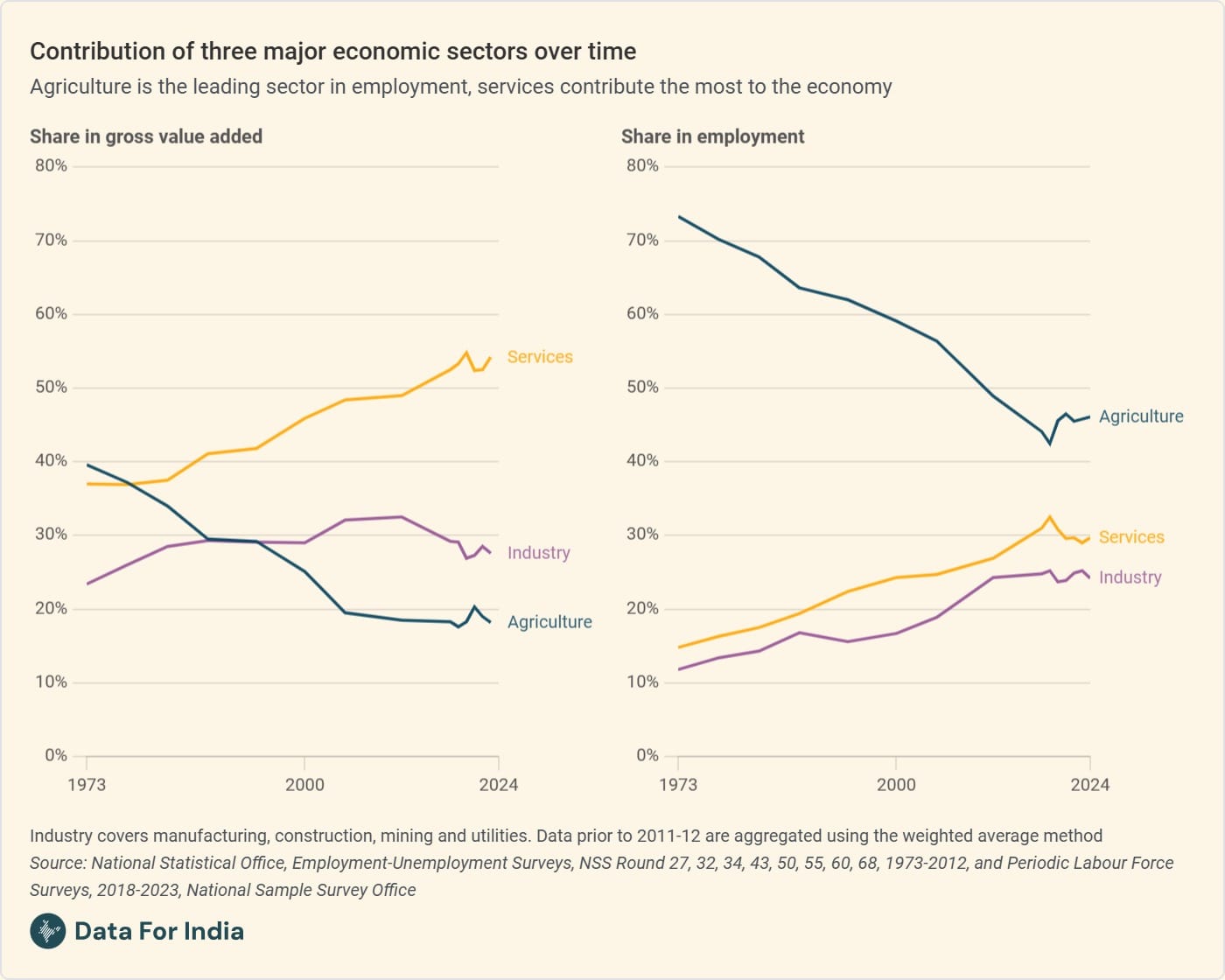
Agriculture employs just under half of India's workers or 280 million people, while industry employs 150 million and services 180 million people (including a small pandemic-era resurgence in agricultural employment, with migrant workers temporarily moving home from shuttered cities to work in fields), as Abhishek estimates in his piece on employment for Data For India. The share of Indian workers in agriculture is higher than in countries with similar contexts that Abhishek looks at, including China, Viet Nam, Indonesia, Sri Lanka and Bangladesh.
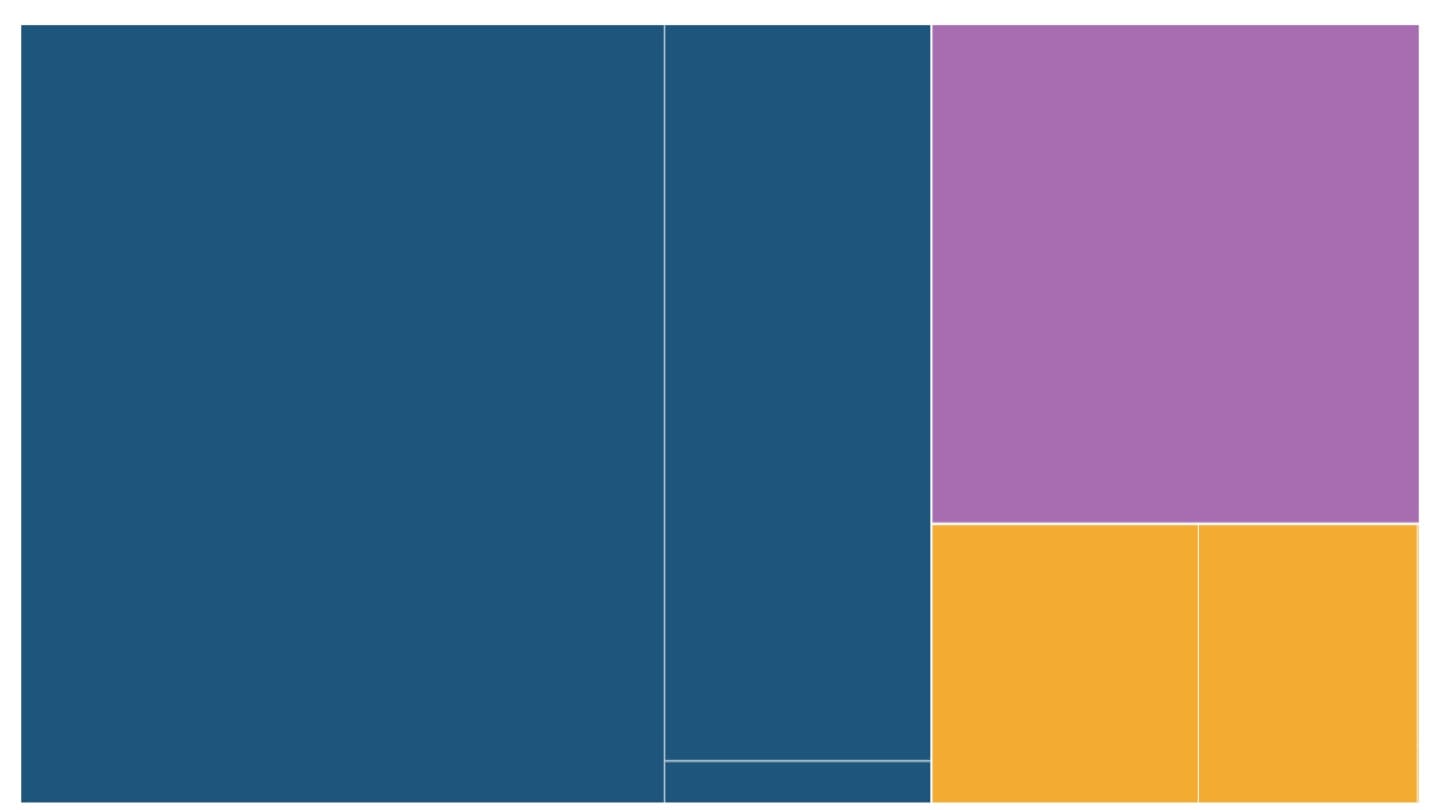
Agriculture now accounts for 18% of GDP but 46% of jobs, while services account for 54% of GDP and 30% of jobs.
From the 1970s to the 2000s, India's services boom was driven by trade and hospitality, where the share in employment largely matched the share in economic output. But in recent decades, the services sub-sectors driving economic growth employ relatively far fewer people; real estate, for instance, accounts for 7% of GDP, but employs just 0.2% of the workforce. Together, real estate, finance, professional services (including information technology, legal and accounting services) and public administration account for 28% of the economic output but just 6% of jobs.
Undoubtedly, Indian workers are over time leaving the land, and the economy is increasingly powered by services. But how precisely that mix will finally look is still evolving, and its ramifications not just on the economy and on labour markets, but also on demographics, social fabric and culture is still something of an unknown.
Not every long-term change in India is a story of relentless growth and improvement - sometimes the picture is more complex, the trajectory quite different from many others, and a future that hasn't yet fully declared itself. That was this week's big shift.