The first edition of The Big Shift went out one year ago, and we wanted to use our first anniversary to do two things. The first is to thank you for coming along on this journey with us. Thanks in particular for your feedback, and do keep it coming - we read and discuss every word. The second is to take stock of some of the big changes that we picked up on this year, and to reflect on what, taken together, they mean for the way India is moving.
- A fundamental realignment of India's population
In our second edition, we looked at this striking chart on the falling risk of childhood mortality in India, and had this to say: "As India ages, more people are dying every year, but they're not dying young. Over time, the burden of mortality shifts away from the youngest Indians to the oldest Indians - as countries get richer and childhood becomes less dangerous, dying in old age becomes the more natural and common course of events, and this change is on its way in India too. By 2031, people over the age of 70 are expected to account for half of all deaths, and this share will only keep growing."

- Enduring puzzles in India's health
In May this year, we looked at child stunting in India, and how despite the fact that growth and development in a country or group reduce the levels of child stunting, they're not enough. A child is considered stunted if their height is lower than the expected height for a similar cohort of children, using World Health Organization standards. The rates of stunting in India are higher than expected, higher than in some comparable countries, and far higher than we as a country might want to accept for our children.
"For the most part, the big shifts that we look at are stories of steady improvement . . . or sometimes of dizzying growth . . . On a few occasions . . . ,the big shift was the absence of a transformation . . . ," we wrote. With child stunting, we said, the "story, however, is somewhere in the middle - there have been improvements in the rates of child stunting in India, but not by as much as economic growth might have promised."

- A generational transformation of India's economy
Early on, we looked at this fundamental transformation of the Indian economy-from largely agrarian to predominantly service-driven, with a worrying stagnation in manufacturing. "Undoubtedly, Indian workers are over time leaving the land, and the economy is increasingly powered by services," we wrote. "But how precisely that mix will finally look is still evolving, and its ramifications not just on the economy and on labour markets, but also on demographics, social fabric and culture is still something of an unknown.
Not every long-term change in India is a story of relentless growth and improvement - sometimes the picture is more complex, the trajectory quite different from many others, and a future that hasn't yet fully declared itself."

- Two different realities of the world of work
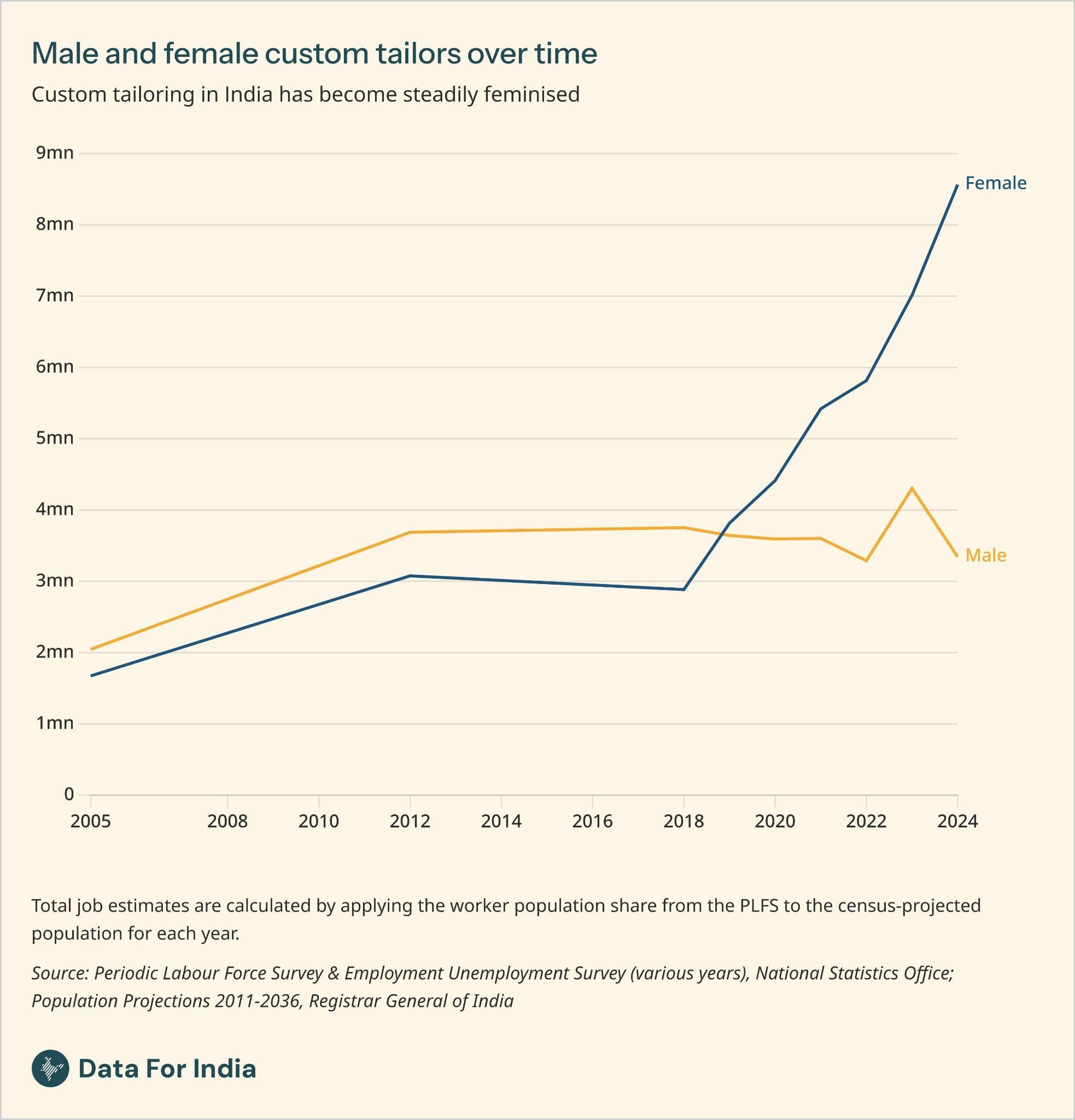
One key dimension of inequality that we see in employment data is of gender, and many readers too respond strongly to work that uses gender-disaggregated data. The low rates of female labour force participation in India are a major area of global discussion, and we were able to identify both an improvement in this indicator, as well as what is driving this change.
We wrote that "the recent increases are largely via self-employed women, and not through any substantial increases in salaried employment . . . Much of the recent rise in female labour force participation is through women doing shorter-term work rather than more stable long-term work.
After well over a decade of being worryingly low, the recent rise in female labour force participation has the potential to signal a truly big shift in the space for women in the productive economy. But looking more closely at what's driving this increase could be far more productive than settling for easy narratives."

- The humbling, moving changes in living conditions for Indians
And finally, let's go back to where it all began, with our very first edition of The Big Shift. "Data For India is not trying to tell 'good news stories' or 'bad news stories', but is simply trying to provide insight based on what a non-partisan view of credible Indian data can tell us," we wrote. "Similarly, not every big shift that this newsletter looks at will be a single line trending from bottom left to top right, every time. On some key health indicators, progress has not been on anticipated lines. On some aspects of employment, trajectories have been surprising and at odds with economic expectations. On some indicators of living conditions, access has improved, but the type of amenity most people have access to is not the most sustainable. Yet on many, many indicators, the long view is not just awe-inspiring, it's also moving."

Looking at these two intersecting lines for rural India and the two diverging lines for urban India is truly moving - it's the story of how kerosene has been replaced with electricity to light up most Indian homes, and it's the sort of long-term transformation that truly defines a changing country.
Every day, we continue to be humbled, inspired and moved by the data we work with, and I hope The Big Shift can continue sharing that part of our journey, and the journey of India, with you. See you next week, and in the years ahead.
If you haven't already, subscribe to get insights on India's long-term transformation delivered to your inbox every Wednesday.