One of the big questions to ask of long-term data around Indian states is this one: is there convergence or divergence? At Independence, there were already wide variations in the levels of development of the new states of India. In the decades since, while the country as a whole has improved on most indicators, the rates of progress among Indian states have varied. What this has meant is that on some indicators, states are now closer to each other than they have ever been, while on others they have moved further apart.
One of the areas where these two (or more) speeds of change is most hotly discussed is when it comes to population growth. Since the Total Fertility Rate - the average number of children that a woman is expected to have in her lifetime, and the key metric on which to measure fertility - of the southern and western states is much lower than the north-central and central-east states, the narrative often is that these are states that have failed to lower their fertility.
A simple long-term line chart (from this piece on fertility, which has more data on all states) can offer some perspective.
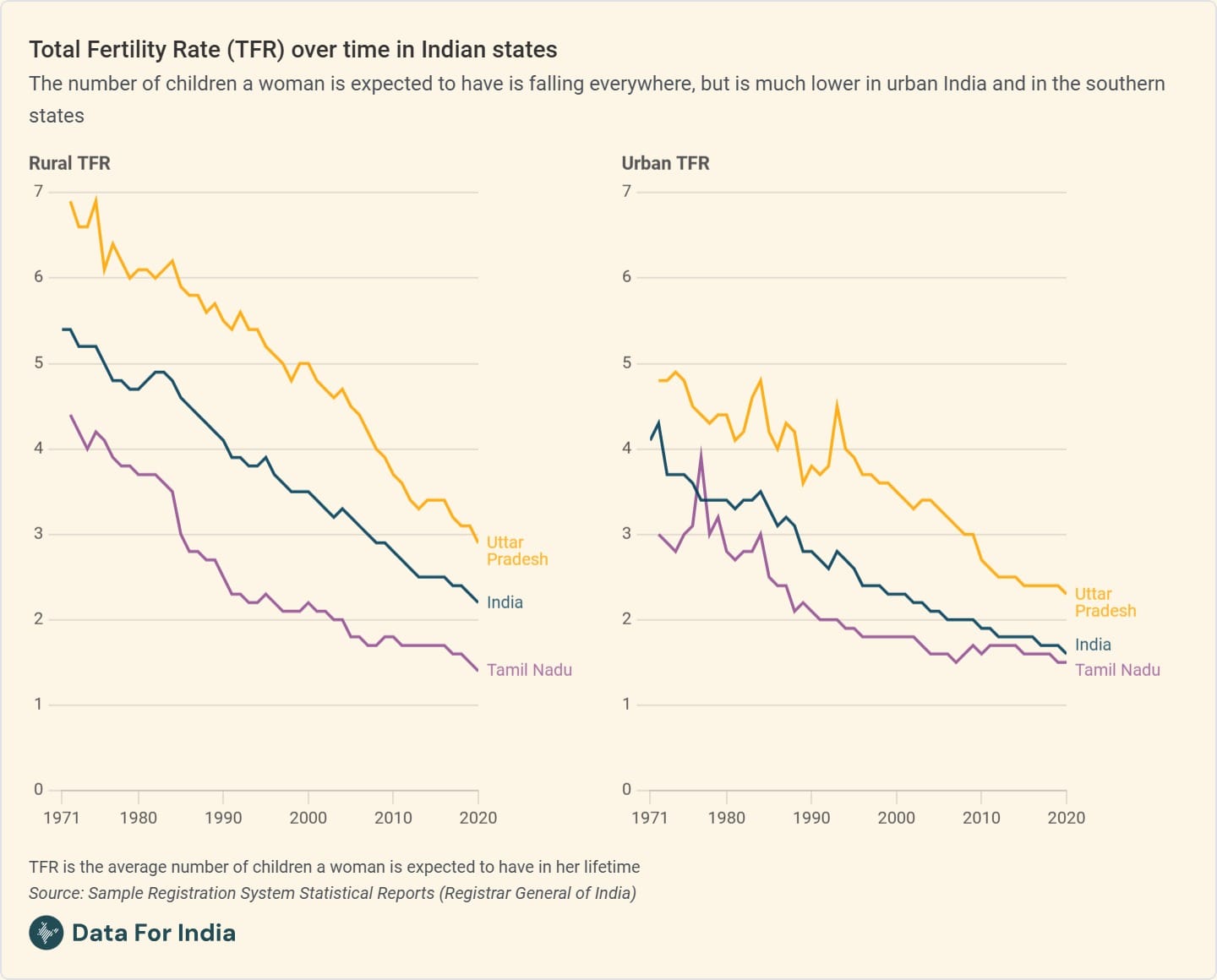
The data above comes from the Sample Registration System, which produces these estimates based on a survey of a sample of the population, and has not produced new estimates after 2020. By 2025, Uttar Pradesh is projected to have also reached the replacement fertility level of 2.1 children for every woman, a threshold that signals the upcoming stabilisation of the population. In fact by 2025, only two states are projected to have not yet hit replacement fertility - Madhya Pradesh (projected to achieve replacement fertility by 2028) and Bihar (2039).
This isn't to say that there aren't large differences between states, and that there aren't sharp implications. For one, TFR has been so low in the urban parts of many Indian states for so long, that it should have driven comparisons with parts of the world where the low birth rate conversation is more alive. "Across the southern and western states, TFR is already below replacement level. In the urban areas of these states, levels of fertility are as low as countries in the developed world. Urban Maharashtra's fertility rate, for instance, is lower than that of Germany," I wrote in this early piece on population growth, alongside a striking chart that compares the TFR in the urban parts of some Indian states with countries in northern Europe and east Asia.
But the Indian story of sharply falling fertility and its implications is not a southern or western Indian story alone. Compared to the richest states, India's poorer states are still some years behind on fertility, but given where they started from, and particularly given their relatively low levels of income, this is, for them too, a big shift.