One of the big reasons that Data For India exists is because of the number of people who told us over the last few years that they did not trust data, or did not trust the way that the data was being presented. Our complete origin story is for another day, but we were confident that we could find good data that should be trusted, and that we knew how to present it in ways that did it and our readers justice, by being fair and showing integrity to the data.
And then every once in a while we come across a data point or points that have us thinking hard about what the best and most fair indicator to talk about something really is. That was the case when my colleague Nileena Suresh worked on this exceptional piece on road accident deaths in India.
We knew that we did not want to use the absolute number alone, because "India has the highest number of deaths from road accidents in the world" felt, if not meaningless, then certainly incomplete to us; India usually has the most of most things in the world, because it has the most people. It's a bit like when you see a headline around Uttar Pradesh having the most of something out of all states - well it's going to, since it has the most people. So Nileena looked at road accident fatalities proportionate to the population in countries around the world. But she also wanted to understand how the big shift here looked - are road accident fatalities growing or falling?
There are at least two widely used indicators that she could use here, and it's significant that the big shifts as seen through these two indicators are in precisely opposite directions.
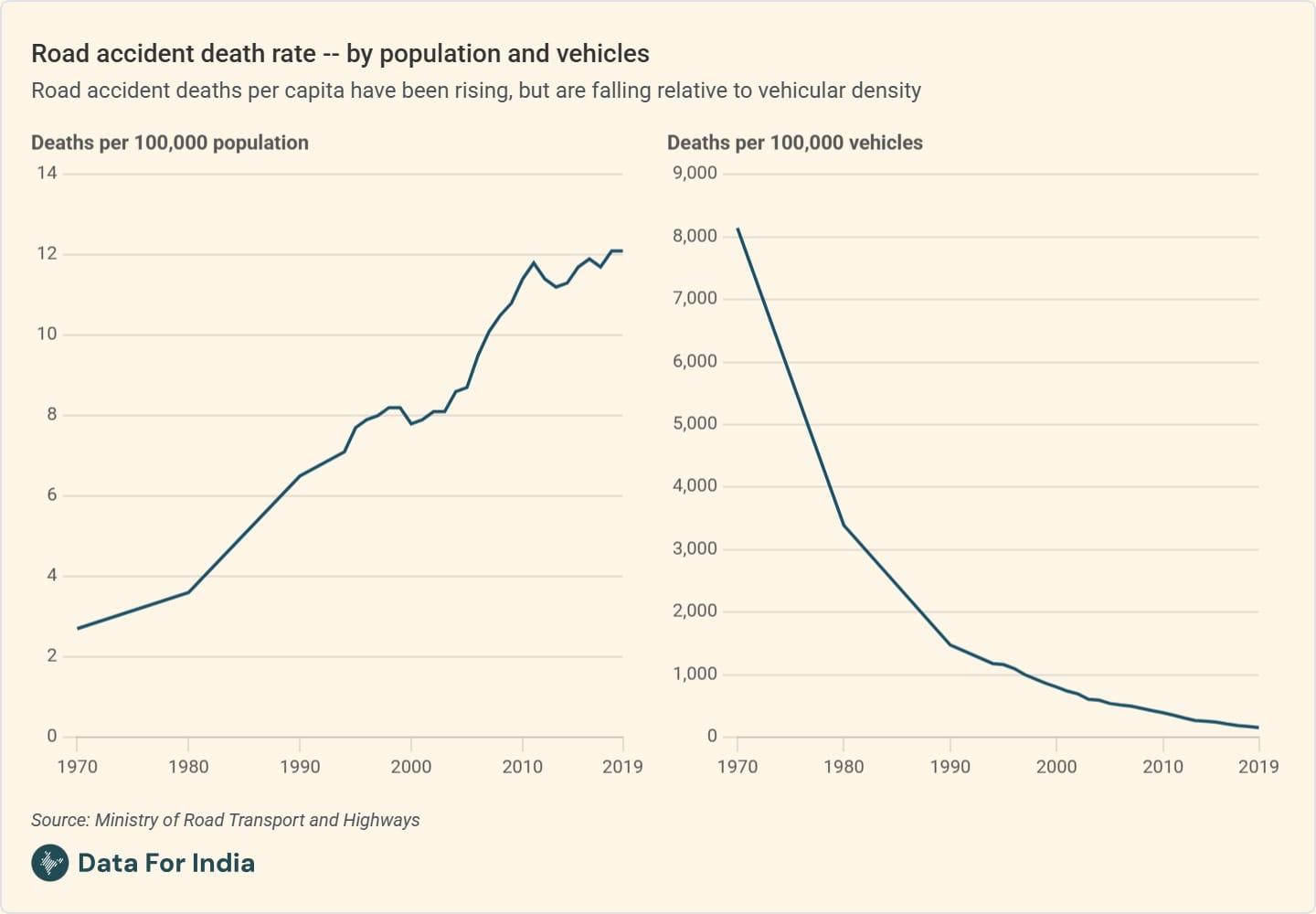
The erosion of public trust in data and those who communicate it comes, in my view, from the experience many people have had lately of some version of this: seeing one or the other of these two charts, without knowing why that indicator was chosen and its implications.
In the end, we felt that both were important. The human experience is at the centre of everything we write, and so the fact that Indians are experiencing a growing likelihood of death from road accidents is essential information (particularly so, as Nileena finds, for young men). But why this is happening is intrinsically tied to the growing number of vehicles on roads.
Talking about methodology is central to what we do, and Nileena does that in a companion piece explaining how road accident deaths in India are counted. There are endless more big shifts we'll be talking about in the weeks and years ahead, but we'll also keep making sure we talk about the data that defines them.