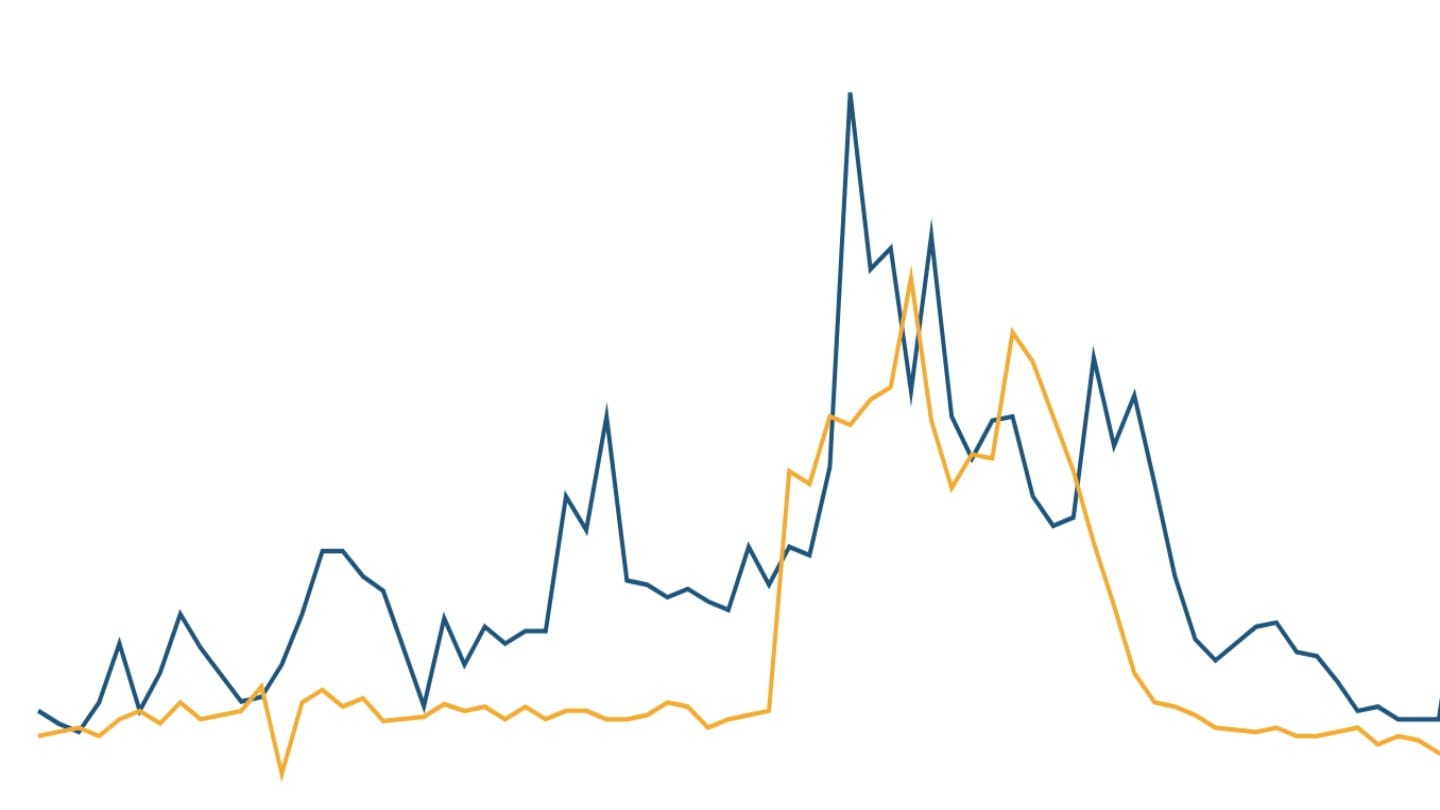
In an earlier edition of The Big Shift ("Rising tides"), I started by saying that "one of the big questions to ask of long-term data around Indian states is this one: is there convergence or divergence?" In that case, we were talking about fertility, where there is broad convergence - fertility is falling in all states, and the gap between the lowest fertility states and the highest fertility states is narrowing. But when it comes to the economy, the big shift that we're seeing is in the opposite direction - it's a story of divergence.
For his piece on the economies of Indian states, my colleague Abhishek Waghmare constructed a unique time-series of the Net State Domestic Products (NSDP, often used as a stand-in for GDP) of states over time, as a share of the total of all states. So you get to look at how each state's domestic product as a share of the total pie of all states changes over time, and you get a sense of whether that state over time accounts for a growing or falling share.
Now keep in mind that this is the state's domestic product, not normalised for its population, so you would expect to see more populous states have a larger share of the pie. What you might also expect to see is for the shares of poorer states to grow over time and for the share of once-richer states to fall over time, if they were moving towards a state of convergence. This wouldn't mean that the richer states weren't growing or that they were getting poorer; it would just mean that the once-poorer states were growing faster and were catching up. But what we see instead is this.
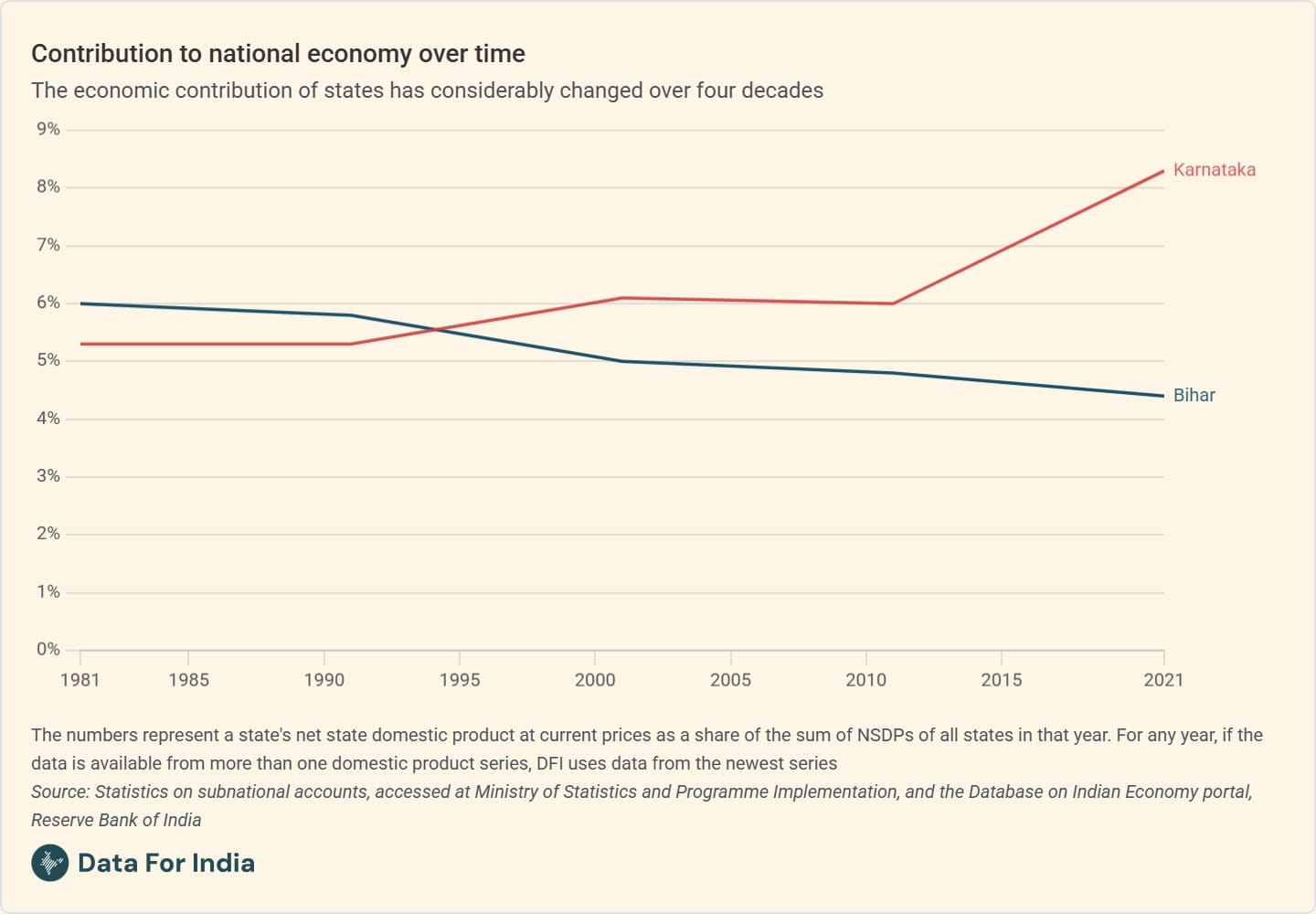
"While all Indian state economies are growing over time, the pace of growth varies among them," Abhishek writes in the piece. "The richer states have grown faster, accounting for a growing share of the total GDP, while the poorer states have grown slower, making up an even smaller slice of the total economy. This has led to a divergence between India's richest and poorest states - instead of the poorest states catching up to the richest states, they are growing further apart." (You can see the data for all Indian states, and not just the two we've selected for the chart here, in an interactive version of the chart in the piece.)
The southern states in particular, Abhishek finds, now contribute considerably more to the national economy than before. "In four decades, their share has increased from 23% to 31%, while that of eastern states has dropped from 18% to 13%, despite both regions having comparable populations," he writes.
Since richer states are also those in which population growth has stabilised faster, the effect on per capita incomes is further magnified - these are states whose GDP has grown faster, while the number of people it is notionally spread out among has grown slower.
Here again, Abhishek constructs a unique time series. If you held India's per capita income to be Rs 100 for each of the last forty years, Karnataka started a little below the national average in relative terms in 1981, and Bihar significantly below. In the forty years since, Karnataka's per capita income has doubled relative to the national average, while Bihar's has fallen further.
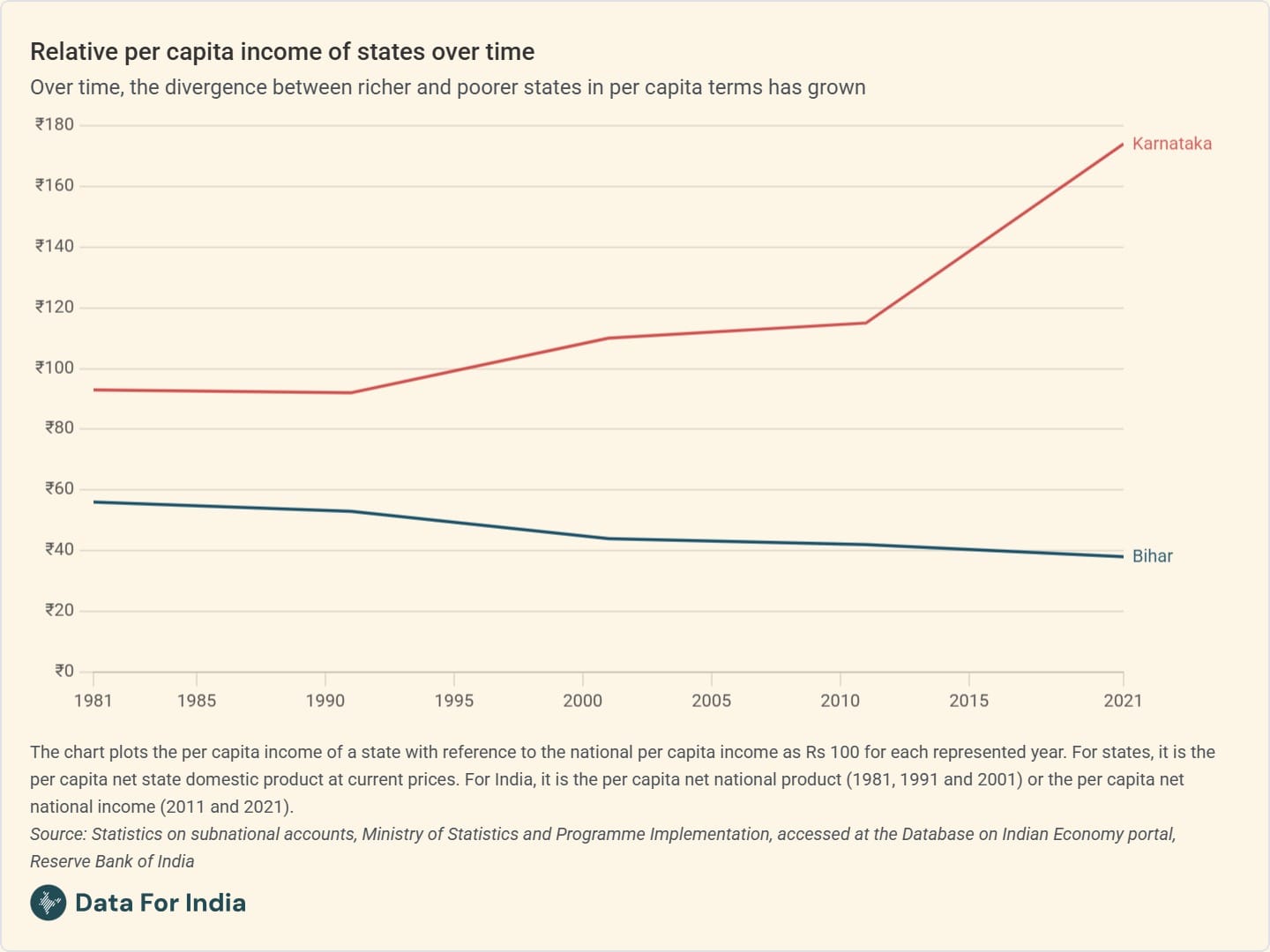
This is a relative measure, and Bihar's actual per capita income has not fallen, nor has that of any Indian state. What has happened is that its distance from the national average, and from the richest states, has grown. The state economy story remains one of growth over time, but the gaps are growing too, and that's this week's big shift.