Most of our work surprises readers (and sometimes surprises me too), and as we keep saying, being surprised by Indian data doesn't mean you, the reader, were wilfully oblivious, but that those whose job it was to produce, understand and communicate this data haven't been doing a good enough job. There's one area, though, where responses usually move beyond surprise and go straight into scepticism or even suspicion. And that's household consumption expenditure data.
India does not officially collect household-level income data because it's just too complicated - this is a substantially agricultural and overwhelmingly informal economy, so for households to accurately report their monthly or annual incomes is difficult. In this situation, most developing economies use consumption expenditure - a household or individual's monthly spending on everything except investments - as a proxy for income. India does that too, through large-size, nationally representative Household Consumption Expenditure Surveys conducted by the National Statistics Office.
Here's where those 'unbelievable' numbers come in: as my colleague Abhishek Waghmare writes for us, the average monthly per capita consumption expenditure in India (on everything including rent, fuel, food and all other expenses) was a little under Rs 5,000 (USD 60) as of 2023. Spending more than Rs 13,000 per month puts you in the top 20% of urban India, and more than Rs 34,000 puts you in top 1%.
These numbers are so much lower than most of us can picture, that they provoke disbelief, although we hope that our work outlining the methodology helps convince readers that the process for collecting this data is pretty solid. But it also helps when you see that despite being low, these numbers still do represent a big shift.
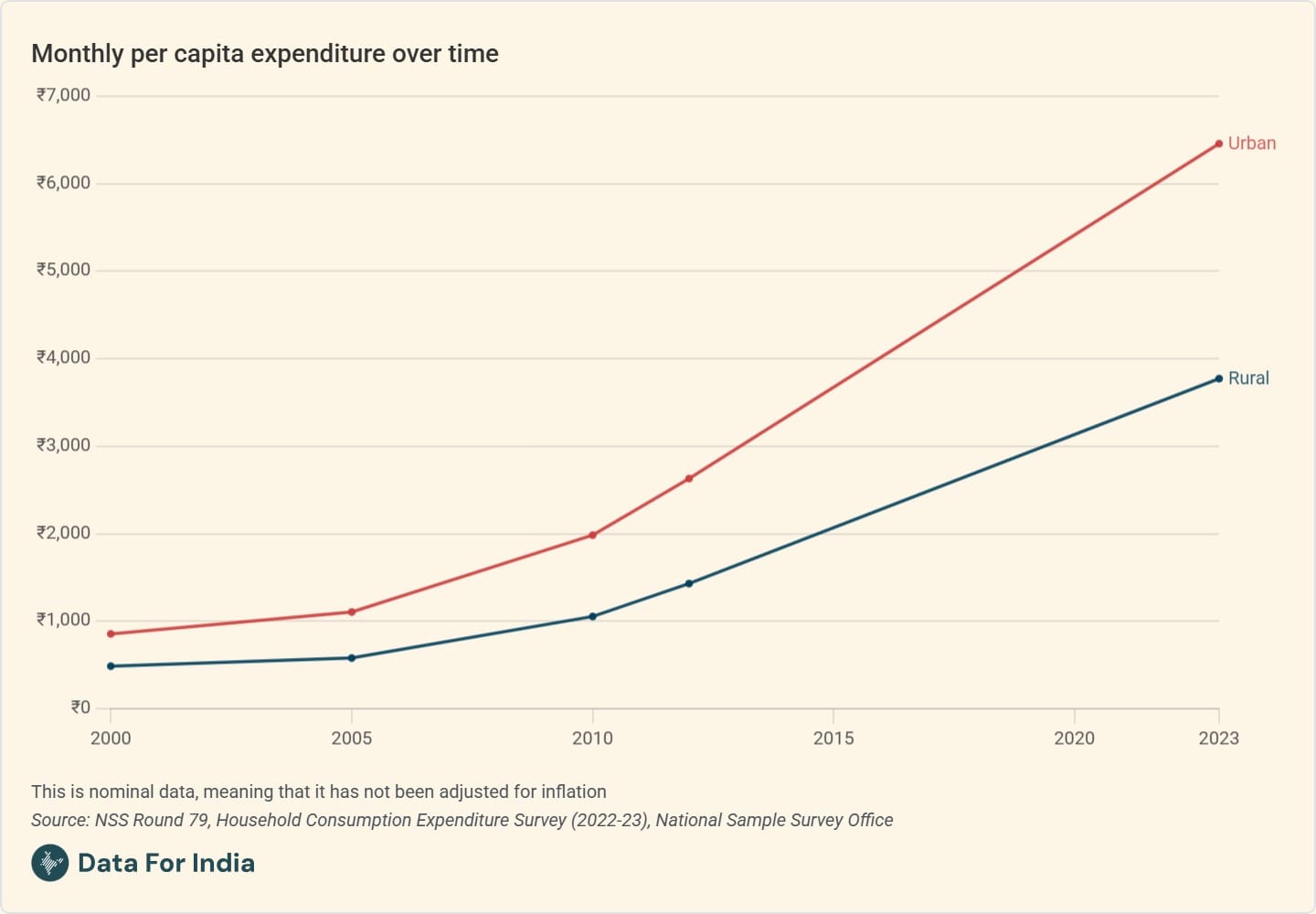
Over the last twenty years, the average monthly per capita expenditure in India has nearly doubled, and in his work Abhishek outlines some other key changes. He also finds that even factoring in inflation, household expenditure has grown substantially.
Nationally representative Indian data of the sort Data For India uses will often do this - surprise you and make you re-scale some of your priors. But it also does usually show that this isn't static, and big shifts are in motion.