One of the best parts of getting to do the work that we do at Data For India is the opportunity to, every day, update my own priors.
In statistics, or, more specifically, Bayesian statistics, priors are the initial set of beliefs and assumptions about a parameter, before you see any data. Journalists are usually taught to feel that these initial beliefs are a sign of "bias" - a chink in the armour, if anyone were to find out - and so for the sake of the Holy Grail of Neutrality, one must pretend to be a machine, miraculously free of any priors. I much prefer the English economics journalist Tim Harford's approach in his book "How To Make The World Add Up", which is to search your feelings, and acknowledge your biases, as a way to start doing a better job of looking at numbers.
When my colleague Abhishek Waghmare set out to look at household ownership of assets in India, I certainly had a set of priors. Broadly, I was expecting television ownership to be quite high, refrigerator ownership to be reasonably high, and washing machine/ air-conditioner ownership to be very rare. When Abhishek came back with his findings, I'd say I was broadly right, but there were still a few huge surprises.
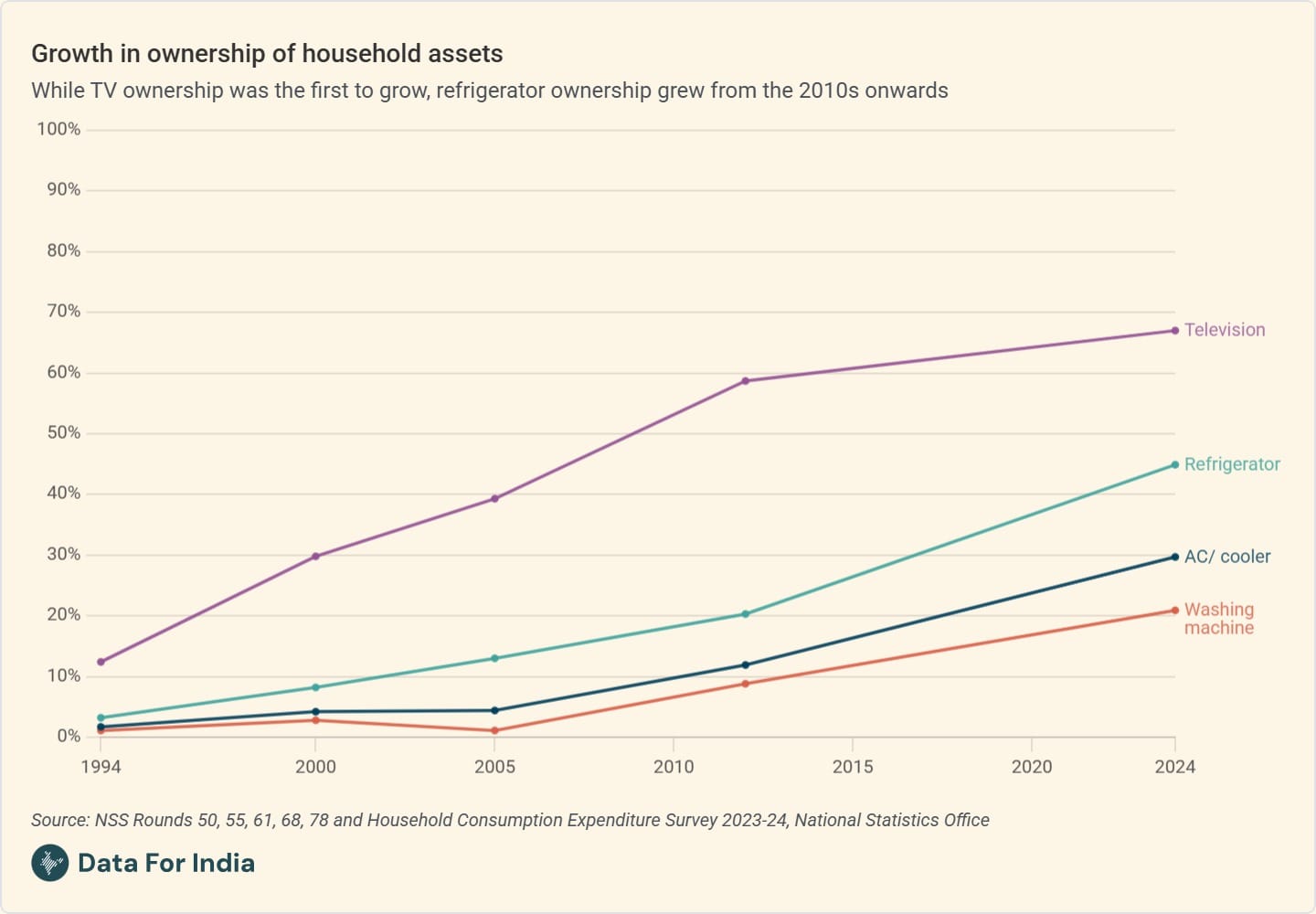
While washing machine ownership is the lowest of the four (and we keep ACs out of most of our analysis because there is a clear climatic/ geographic dimension to their ownership), I was still surprised that more than one in five Indian households now have a washing machine. When you look at urban India alone, that number doubles to two in five households. Washing machine ownership is of course widespread among the richest fifth of urban Indians, where nearly all households own one. But even in the poorest fifth of urban Indian households, one in three own a washing machine. That is absolutely not where my priors were.
Bayesian thinking requires us to update our beliefs with new data. Our work on asset ownership, and our work at Data For India more broadly, often shines a light on key gaps and inequalities that persist. But the washing machine data, and much of our other work, also shows that the big shifts that India has undergone in the last two decades have dramatically altered what the baseline itself looks like. We keep updating our priors.