For the most part, the big shifts that we look at are stories of steady improvement (as in the case of access to toilets), or sometimes of dizzying growth (as it was with the rise of UPI as a payment mode). On a few occasions, as in the case of salaried employment, the big shift was the absence of a transformation - that salaried jobs hadn't grown as fast as hoped. Today's story, however, is somewhere in the middle - there have been improvements in the rates of child stunting in India, but not by as much as economic growth might have promised.
First, a quick explanation of child stunting, because it can be a hard thing to wrap your head around. A child is considered stunted if their height is significantly lower than the average for children of the same age and gender using World Health Organization growth standards. Child heights matter not just on their own, but also because they are often indicators of other deprivations including malnutrition of the child's mother, the child's own under-nutrition and exposure to disease as well as social deprivations. Children who are stunted can experience long-term effects on health, physical and cognitive development, including on their learning levels in school and their earning potential as adults.
What that means then is that socio-economic development can reduce the prevalence of stunting - richer countries have lower rates of stunting, and children in more privileged households are less likely to be stunted. Which is why this chart from my colleague Nileena Suresh's piece for us on child stunting is so worrying.
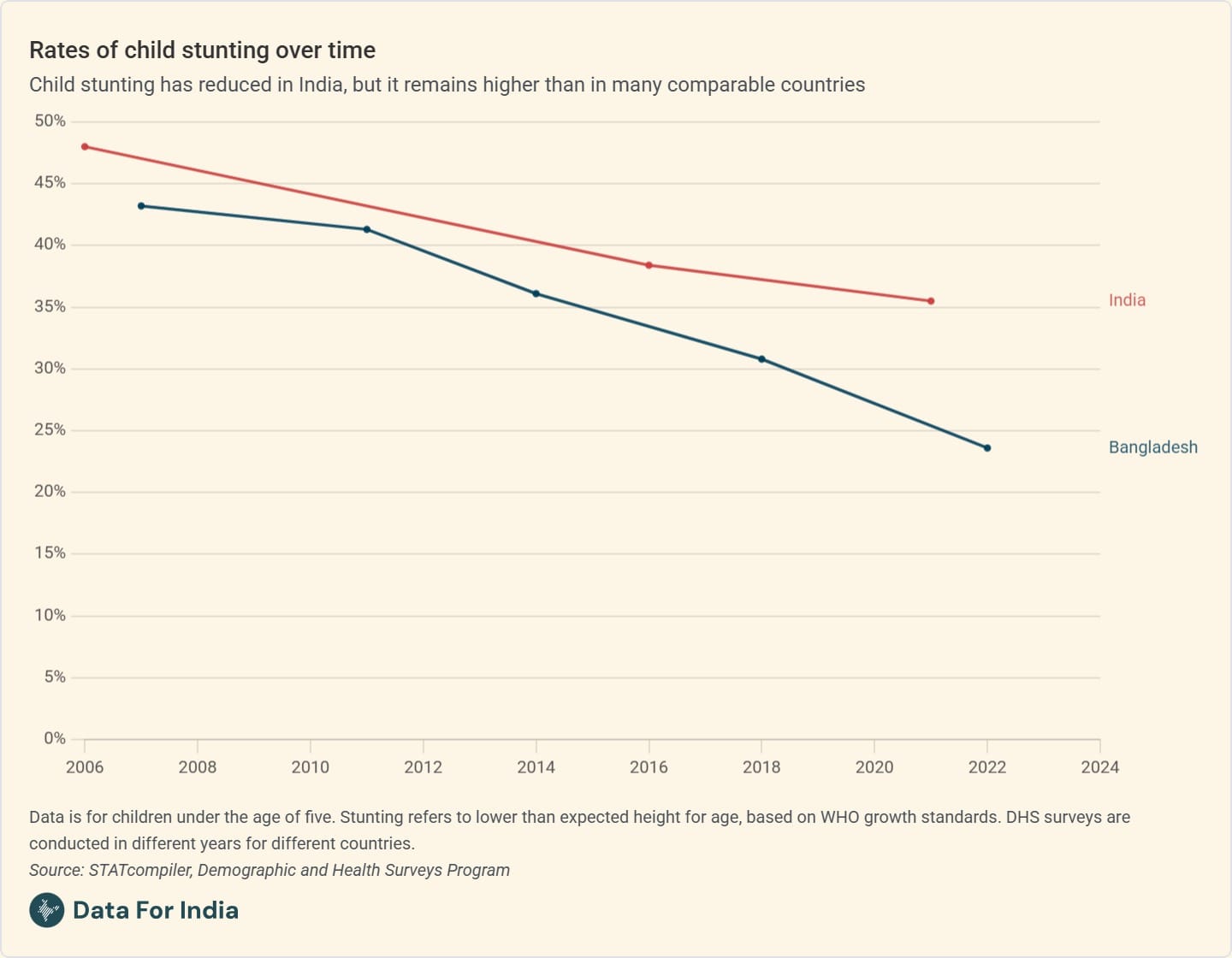
The story here isn't that child stunting isn't declining in India - it is, and, as Nileena writes in the piece, it's lowest among the richest groups and in the richest states. But what certainly is a concern is that given how rapid economic growth in the last twenty years has been, it hasn't declined fast enough. One in three Indian children under the age of five is still stunted, and we also look at why this number might still be so high.
There are certainly grounds to think about whether the way growth standards have been constructed is the best way to benchmark children, especially in poorer parts of the country. Nileena and my colleague Nandlal Mishra examined these growth standards in an accompanying piece for our Measurement vertical, and found that while much of the criticism of these standards is based on inaccurate claims, they are perhaps more aspirational than immediately actionable.
But these are by no means incorrect measures, and we're also seeing many other countries including Bangladesh make much faster progress against the same standard. Over the last six months of looking at these long-term changes, we've certainly seen some big shifts propelled by economic growth - child stunting just isn't one of them yet.