Happy new year to all readers of The Big Shift!
Underpinning any change that we've tracked are the people whose hard work has transformed this country, and in whose lives and selves these big shifts are playing out. It is in looking at the trajectories of their lives that I see the biggest shift that India's future holds - the beginning of the end of India's demographic dividend.
In an influential 2003 book, the economist and demographer David E Bloom and his co-authors coined the term 'demographic dividend' to refer to a boost in economic growth that a country with a large share of its population in the working age can expect to benefit from, provided the right policies are in operation, as I wrote in this piece for us on the demographic dividend. The demographic dividend comes not just from the size of the working-age population, but, more importantly, from its relative share in the total population.
Two processes have been taking place in India to tilt the scale in its favour - one, the share of the child population is declining as fertility falls, but two, the elderly population is not yet very large. This has meant that the relative share of the working-age population - the only age group that in economic terms is able to generate resources and propel growth - has been growing, even as it falls in the developed world. But that window is now closing.
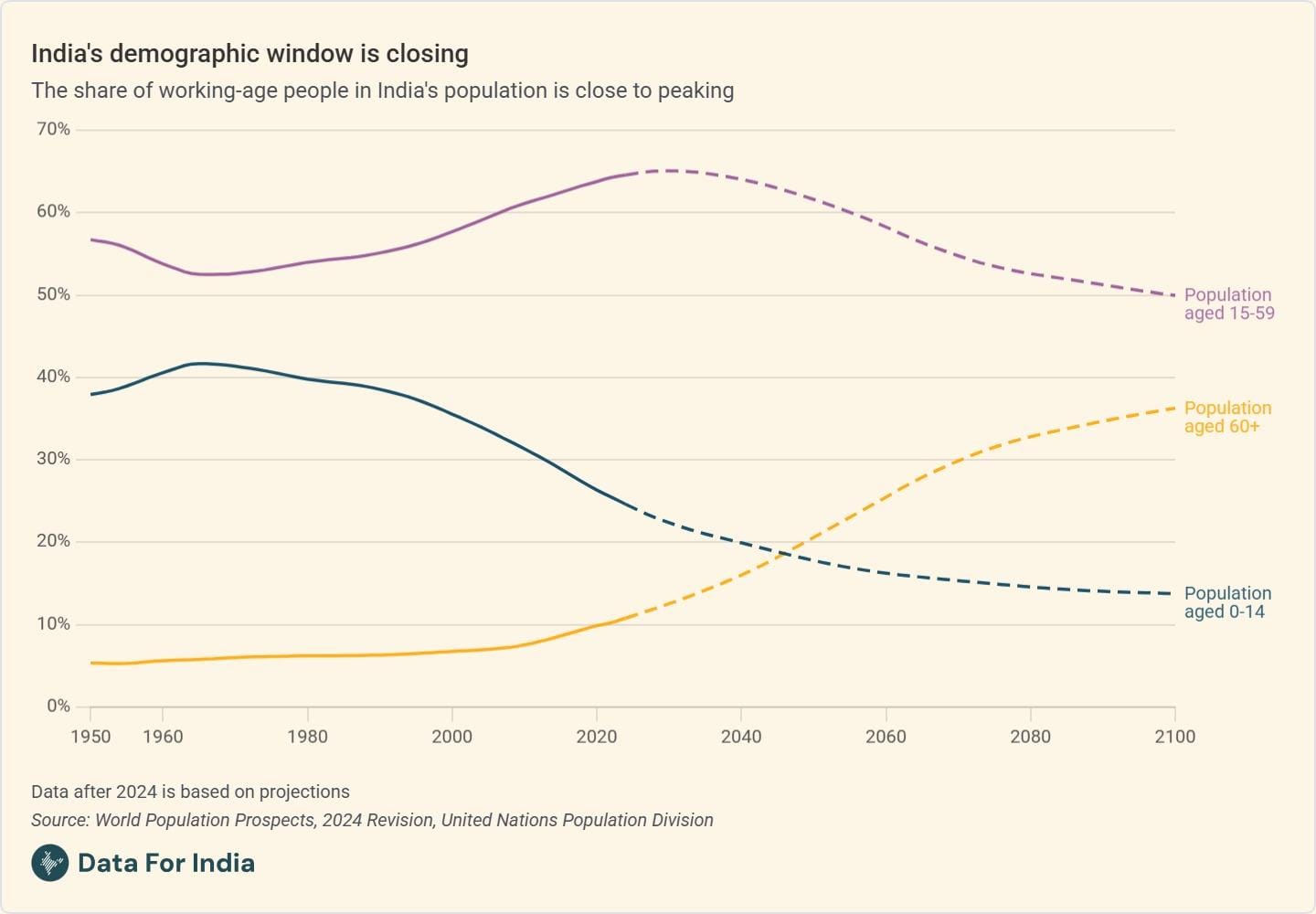
The relative share of the working-age population is projected to be at its peak between 2025 and 2035, after which it will begin to decline, as it is elsewhere. In some parts of the country, this has already begun; in the decade ahead, the southern states will see their working-age populations begin to shrink, even as the north-central states will see their working-age populations grow, I wrote in an earlier piece for us on the ages of the populations of Indian states.
This new stage in our country's story requires new policy of course, but also new imagination and new words. We have repeated the phrase 'demographic dividend' ad nauseam for so long now, that we've nearly forgotten what it means, and what its absence will mean. Did we make the most of this dividend? Are there other, smaller, routes to progress still to chart? A new year, and new questions.