The basic facts about life expectancy are staggering enough; a child born at the dawn of Indian Independence could expect to live until he was forty, and the number was even lower for girl children. It's partly why science-minded doctors find some health influencers' spiels about aiming to "live like our grandparents did" so infuriating; the median Indian born in the early 1950s could scarcely hope to live to become a grandparent. Life expectancy for a child born today is now in the seventies, and that is in some ways the biggest shift of all - for people to be able to simply live longer, and for the expectation of life at birth to be of a long (and hopefully pleasant) road ahead.
Hidden within this average however, are many startling, smaller stories. For one, of course, is the fact that, as I wrote in this piece for us on mortality - the expectation of life is not uniform across India: "a child born in Delhi can expect to live more than ten years longer than a child born in Chhattisgarh today," I wrote in the piece. "In most states, there is also a significant urban advantage, and an urban Indian can expect to live more than 4.5 years longer than a child born in rural India."
But there's another aspect that's much more unusual and much less well-studied; the shifting female advantage/ disadvantage in life expectancy.
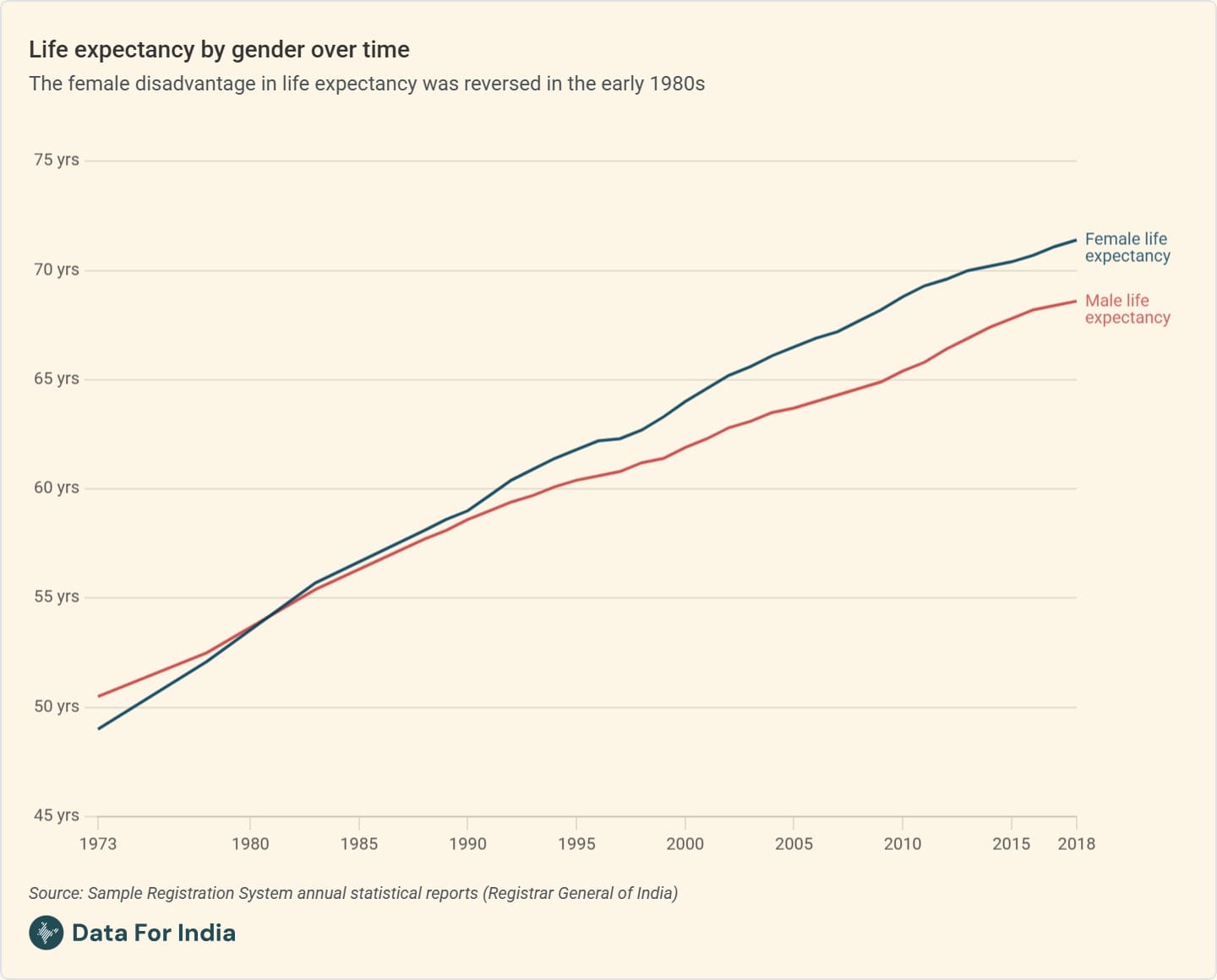
Across the world, women tend to live longer than men, owing to a combination of biological and social factors nicely summarised by Saloni Dattani and Lucas Rodés-Guirao for Our World In Data - girls are more likely to survive infancy and younger childhood than boys for largely biological reasons; in young adulthood, men are more likely to succumb to accidental deaths; and in old age, men are likely to have higher mortality rates from non-communicable diseases, in part on account of differences in health behaviours.
In India, the female advantage in survival appears only in adulthood; age-specific death rates from India's Sample Registration System show us that there isn't yet evidence of a female advantage in infancy, childhood and young adulthood. Looking at that graph above, it would appear that as India's population began to age, the female disadvantage in life expectancy began to reverse itself. This would also explain this stunning graph.
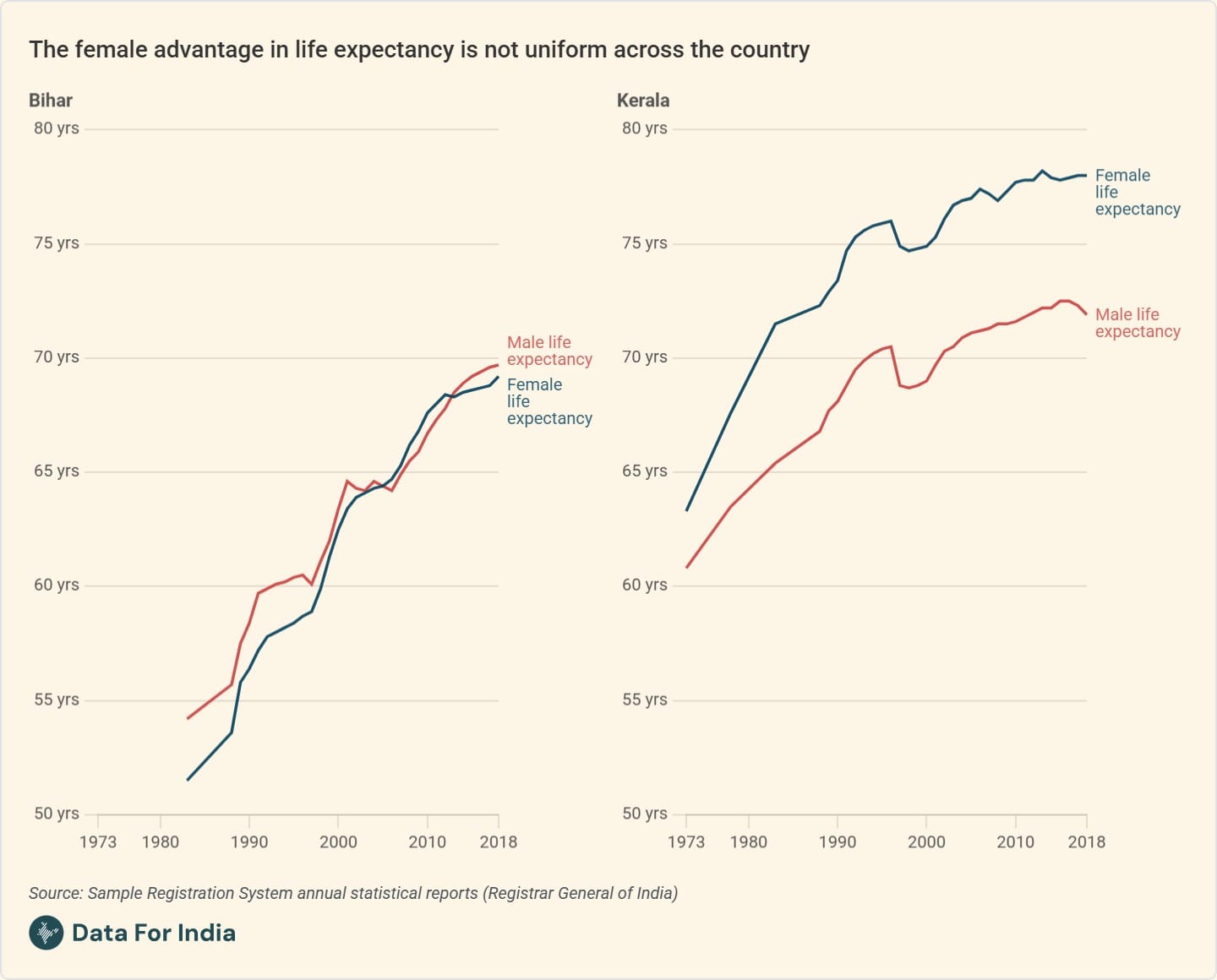
It's not just that life expectancy is several years apart in India's richest and poorest states. It's also that the female advantage in life expectancy has existed for decades now in India's richest states, but is yet to establish itself in India's poorest states, that also tend to be much younger.
Perhaps it isn't one big shift at all, but many small shifts, all propelling us at different speeds to a common point - the expectation of living longer.
As some of you may know, Data For India recently turned one. As part of our work to get better, we are reaching out to our subscribers to participate in a short online survey about your experience of using the Data For India website. Look out for our survey in your email shortly - I would be honoured to hear from you.