That India's population growth is slowing down finally seems to be something that everyone accepts. We also now broadly agree that the demographic mode through which this is taking place is through falling fertility - the average number of children that a woman can be expected to have in her lifetime has fallen below the 'replacement level' of 2.1 children, and to substantially lower levels in India's southern and western states. But what this means in the lives of women is something of a surprise - there's certainly a big shift happening here, but not quite in the way most of us might picture it.
One trend that most people would probably correctly identify is that Indian women (as with women elsewhere in the world) are having their first child later than in earlier generations, as they stay in education longer and get married a little later. But if you had to put a number to what age that is, you'd probably get it wrong - I know I certainly would.
The median Indian woman has her first child when she is just over 21 years old. What this number means is that in 2019-21, India's National Family Health Survey asked nearly half a million women between the ages of 25 and 49 when they had had their first child, and the median value (the mid-point of the distribution) was 21.2 years. This sample of women respondents was representative of India's total female population of the same age.
Let's be honest - in a pop quiz, I would have got this wrong. I think I would have put this number at at least 25 years old.
The median Indian woman is having her first child later than women a generation ago. But it's surprising to me that the number has moved so little. Nearly three decades ago, the median woman had her first child at 19.4 years; so the number has moved by less than two years over this time.
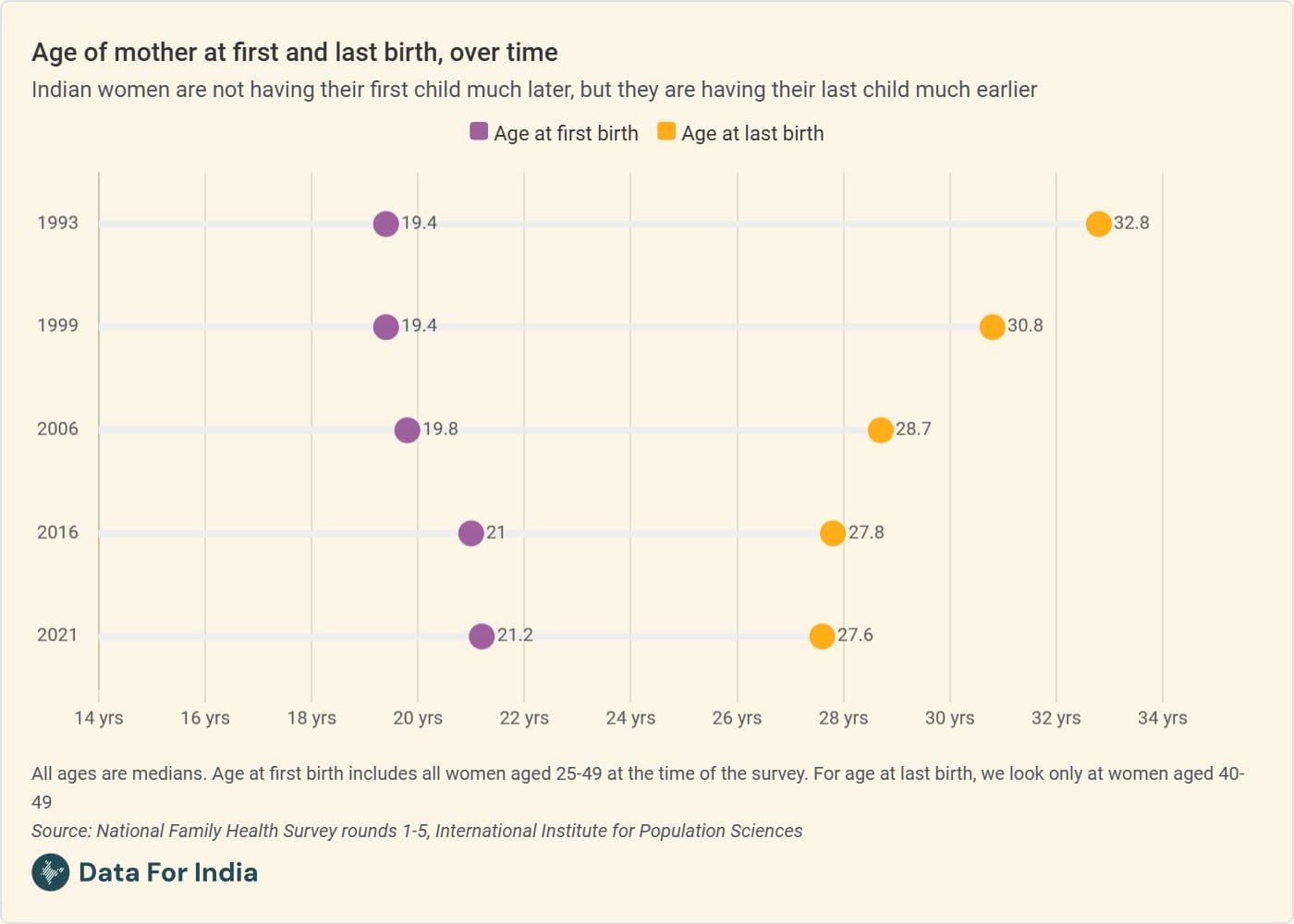
What's moved to a greater extent is the number on the other side of this graph - the age at which Indian women are having their last child. This number is calculated by asking women aged 40-49 at the time of the survey when they had their last child. We look only at older women for this question, because they have finished having all their children by this age.
The mother's age at last birth might not seem like an important indicator in times when most women have at most two children, but three decades ago, this was not the case. In 1993, more than a quarter of Indian mothers had five or more children. Such large families are now rare - in 2021, fewer than a tenth of mothers had five or more children.
It seems obvious if you think about it. Falling fertility means that families are limiting the number of children they have, which means that women stop having children (or "complete their fertility" in demographic terms) much earlier than they did in the past. "As families become smaller, more women are completing all their pregnancies in their twenties and early thirties. As a result, the median age at which an Indian mother has her last child has fallen substantially," I wrote in my piece for Data For India on the topic.
That's what we see in the data. The median age at which women have their last child has fallen from 32.8 years in 1993 to 27.6 years, meaning that the median age at last birth has fallen by 5.2 years, or by much more than the median age at first birth.
So the end result is that that window of fertility has narrowed substantially. One generation ago, the median Indian woman was having several children over a period of more than 13 years. Now she's having much fewer children, and she has them all in half as much time - in just over six years.
This has profound implications not just for demographics and population, but also for the lives of women, including potentially their health, employment opportunities and time for leisure. It's a major change in what a crucial time in women's lives could look like, and that's this week's big shift.