To talk about women in India's labour force, as this week's newsletter does, is to necessarily start with an ugly assumption - that the women out of the labour force are not working. When enumerators canvass respondents in India's labour surveys, they first encode the responses in one of three ways - is the person working, not working but seeking/ available for work, or neither working nor looking for work. That last category puts you out of the labour force, and a majority of Indian adult women are in this category, while a majority of Indian adult men report that they are working.
This majority of Indian women is of course working - just not in ways that are counted as productive work from the points of view of economists. They are raising children and cooking and cleaning (quaintly encoded in labour statistics as "child care and personal commitments in home-making"). This is essential, fundamental, life-sustaining work, but does not technically contribute to the GDP. There is a vigorous debate about whether this is right, and we've alluded to that a little bit in our work here.
The minority of Indian women who report that they are either working or looking for work are the ones we're talking about when we look at India's female labour force participation rate (the share of women in the labour force relative to their population), an indicator that there has been particular interest in in the last five years or so.
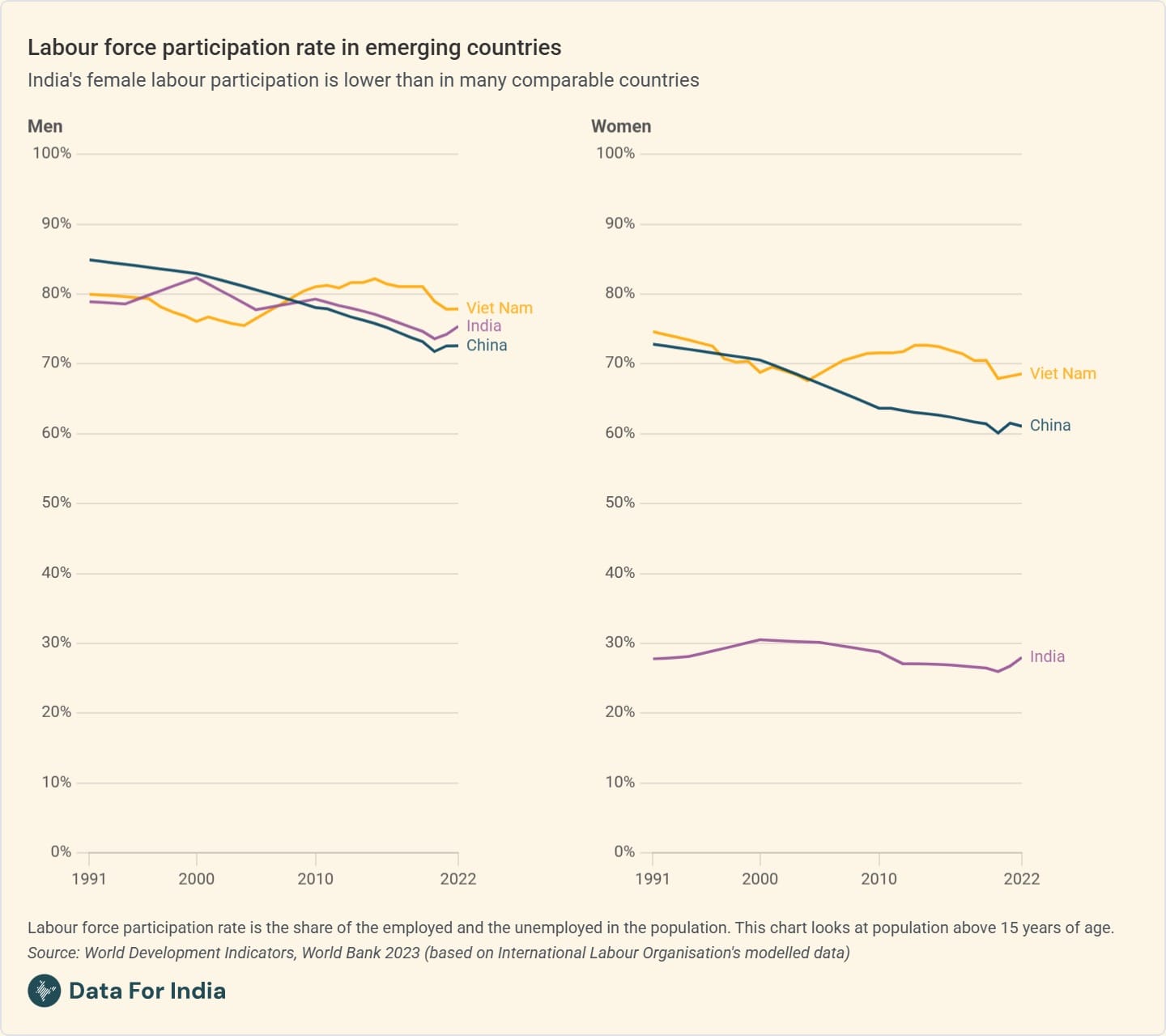
In the chart above, you will notice two things. One, the labour force participation rate for men in India is comparable to the equivalent rates in China and Viet Nam. Two, the female labour force participation rates in China and Viet Nam are only about ten percentage points lower than the equivalent rates for men in those countries; in India, the labour force participation rate for women is half what it is for men.
In the early 2000s, this became a number of huge global interest because not just had female labour force participation in India been lower than in comparable countries, but it also began to fall further. In the last year or so, there has been another round of interest in this statistic, but this time because it is rising.
Rather than respond to every annual increase or decrease as if they were sports scores, my colleague Abhishek Waghmare took the long view of this data for this piece he did trying to understand what drove the big 2000s fall and recent gains in female labour force participation in India.
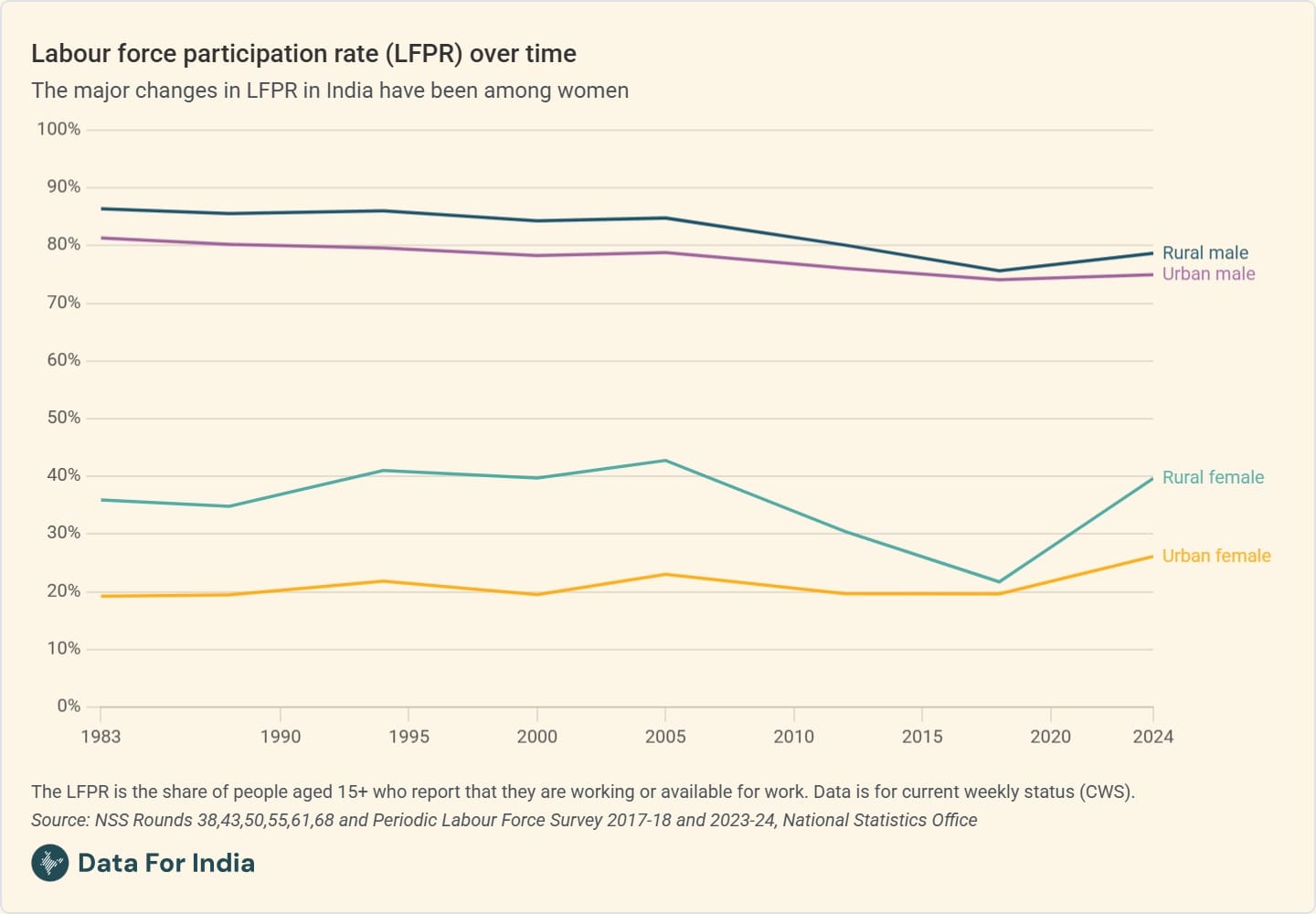
He finds, for one, that the key volatility was in labour force participation rates for rural women. Looking at economic sectors, he finds that this was explained by a big withdrawal of women from agriculture followed by an equally large recent return. Secondly, he finds that the recent increases are largely via self-employed women, and not through any substantial increases in salaried employment. Finally, he finds that much of the recent rise in female labour force participation is through women doing shorter-term work rather than more stable long-term work.
After well over a decade of being worryingly low, the recent rise in female labour force participation has the potential to signal a truly big shift in the space for women in the productive economy. But looking more closely at what's driving this increase could be far more productive than settling for easy narratives.