That infancy, or the first year of life, is one of the most vulnerable periods was something that I was aware of. My own work on mortality, for example, had shown me that across all age groups, six in every 1,000 people die every year in India, but among infants alone, 26 in every 1,000 die. What I was more surprised by is how sharply the risk of infant mortality is compressed into the first days of a child's life.
In her work for us on infant mortality, my colleague Nileena Suresh finds that over seven in ten infant deaths occur in the first month after birth, or in the neonatal period. Among these neonatal infant deaths, the leading causes are complications from preterm birth, birth asphyxia, and infections such as sepsis or lower respiratory infections. Preterm birth complications alone are responsible for about a third of neonatal deaths.
Deaths that occur in the post-neonatal period, meaning after the first month up to the first year, are mainly caused by lower respiratory infections, diarrhoea, and congenital heart anomalies.
As the country gets richer and better developed, deaths from infectious diseases become more easy to control, as we've written about before. As a result, we're seeing that while infant mortality as a whole is dropping steadily, the share of infant deaths that take place within the first month is growing. This is because infant deaths that are as a result of infectious diseases are much easier to control, while deaths from preterm and neonatal disorders are harder to contain.
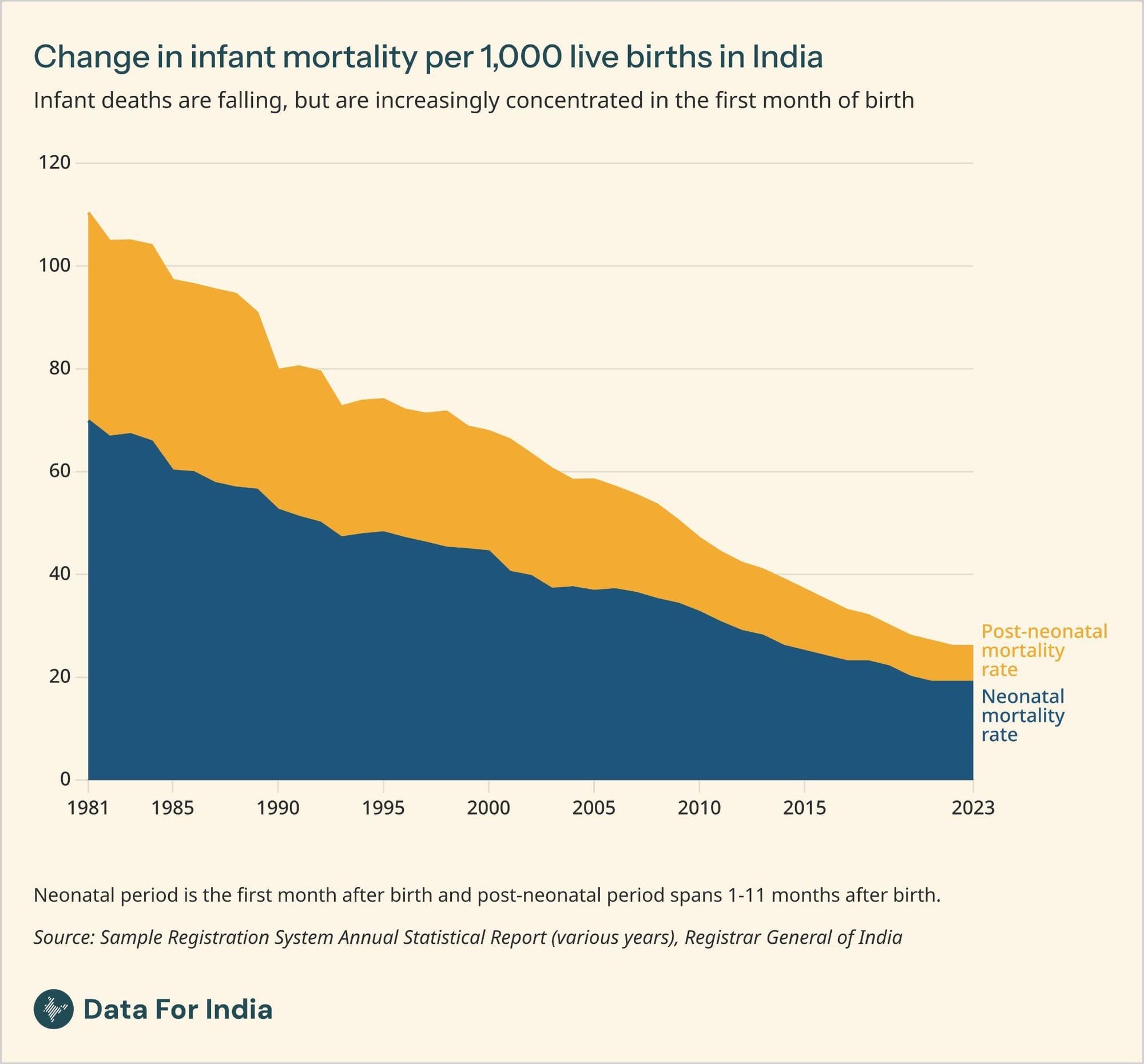
As Nileena writes, the share of deaths within the first month has increased from 61% in 2003 to 73% in 2023, meaning that infant deaths are increasingly concentrated in the earliest days of life.
Overall, the big shift is one of great improvements in infant survival. But to cut this risk further, focusing on the health of pregnant women and care of infants in their first days of life will be key.