Some of the disbelief that communicating data in India is met with is uniquely Indian; the surprise that we encounter every time we share our work on the vast majority of Indians being meat-eaters, for instance, is a uniquely Indian experience. Some of this is universal; across the world, for instance, the rich misidentify themselves as middle class. Also universal - the conviction that your city or country is much less safe than the numbers suggest.
Virtually every person that I have shared my colleague Ameya Bokil's findings on homicide rates over time in India with has reacted with complete surprise. Ameya's findings, based on India's National Crime Records Bureau, show that the number of murders reported every year relative to population is steadily falling.
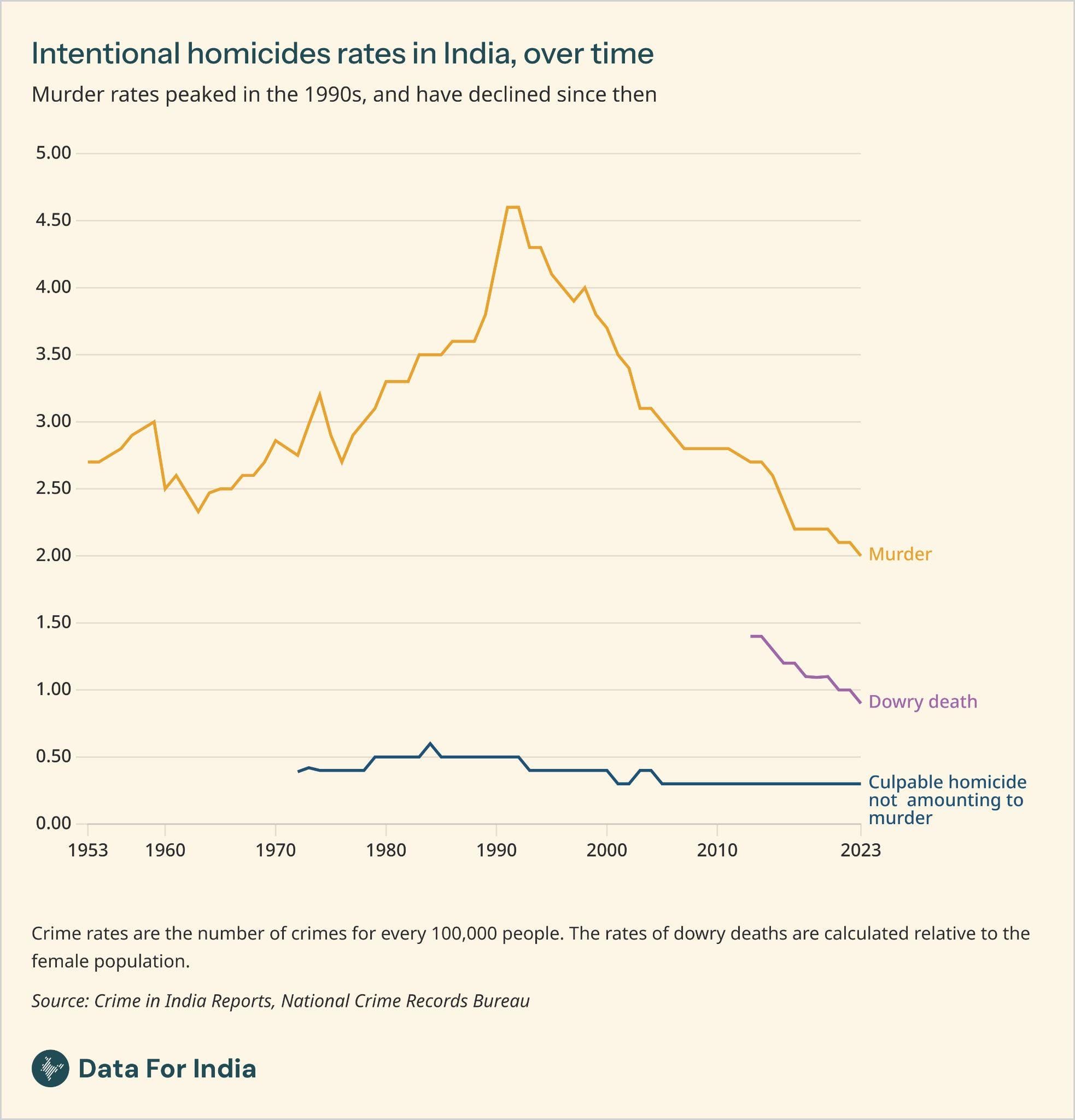
This is true of most of the world, and murder rates in India are particularly low compared to many middle-income countries in Africa or Latin America. There isn't much good research about why this is happening. One theory is that the decline in insurgency-related homicides (except notably in Manipur) might have lowered homicide rates, but the vast majority of homicides in India are for inter-personal reasons.
What's worth thinking about, though, is why our perceptions, both in India and the rest of the world, are so far off from reality. Here I'm going to blame the media, both in India and globally - there is for some reason a huge media incentive to over-index on violent crime, and I think this does great damage to our perception of the world. (It also makes it almost impossible to read newspapers with your kids.) Changing that is certainly a big shift I'd love to see.