The size and the constitution of a country's prison population often demonstrates a country's policy on crime and punishment, the state of its criminal justice system, as well as its socio-economic conditions.[1]
At the end of 2023, 1332 prisons[2] across India held 530,333 incarcerated persons, the fourth highest in the world. Data on India's prisons and its prison population comes from the National Crime Records Bureau's (NCRB) annual Prison Statistics report.
Prison inmates in India are categorised in four ways:
- convicts are those found guilty of a crime and punished by a period of imprisonment;
- undertrials are those awaiting the completion of their trial and are yet to be found guilty;
- detenues are those detained to prevent them from committing a crime; and
- others, who are inmates other than the three categories mentioned above.
The vast majority of prison inmates in India have not been convicted of any crime. Three out of four inmates are undertrials, with convicts making up most of the rest. Offences such as murder, attempt to murder, rape and those under drug laws are the ones that send most people to prisons, whether as convicts or undertrials.
The majority of prison inmates in India are male; of the 530,000 people in prison at the end of 2023, just 4% were female or reported as transgender. India's prisons also house many children; nearly 1500 children lived in the care of women inmates at the end of 2023, most commonly their mothers.
About nine out of every ten people in prison are adults up to the age of 50. Much fewer older persons are in prisons. This may be both a result of fewer older persons accused of crimes and the fact that age and health are factors in the grant of bail.
Over-crowding in Indian prisons
India's prisons face significant crowding. Although India's 1332[3] prisons had a holding capacity for around 440,000 inmates, they held over 530,000 persons at the end of 2023. The occupancy rate[4] was, as a result, 120%, which means that twenty additional people were in prisons for every 100 the prisons should have. .
Some parts of the country face significantly more prison over-crowding than others. The prison occupancy rate varies widely across states as well as kinds of prisons.[5] Delhi, which has 16 prisons, was at 200% occupancy in 2023, meaning that there were twice as many inmates as the prisons had capacity for. Meghalaya, Uttarakhand, Maharashtra, Madhya Pradesh and Uttar Pradesh, all had over 150% occupancy rates.
In fact, only ten of the country's 28 states and four of its eight Union Territories had populations within their capacity.
Increase in prison population
The prison population in India has been steadily rising. In 1998, India's prisons had just over 275,000 inmates. By 2023, the number of inmates had almost doubled. The prison population saw a record jump in 2021 and 2022 during the COVID-19 pandemic, as a result of increased arrests and the delay in bail hearings due to the courts' limited functioning.[6]
The rise in the number of undertrials in particular has been an area of concern, since this indicates a growing number of people in prison without being found guilty. Throughout the 2000s the proportion of undertrials in the total prison population remained around 65%, until 2013 when it began rising again. During the pandemic, this rise was sharp and it reached a peak of 77% in 2021.
Uttar Pradesh, Bihar, Madhya Pradesh, Maharashtra and Punjab are the states with most prison inmates. The five together account for 51% of the country's prison population though they represent 43% of the country's total population.
Smaller states like Sikkim and Himachal Pradesh, as well as Jammu & Kashmir, Punjab, Haryana have had the biggest growth, with their prison populations tripling over the last 25 years.
Rate of incarceration
Looking at the prison population in relation to a state or country's total population is an important indicator that can help understand the state of policing, the levels of criminalisation, and other legal and sociological structures.
The rate of incarceration is calculated as the number of people in prison for every 100,000 of the total population of a region.[7] At the end of 2023, the rate of incarceration in India was 38 inmates for every 100,000 people.
Rates of incarceration in Indian states
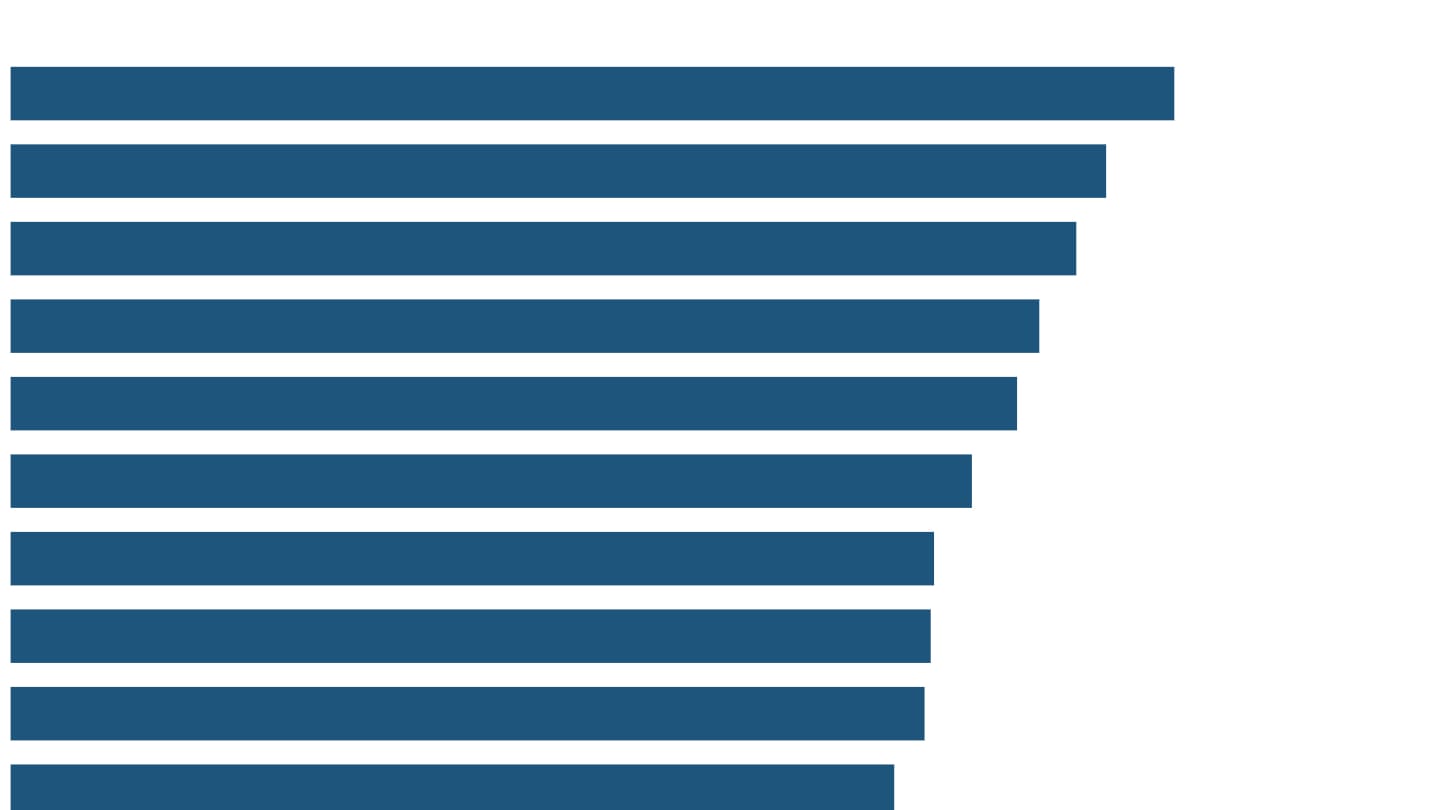
Relative to the state's total population, Punjab (102 inmates per 100,000 population) has the highest levels of incarceration for a large state; this means that there is one person in jail for every 1000 people in the state. It is followed by Delhi (92), Haryana (84), Chhattisgarh (60) and Uttarakhand (59).
Global trend
In absolute numbers, India follows only the United States of America and Brazil in terms of its overall prison population.[8]
Relative to population, however, the United States' incarceration rate overshadows India's, with 2022 data showing 529 prison inmates per 100,000 population in the US against India's 40. However, the incarceration rate in the US is on the decline, while that of India as well as countries like Brazil and Turkey are rising.
Significantly, El Salvador, Cuba and Rwanda, appeared to have surpassed the United States' rate in recent years to take the first three spots, according to UNODC.
[1] Bruce Western, Punishment and inequality in America (2006); Michelle Alexander, The New Jim Crow: Mass Incarceration in the Age of Colorblindness (2011). United States' high prison population numbers for instance have been linked to inequality and racial discrimination by a number of scholars. Law Commission of India, 'Amendments to Criminal Procedure Code, 1973- Provisions Relating to Bail' (May 2017). In India, the linkage between India's high proportion of undertrials and poverty was drawn by the Law Commission of India in its 268th report on bail reforms.
[2] In the Indian context, 'prisons' and 'jails' are used interchangeably unlike the United States of America, where prisons is used to refer to long term detention facilities run by federal and state governments, while jails is used to refer to shorter term facilities that hold inmates awaiting completion of trials or incarcerated for short sentences. These are usually run by local governments.
[3] Indian prison system consists of eight types of jails: Central Jails (152 in number), District Jails (436), Sub-Jails (549), Special Jails (47), Women's Jails (35), Open Jails (101), Borstal Schools or youth detention centres (10), and Other Jails (2).
[4] Occupancy rate is calculated as actual prison population divided by the prison capacity, expressed as a percentage.
[5] District jails (137%) and central jails (121%) are the most overpopulated, separate women's jails (60%) have the lowest occupancy.
[6] Commonwealth Human Rights Initiative, Analysis of Changes in prison Population between December 2019 and November 2021 (July 2024); Sakshat Bansal and Shruti Sahni, Bail, Prisons and COVID-19: An Indian Perspective, Alternative Law Journal Vol. 46(4) pp. 326-331 (2021). The year 2022 ended with over 570,000 inmates but during the year, the number had risen to 620,000.
[7] The NCRB does not report this indicator in its prison statistics report. We calculated it by using annual prison population data from the NCRB reports and total population data computed by DFI. For the period 1998-2011 population totals are interpolations based on 1991, 2001 and 2011 census data, and for 2012-2023 they are projections collated from the Registrar General of India's Population Projection Report (July, 2020).
[8] While the UNODC does not report data for China, other sources peg China's prison population to be nearly 1.7 million, shy of the USA's own 1.8 million.