Most big shifts track the share of people who had something or did something in the past in India, against the share of people who have or do it now. Underlying this is one basic assumption: we need to know reliably how many people were there in the past and how many people are there now for all of this to be meaningful. Unfortunately, we are currently the furthest we have ever been from knowing this credibly.
The reason is obvious: we haven't had a census since 2011, and the one currently in the field will only throw up basic numbers by 2027. That's at least 16 years without a proper headcount of the people in whose lives we're trying to track all these big shifts.
But here's what I'm more concerned about: this obvious absence hasn't stopped anyone - the government, the private sector, academia, multilateral agencies, the media, and even us! - from coming up with the number of people who, say, are unemployed, or own phones, or die of malaria.
How are we doing it? We're all using some manner of population projections. My colleagues Pramit Bhattacharya and Nandlal Mishra examined the track record of population projections, and found that India's own projections based on its censuses, as well as projections made by the United Nations, suffer from a shared problem - they're decent at short-term projections, but get progressively worse at long-term projections.
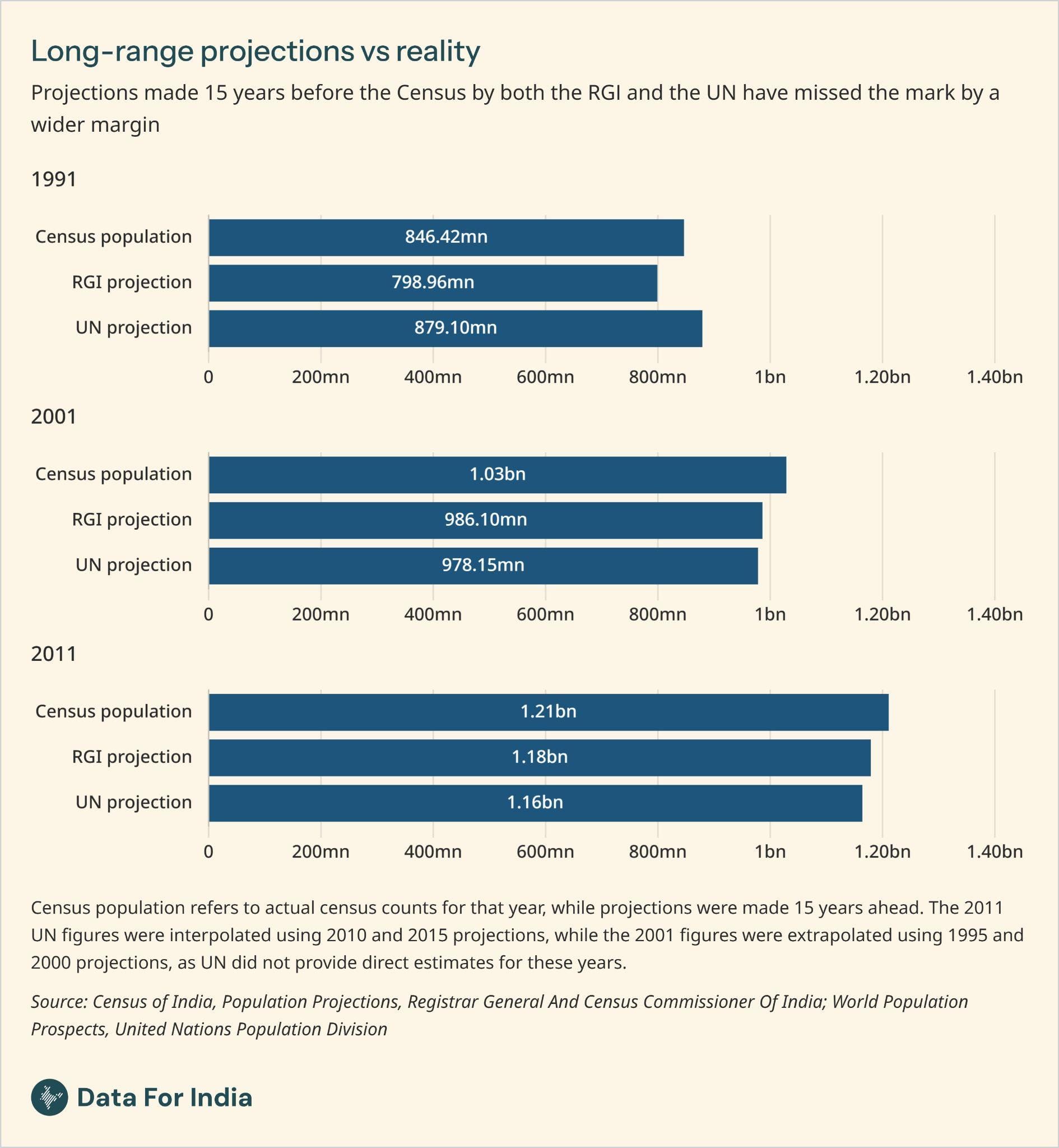
This chart shows the actual population in each Census year ('Census population') and compares it with the population projected 15 years before by India's Census department ('RGI projection') and by the UN ('UN projection'). Not only were the projections substantially off, but it's also likely that they were skewed in particular directions - missing more men, or more elderly, or more urban people, for example - that could lead to particularly problematic conclusions in some sectors.
There's no real way past this until the 2027 census data comes out, but at the very least it's useful to be a little circumspect in our confident assumptions and pronouncements about absolute numbers in India today. There's also the distinct possibility that when the actual data comes out, we might have to alter and update many of our notions of India's big shifts.