India is the world's second-largest producer and consumer of tobacco, after China.[1] In 2025, over one in five adults in India consumed tobacco in some form.[2]
One distinctive feature of tobacco use in India, as well as in several other South Asian countries, is the widespread use of smokeless tobacco like gutka and khaini.[3]
Smokeless tobacco, or tobacco which is chewed, has deep cultural roots in India. Chewing betel leaf and similar preparations has long been part of the culture across regions. While tobacco itself was introduced to India during the colonial period, it came to be used with these existing forms of chewing, contributing to the widespread use of smokeless tobacco in the country.
Tobacco use is a leading cause of non-communicable diseases like cancer, heart disease, stroke, chronic respiratory diseases and several other illnesses because of its nicotine and carcinogen content. Both smoking and smokeless tobacco can cause serious and potentially fatal diseases, including cancers of the oral cavity, oesophagus and liver.
Tobacco use is linked to an estimated seven million deaths globally each year. In India alone, it is estimated to cause about 1.35 million deaths annually, according to the World Health Organization.[4]
India in global context
Globally, about one in five adults used tobacco in 2025, according to the World Health Organization (WHO), similar to the levels in India.
Tobacco use is also relatively high in several other Southeast Asian countries, although levels vary considerably. Bangladesh and Nepal have higher tobacco use than India, while consumption is lower in some other countries like Vietnam and Thailand.
Who uses tobacco in India?[5]
Tobacco use is higher among older men
As in most countries, tobacco use in India is significantly higher among men than women. Nearly four in ten Indian men use tobacco, compared with about four in 100 women.
Tobacco use is also higher among the older population, and this difference is particularly striking among men. More than half of men in their 30s and 40s use tobacco, compared with just over a quarter of men in their 20s.
Among women as well, tobacco use is higher among older age groups, reaching about 17% among women aged 50 and above. This generational gap is also seen globally, with younger people generally less likely to use tobacco than older adults.
The use of tobacco products differs in rural and urban areas
Tobacco use is higher among India's rural population than its urban population. Among those older than 15 in rural areas, about 27% - or over a quarter - use tobacco. Only 17%, or less than a fifth of the population, do so in urban areas.
The form of tobacco which is consumed also differs in urban and rural areas.[6] Most tobacco use in India is in the form of smokeless products which are chewed, such as gutka, paan masala and khaini. Two-thirds of people aged 15-49 who consume tobacco use chewing products, while around half smoke. These categories overlap because respondents can use more than one form of tobacco.
Cigarette or bidi-smoking is more common among urban men, while smokeless or chewing tobacco is more common among men in rural areas.[7]
Smokeless products such as gutka, paan and khaini are, on the other hand, much more common among the small share of women who consume tobacco, in both urban and rural areas.
Tobacco use is higher among poorer groups
Tobacco use is highest among the poorest people in both rural and urban areas, driven largely by chewing tobacco products. Several factors explain this pattern, including the low price of tobacco.[8] Research also suggests that tobacco can suppress hunger[9] and a 2016 report by the Ministry of Health and Family Welfare found that some women reported using smokeless tobacco to alleviate hunger and skip meals.[10]
In rural areas, chewing tobacco is more common across all wealth groups. Among the poorest men, nearly half chew tobacco products, compared with about one in five among the richest men.
In urban areas, chewing tobacco is more common than smoking in all wealth groups, except in the richest segment. However, even in the richest urban group, one in ten people chew tobacco products.
Overall, however, tobacco use is lower in urban areas, largely because the usage of chewing tobacco products is less common than in rural areas.
Tobacco use varies across states
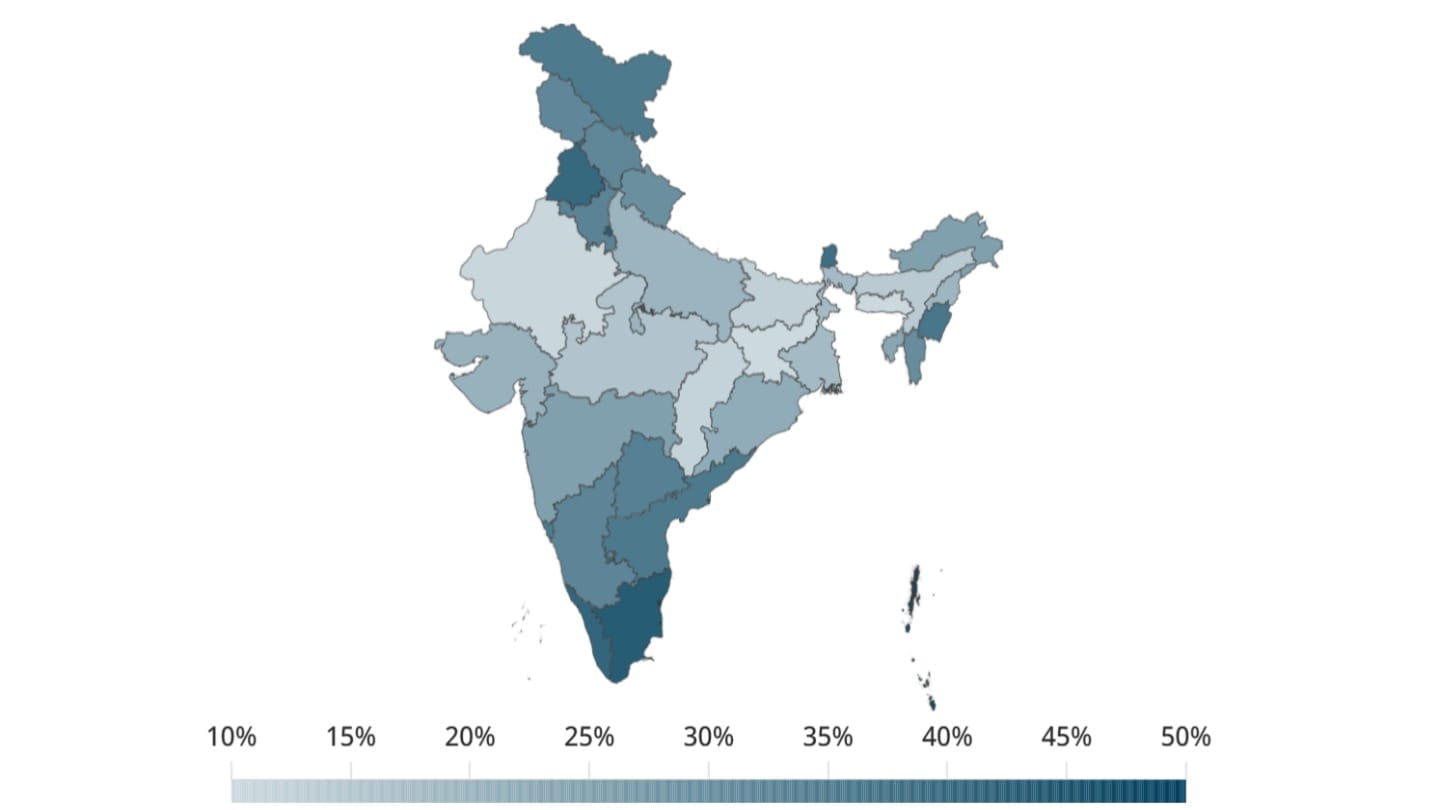
Tobacco consumption varies considerably across Indian states. It is highest in the north-eastern and eastern states and lowest in the southern states and Punjab.
The type of tobacco used also differs by region. In western and central India, chewing products such as gutka, paan masala and khaini are more common. In the southern and northern states, where overall tobacco use is lower and incomes are higher, smoking bidis and cigarettes accounts for a larger share of tobacco use. Within the north-east, chewing tobacco is more common in Assam, Arunachal Pradesh and Manipur, while smoking is more prevalent in Meghalaya and Mizoram.
These differences reflect both cultural practices and socioeconomic conditions across regions.
Decline in usage of tobacco
Across the world
The usage of tobacco is, however, declining across the world, including in India.
Data for India also reflects a similar trend of decline in tobacco use across rural and urban areas and among both men and women. Six in ten men aged 15-49 used tobacco in some form in 2006, compared with around four in ten in 2021.[11]
Public health campaigns to discourage people from taking up tobacco may have had a role to play in this decline. Research has shown that targeted efforts to reduce tobacco use among groups with higher consumption explains most of the decline in tobacco use.[12] This number may continue to grow: in 2021, three in ten men who use tobacco reported that they had tried to quit in the previous 12 months.
Smoking has declined more than use of chewing tobacco products
The decline in tobacco use has been sharper for smoking than for smokeless tobacco. Among men aged 15-49, around one-third smoked cigarettes or bidis in 2006. By 2021, this had fallen to less than one in five. In contrast, more than a quarter continued to use smokeless tobacco in 2021.
Driving the slower decline for chewing tobacco is an increase in the share of richer rural men who chew tobacco products. In urban areas, chewing tobacco use has declined sharply in recent years among men aged 15-49 across all wealth groups. In rural areas, however, the decline has been much smaller, especially among richer groups. While fewer people in these groups consume chewing tobacco products, the share has remained steady and even increased slightly between 2016 and 2021.
[1] World Health Organization.
[2] Global Health Observatory, World Health Organization.
[3] Tobacco mixed with betel nut, slaked lime and flavouring, commonly produced and distributed in sachets or tins.
[4] World Health Organization.
[5] To understand patterns of tobacco use in India, we use data from the National Family Health Survey. The latest survey for which unit-level data is available is from the fifth round, conducted in 2019-21.
[6] We use data from the National Family Health Survey (NFHS) to examine these patterns. The survey lists several tobacco products like cigarette, bidi, gutka, khaini, etc and asks respondents about their use of each of these specific tobacco products. For this analysis, we have grouped these products into smoking and chewing tobacco. The two categories do not add up to total tobacco use because some people use both forms. Among men, 20% of those aged 14-59 only chew tobacco, 14% only smoke and 7% do both. Whereas among women, over 3% only chew tobacco, while less than 1% smoke.
[7] Bidi is tobacco rolled in tendu leaf.
[8] Smokeless tobacco and public health in India, Ministry of Health and Family Welfare.
[9] Nicotinic receptor-mediated effects on appetite and food intake (2002), Jo YH, Talmage DA, Journal of Neurobiology.
[10] Smokeless tobacco and public health in India, Ministry of Health and Family Welfare.
[11] National Family Health Survey 2019-21, International Institute for Population Sciences (IIPS).
[12] Declining trend of smoking and smokeless tobacco in India: A decomposition analysis (2021), Lahoti, Dixit; Public Library of Science (PLOS).