To look at how much something has changed, you usually need to look at two points in time: where it started, and where it is now. But how do you define when something started? In climate measurement, I find now with my colleague Juhi Chatterjee's work, this is a particularly important question.
In her work for us on regional temperature trends in India, Juhi wanted to look at how warming affects different parts of the country differently. One way to do this is simply by looking at absolute changes in mean temperatures, as she did for our piece on national temperature trends.
But absolute temperatures vary widely due to differences in latitude, elevation and proximity to the coast. So a better way to do this is by looking at temperature anomalies, defined as deviations from a historical baseline. Which brings me back to my original question - where does time begin, or what should the baseline be?
The India Meteorological Department follows World Meteorological Organization guidelines in defining the baseline as the average of a climate variable over a continuous 30-year period. These baselines are updated every decade to ensure that "normal" conditions reflect the most recent climate context. The current baseline used by both the WMO and the IMD is for the 1991-2020 period.
Negative anomalies (shown in blue) indicate temperatures cooler than the baseline average, while positive anomalies (shown in red) indicate warmer-than-baseline conditions.
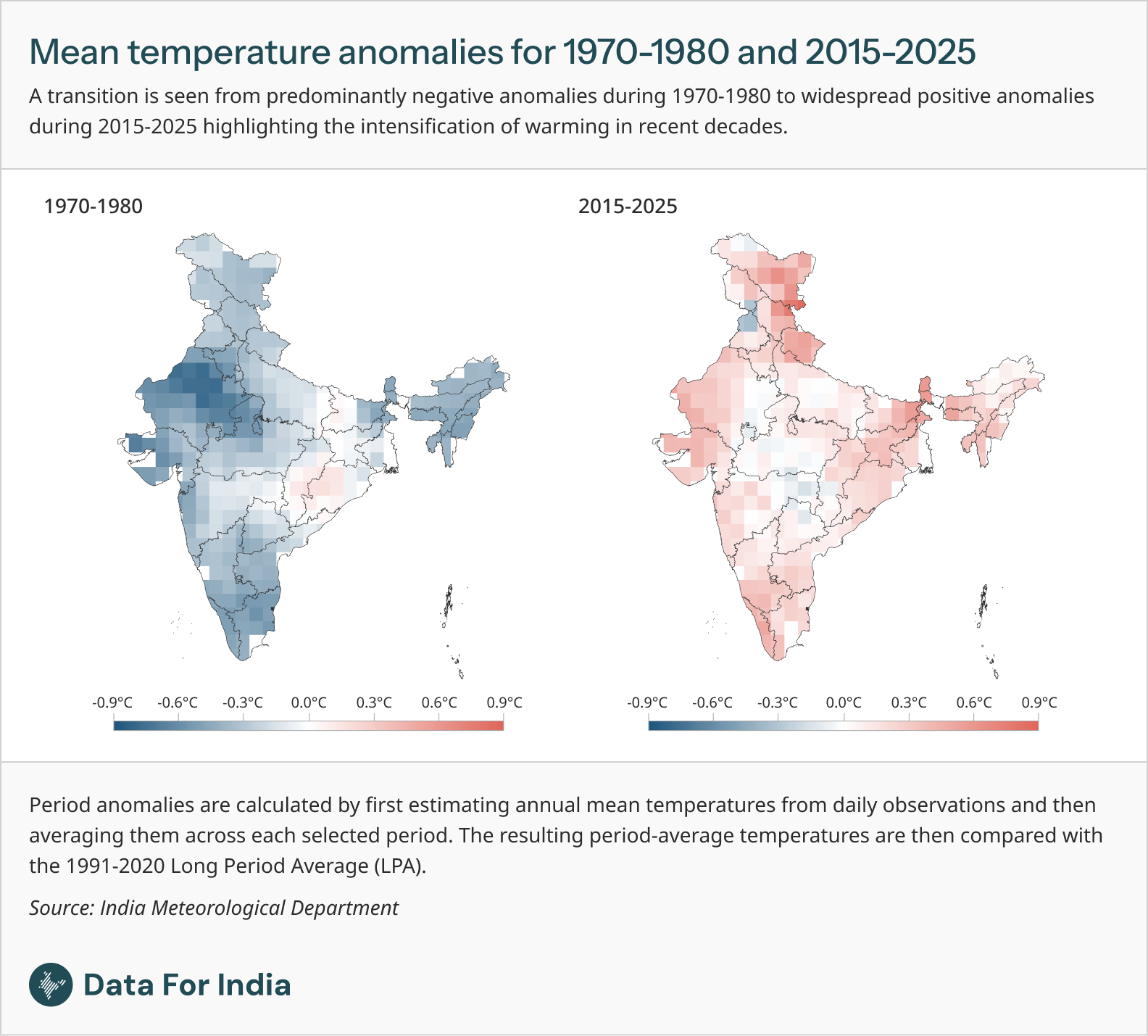
What you see immediately is that most states were cooler than the 1991-2020 baseline during the 1970s, while most states were warmer than the baseline between 2015 and 2025. The strongest warming was concentrated across northern and north-eastern India where parts of states such as Jammu and Kashmir, Himachal Pradesh, Uttarakhand, Assam and Arunachal Pradesh recorded mean temperature anomalies ranging from +0.5°C to +0.8°C above the 1991-2020 baseline.
It also suggests that the choice of baseline is not trivial. Given how much cooler the 1970s were, imagine how much hotter the recent decade would look in comparison if the 70s were the baseline. Writing for us on the impact of the choice of baseline, Juhi points out that updating baselines is important for climate monitoring because newer reference periods better represent the current climatic conditions experienced by populations. At the same time, older baselines better highlight the cumulative scale of long-term warming.