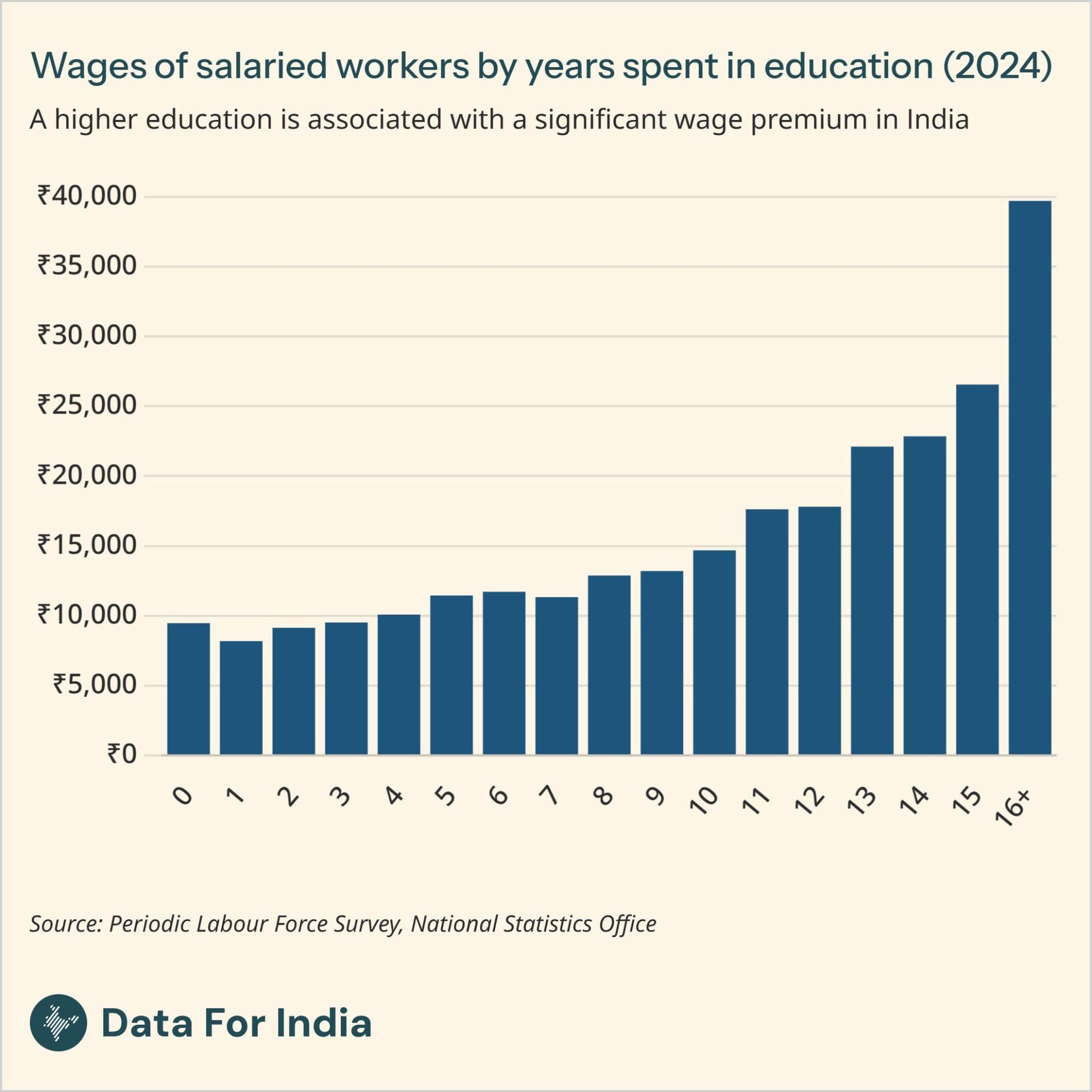
A higher education is associated with a significant wage premium in India
One in six Indian workers is a salaried or a regular wage worker. Labour statistics define salaried or regular wage employment as the working arrangement in which employees who work in enterprises owned by others are paid their wages on a regular basis, generally from the same employer.
The wages of salaried workers between 25 and 50 years of age gradually increase with each new year of completed formal education. Here, formal education begins in Grade 1, and a child completes one year in formal education when she successfully clears the first grade.
But this increase in wages comes in distinct stages. For workers with zero to seven or eight years in formal education, there is little change in earnings. This means that completing the primary level of education does not raise income levels.
The first significant increase in wages is seen for workers who spent 11 or 12 years in education, equivalent to completion of high school. Beyond that, wages continue to gradually rise for workers with every additional year of completed education, meaning that they are enrolled in a higher education programme.
The largest increase in wages, however, is for workers with 16 or more years of education. This is equivalent to the completion of a four-year undergraduate programme. Salaried workers with a higher education earn twice that of those with secondary education, and thrice that of those with only primary education.
Read more about the kinds of jobs that India's salaried workers do.