Editions list close
  • October 2026

    October 19, 2026

    Tobacco usage in India is highest among older people
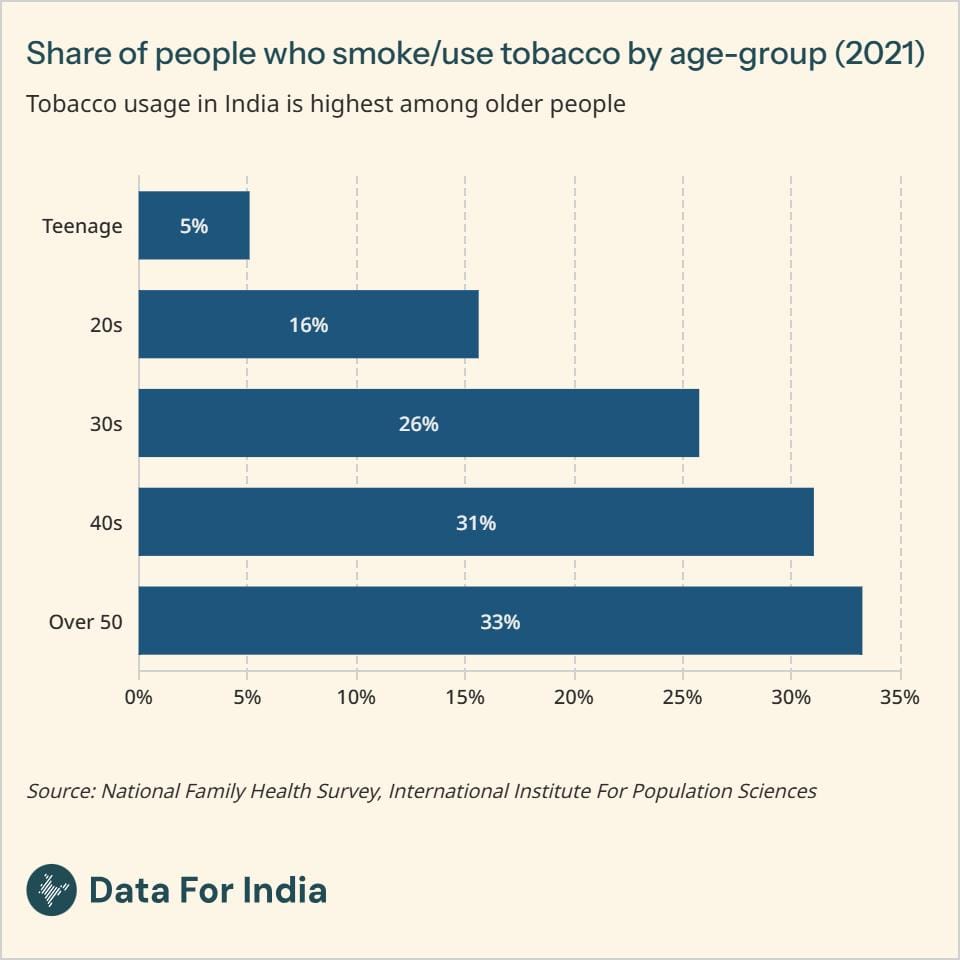
    About one in four Indians over the age of 15 reported smoking or using some form of tobacco as of 2021, according to the National Family Health Survey 2019-21. However, there is a significant divide in tobacco consumption between younger and older adults.

    Across the population, over one in three Indians in their 40s and 50s consume tobacco, compared to just half that share among those in their 20s. The gap is particularly striking among men. Over half of Indian men in their 30s and 40s consume tobacco, whereas the share is just over a quarter among men in their 20s.

    Tobacco consumption is much less common among women. Overall, just 4% of women consume tobacco in some form. However, even among women, prevalence increases with age, reaching about 17% among women aged 50 and above.

    Tobacco is consumed in many forms, the most common being paan masala or gutkha, followed by cigarettes, khaini and bidis. Across age groups, chewing tobacco like gutkha, paan masala and khaini is more common than smoking. About two-thirds of tobacco users consume these products, while around half smoke bidis or cigarettes. Regardless of the form, tobacco has serious health consequences and is a major risk factor for serious non-communicable diseases, like cancers, heart disease and respiratory illnesses.

    This generational gap is observed globally. Across most countries, younger people are less likely to use tobacco than their older counterparts.

    Read more about what's changing in tobacco usage in India.

    Health
    Copy citation
    1. Tobacco usage in India is highest among older people by Nileena Suresh, Data For India (October 2026): https://www.dataforindia.com/data-bytes/tobacco-usage-in-india-is-highest-among-older-people/

  • September 2026

    September 21, 2026

    In most Indian states, 90% of births now take place in healthcare facilities

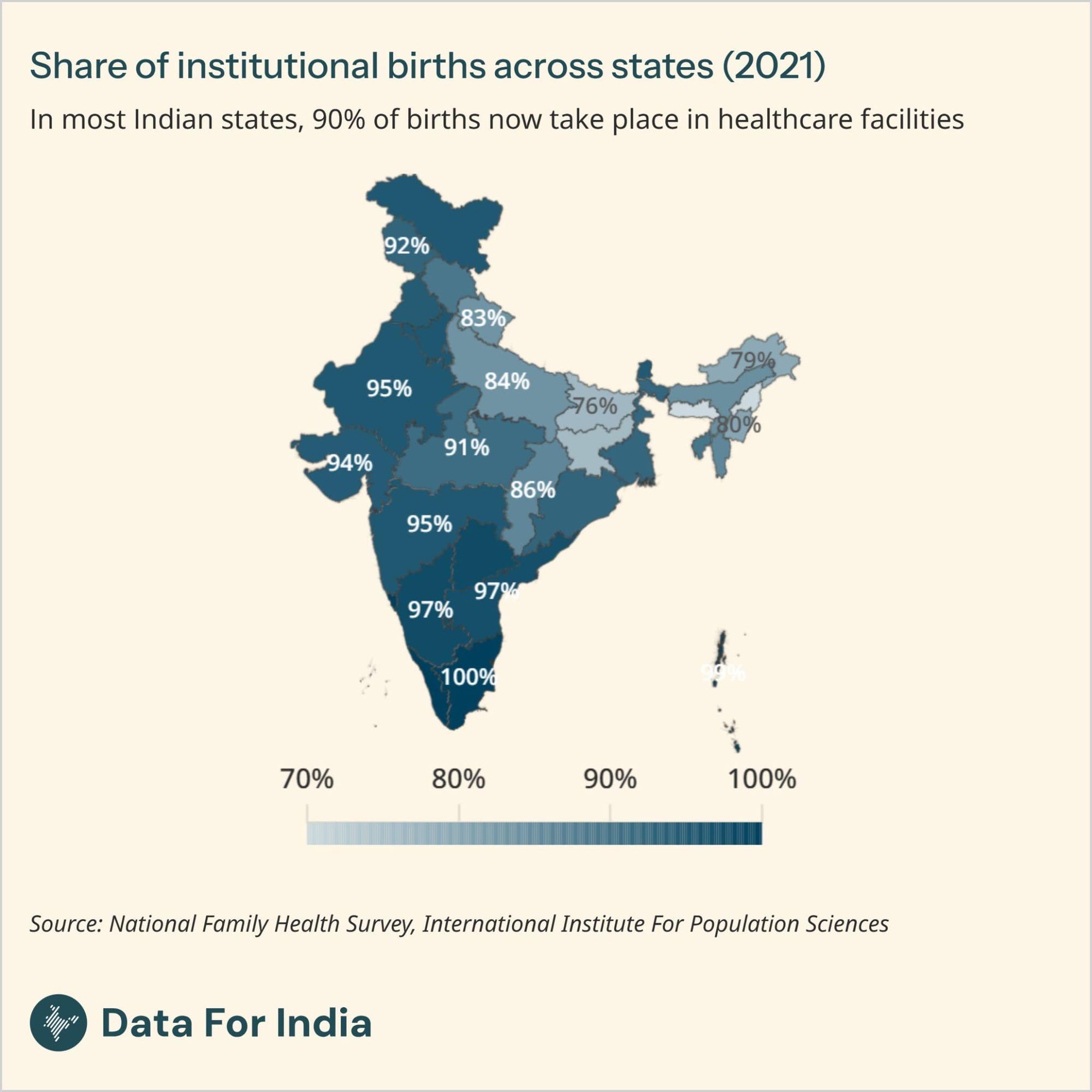
    Institutional births refer to deliveries that take place in a health facility, whether public or private. As of 2021, nearly nine in ten births in India were institutional.

    Among the larger states, Tamil Nadu and Kerala reported the highest levels of institutional births. At the other end, more than one in five deliveries still took place at home in five of India's states - Arunachal Pradesh, Bihar, Jharkhand, Meghalaya and Nagaland - as of 2021.

    Ensuring that women give birth in a health facility is one of the most effective ways to reduce both maternal and infant deaths. Childbirth can involve complications that require timely medical care, making access to skilled health personnel and emergency obstetric services critical.

    India has made significant progress in improving the number of institutional deliveries in the last three decades. In 1993, only about 25% of births took place in a public or private health facility. By 2021, this increased to nearly 90% of deliveries, and much of this progress came from rural areas.

    Some states in particular have seen rapid progress. In Rajasthan and Odisha, for instance, only about one in ten births took place in a health facility in the early 1990s. By 2021, this had increased to more than nine in ten births.

    Public health facilities account for most institutional deliveries in India, particularly in rural areas. Yet access remains uneven. Among the poorest rural households, more than 25% of births still occur at home.

    Read more about the determinants of maternal mortality in India.


    Health
    Copy citation
    1. In most Indian states, 90% of births now take place in healthcare facilities by Nileena Suresh, Data For India (September 2026): https://www.dataforindia.com/data-bytes/in-most-indian-states-90-of-births-now-take-place-in-healthcare-facilities/

  • August 2026

    August 3, 2026

    Most tobacco consumption in India is of gutkha, not cigarettes

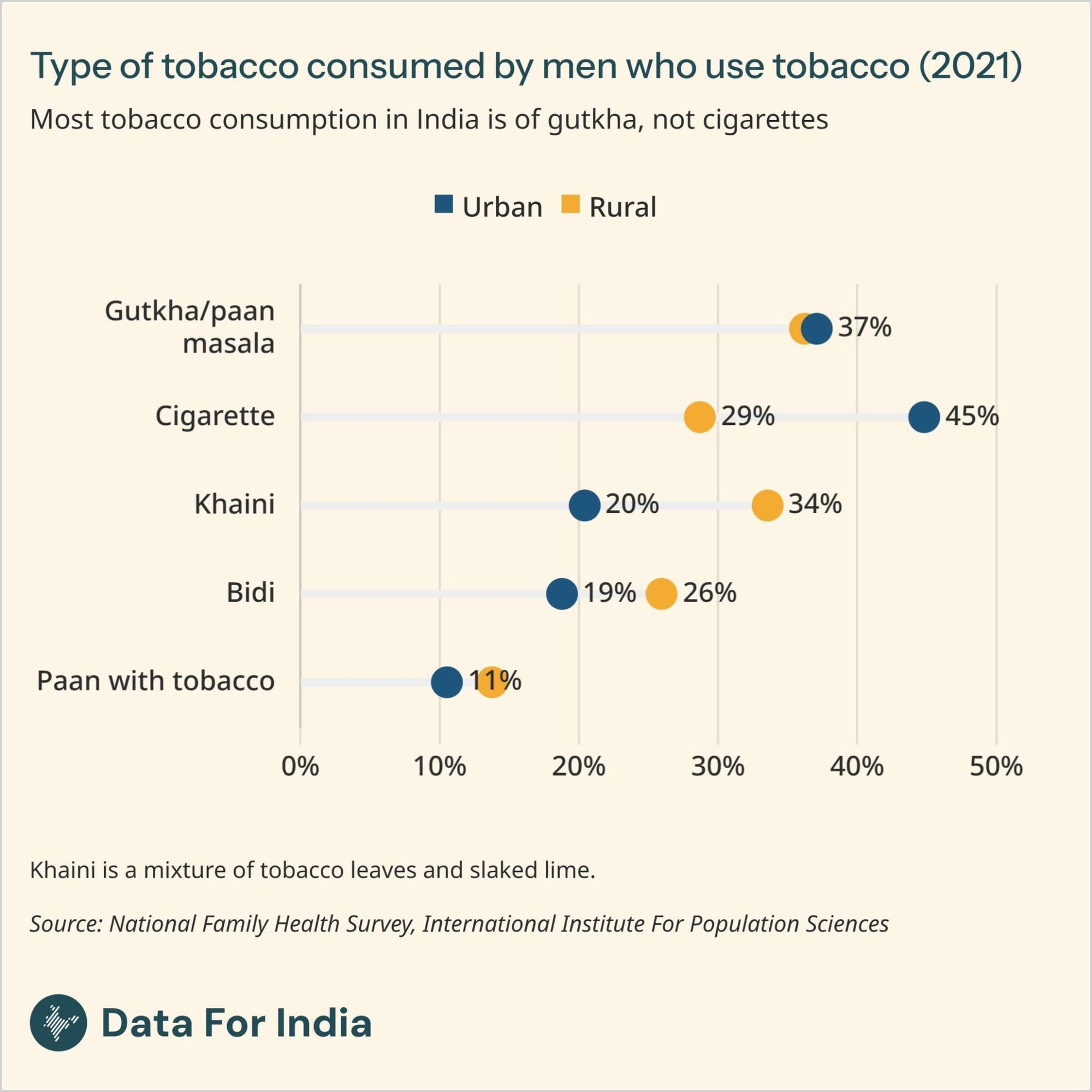
    The majority of tobacco use in India is of chewing tobacco products such as paan masala, gutkha, or khaini. Gutkha is pre-mixed paan masala with tobacco. Paan masala is also sold separately and mixed with tobacco later to be consumed.

    Since most tobacco consumption in India is by men, we look at the type of tobacco usage by men. About 40% of men aged 15-49 use tobacco in some form, compared to just 5% of women, according to the National Family Health Survey, 2021.

    Tobacco use in India as measured by the NFHS includes smoking cigarettes or bidis, as well as chewing tobacco products such as khaini (tobacco leaves mixed with slaked lime), paan masala, gutkha, and other similar preparations. Since respondents may use tobacco in more than one form, the NFHS does not measure consumption of these products as discrete categories.

    More than a quarter of men chew tobacco products, while under one in five men smoke bidis or cigarettes. Tobacco usage is higher in rural areas, and the form of usage also differs, with cigarette smoking more prevalent among urban men.

    Both forms of tobacco have major health impacts, including life threatening conditions like cancer of the oral cavity, oesophagus and liver, as well as heart diseases and respiratory illnesses.

    Read more about the most common diseases in India.


    Health
    Copy citation
    1. Most tobacco consumption in India is of gutkha, not cigarettes by Nileena Suresh, Data For India (August 2026): https://www.dataforindia.com/data-bytes/most-tobacco-consumption-in-india-is-of-gutkha-not-cigarettes/

  • July 2026

    July 2, 2026

    The usage of tobacco is much higher in India's central and eastern states

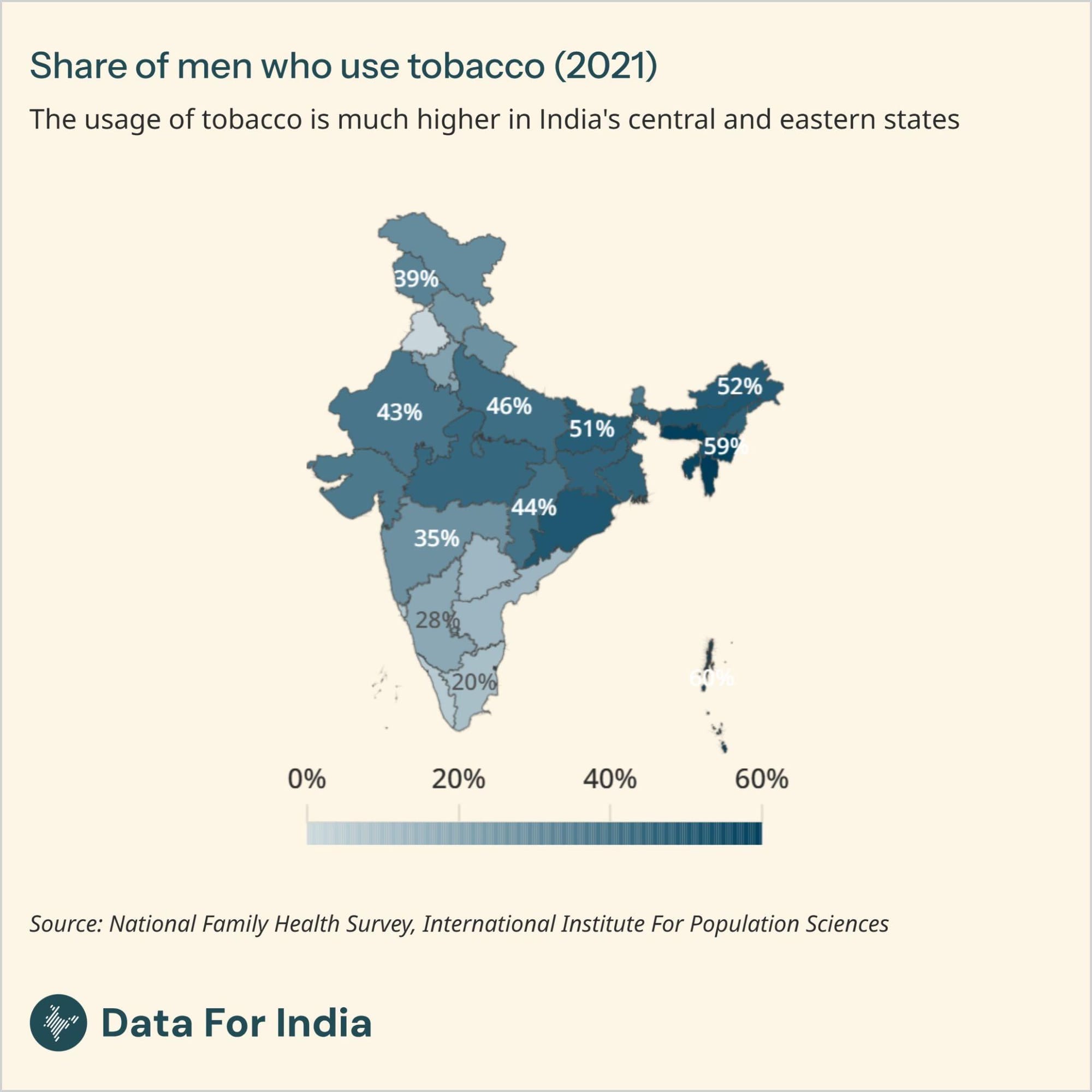
    The usage of tobacco varies by region in India and is highest in its eastern states and lowest in the southern states and in Punjab.

    Almost four in ten men aged 15-49 use tobacco in some form, according to the National Family Health Survey (2019-21). Given that fewer than one in ten women use tobacco, we look at data for men to understand regional patterns in tobacco consumption.

    Tobacco use is highest in India's north-eastern states, where more than half the male population uses tobacco or tobacco products. Several eastern states, including Odisha and Bihar, also report very high tobacco use among men at over 50%, followed by Jharkhand and West Bengal.

    In contrast, many states in the south, as well as Punjab, have much lower levels of tobacco consumption.

    The type of tobacco consumed also varies widely across states. In western and central India, most men who use tobacco consume chewing products such as gutkha, paan masala and khaini. In the southern and northern states, where overall tobacco use is lower, smoking bidis or cigarettes is more common among those who do consume tobacco. In the north-eastern states, patterns differ by state, with chewing tobacco more common in Assam, Arunachal Pradesh and Manipur, while smoking is more prevalent in Meghalaya and Mizoram.

    All forms of tobacco have serious health consequences and are a major risk factor for serious non-communicable diseases, like cancers, heart disease and respiratory illnesses.

    Read more about the rise of non-communicable diseases in India.


    Health
    Copy citation
    1. The usage of tobacco is much higher in India's central and eastern states by Nileena Suresh, Data For India (July 2026): https://www.dataforindia.com/data-bytes/the-usage-of-tobacco-is-much-higher-in-indias-central-and-eastern-states/