Editions list close
  • October 2026

    October 5, 2026

    North-eastern states have the highest shares of workers in government jobs
    Jobs in the public sector remain among the most sought after in India. The public sector is made up of various departments and arms of the government, including companies run directly by the government. Jobs in the public sector are more secure with greater employment benefits than in the private sector.

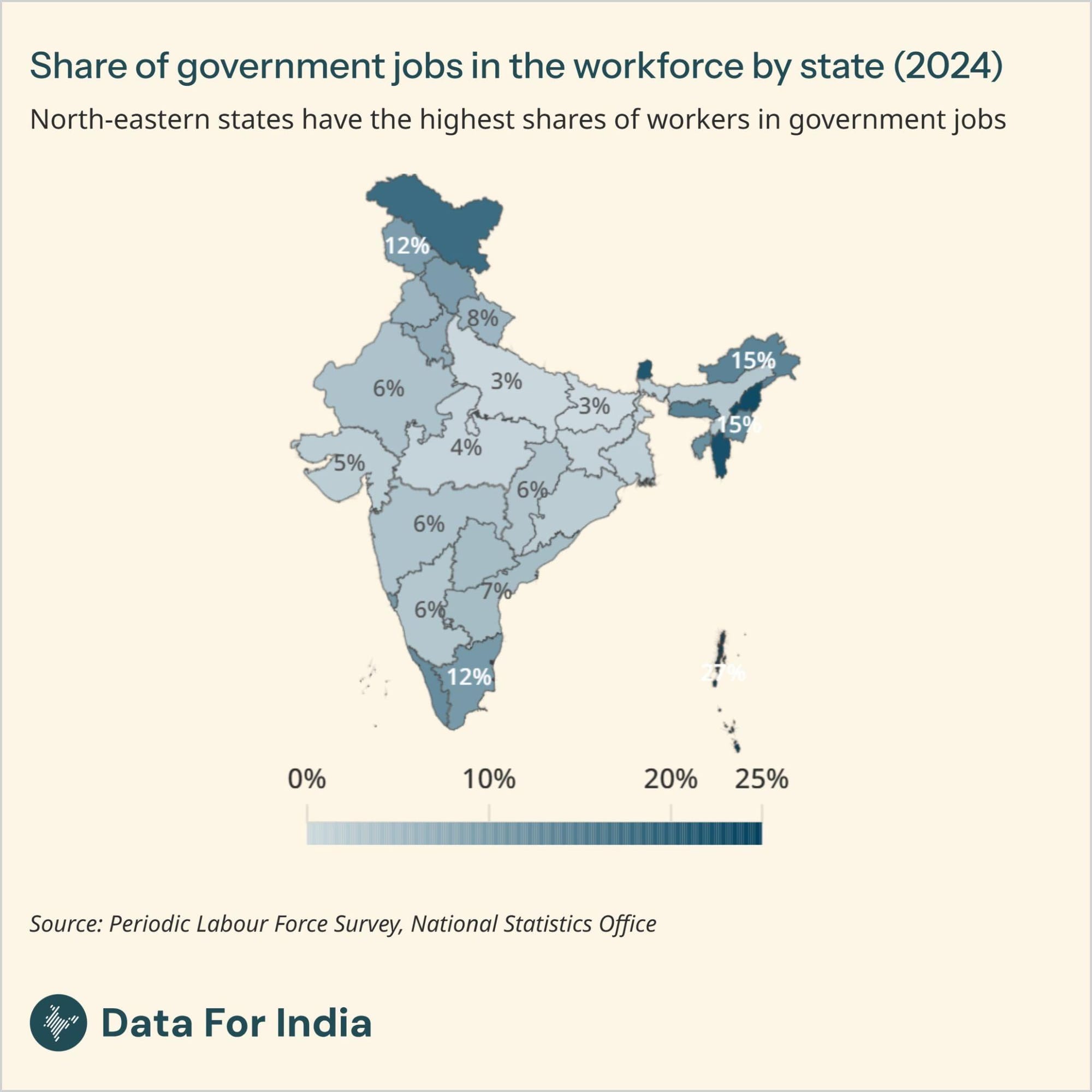
    Yet the public sector can only offer a minority of Indian adults jobs. Just 6% of workers in India are in the public sector. Another 6% of workers are in private companies. The majority of India's workers, meanwhile, are employed in household enterprises.

    This data comes from the 2023-24 round of India's annual Periodic Labour Force Survey, a nationally representative labour survey conducted by the National Statistics Office.

    The share of the workforce in government jobs is highest in India's north-east, where the private sector remains small. One in four jobs in Mizoram, Nagaland and Sikkim are in the public sector. The share of public sector jobs is also high In India's richer and better educated southern states, including Kerala and Tamil Nadu, where between 10% and 15% of the workforce is in the public sector.

    The share of the workforce in public sector jobs is lowest in India's poorest regions with the lowest levels of education, including large parts of central and northern India. Only 3% of workers in Bihar, Madhya Pradesh and Uttar Pradesh are in government jobs, while more than 90% of the workforce there works in household enterprises.

    Read more about the size of India's formal sector.

    Work
    Copy citation
    1. North-eastern states have the highest shares of workers in government jobs by Abhishek Waghmare, Data For India (October 2026): https://www.dataforindia.com/data-bytes/north-eastern-states-have-the-highest-shares-of-workers-in-government-jobs/

  • August 2026

    August 17, 2026

    A higher education is associated with a significant wage premium in India

    One in six Indian workers is a salaried or a regular wage worker. Labour statistics define salaried or regular wage employment as the working arrangement in which employees who work in enterprises owned by others are paid their wages on a regular basis, generally from the same employer.

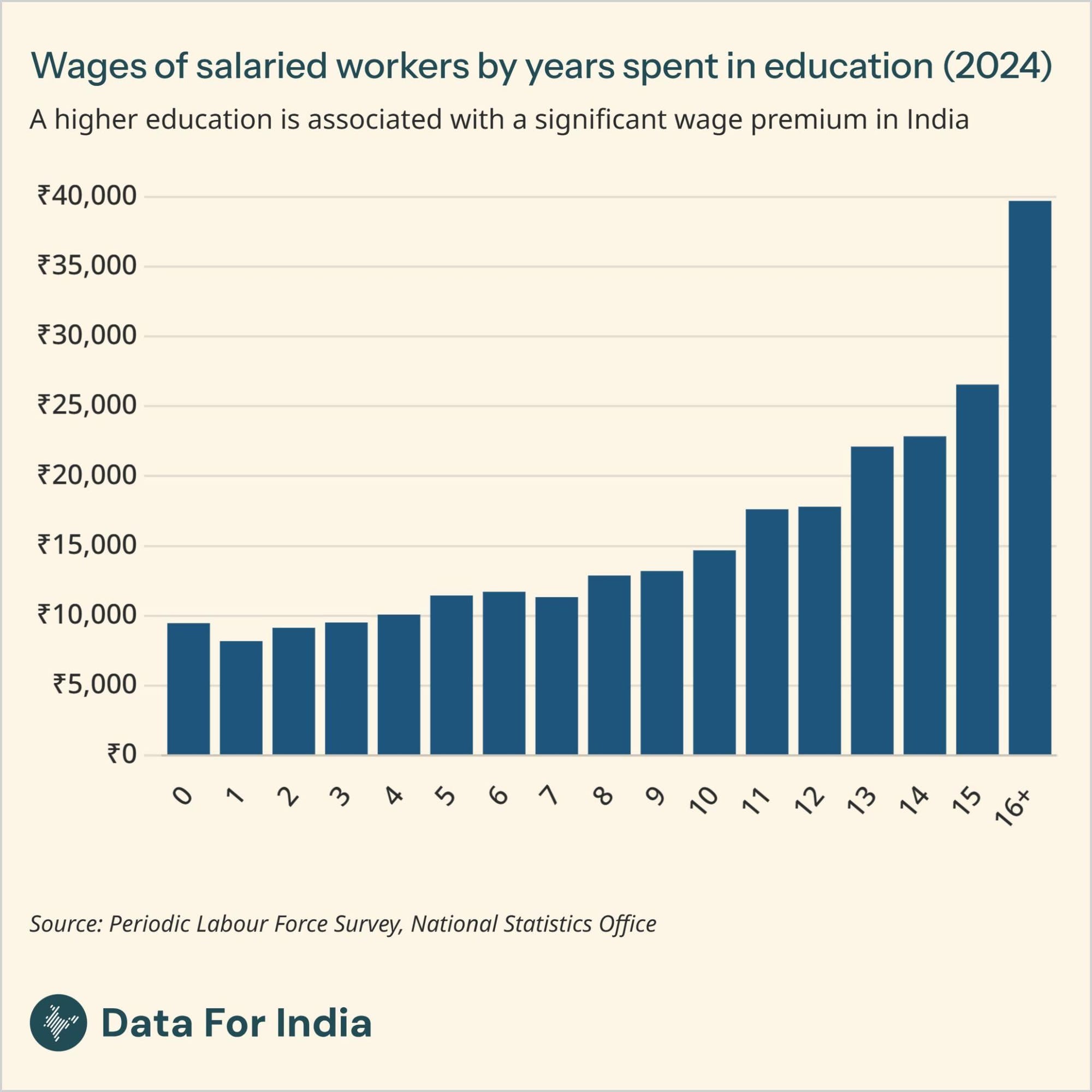
    The wages of salaried workers between 25 and 50 years of age gradually increase with each new year of completed formal education. Here, formal education begins in Grade 1, and a child completes one year in formal education when she successfully clears the first grade.

    But this increase in wages comes in distinct stages. For workers with zero to seven or eight years in formal education, there is little change in earnings. This means that completing the primary level of education does not raise income levels.

    The first significant increase in wages is seen for workers who spent 11 or 12 years in education, equivalent to completion of high school. Beyond that, wages continue to gradually rise for workers with every additional year of completed education, meaning that they are enrolled in a higher education programme.

    The largest increase in wages, however, is for workers with 16 or more years of education. This is equivalent to the completion of a four-year undergraduate programme. Salaried workers with a higher education earn twice that of those with secondary education, and thrice that of those with only primary education.

    Read more about the kinds of jobs that India's salaried workers do.


    Work
    Copy citation
    1. A higher education is associated with a significant wage premium in India by Abhishek Waghmare, Data For India (August 2026): https://www.dataforindia.com/data-bytes/a-higher-education-is-associated-with-a-significant-wage-premium-in-india/

  • July 2026

    July 6, 2026

    Women's absence from India's workforce is most evident in their 20s

    Welcome to the first edition of Data Bytes. Here's a little about our thinking behind launching this format. A new Data Byte will land in your inbox every Monday morning.

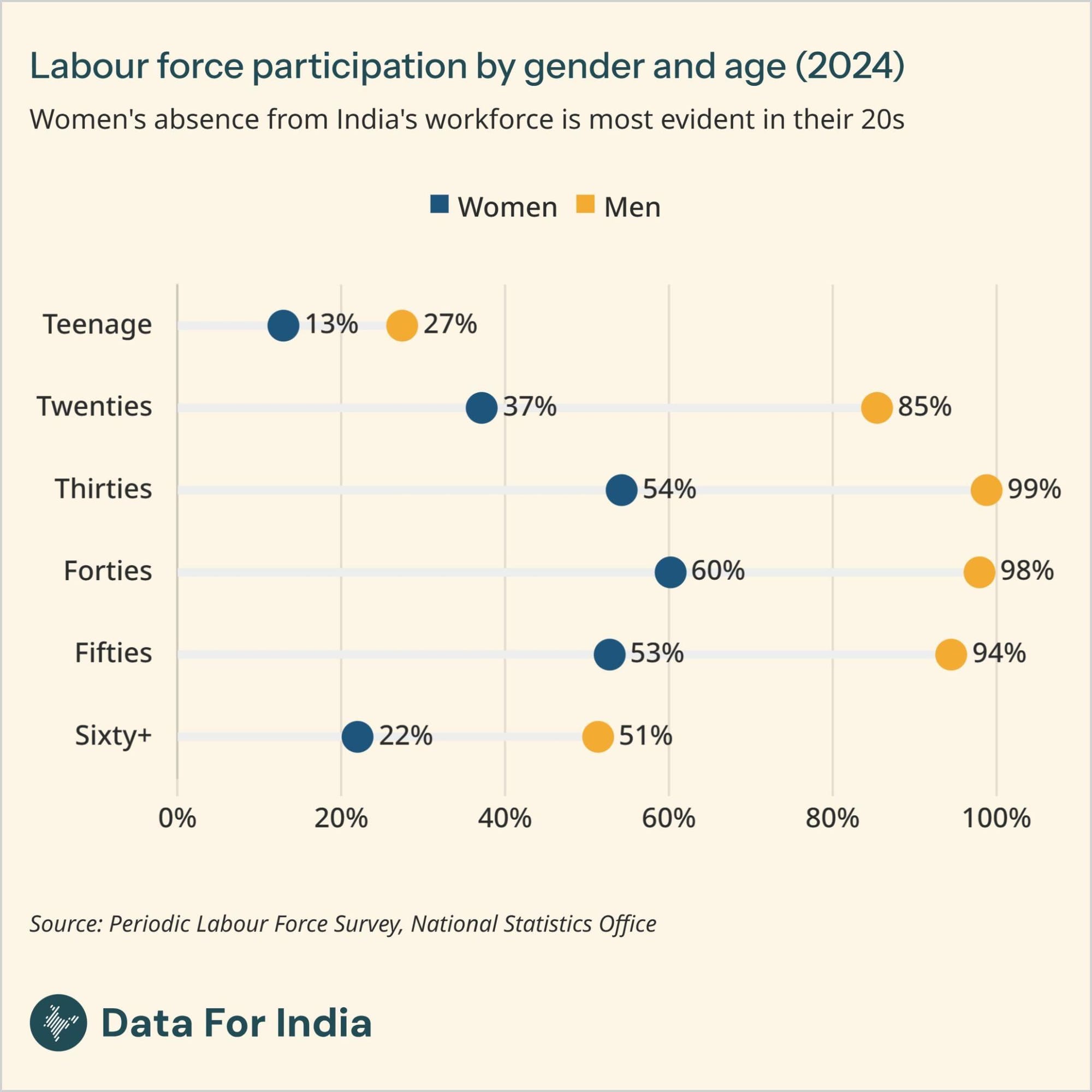
    The share of people in an age group who are either working or looking for work is known as the labour force participation rate (LFPR). The LFPR is an important indicator to measure whether most adults are in the productive economy. In India, female labour force participation is far lower than that of males at every age.

    Across the world, labour force participation rises with age once adults complete their education, and then falls in old age. This is certainly the case for men in India.

    Men's LFPR increases sharply from the teenage years until the mid-twenties, and remains at nearly 100% during the prime working years. It then reduces slowly until the age of 60, and sharply after that.

    The likelihood of an Indian woman being in the labour force (two in five) is half of that of an Indian man (four in five). In India's Periodic Labour Force Survey, women report household duties, including child care and chores, as the main reason for staying out of the labour force.

    But the gap between male and female labour force participation rates is widest in their twenties and thirties. The main reason for this demographic blip in women's labour participation is child-bearing and child-rearing. About 70% of births in India are now to women in their twenties.

    Read more about what brings women back into the labour force here.


    Work
    Copy citation
    1. Women's absence from India's workforce is most evident in their 20s by Abhishek Waghmare, Data For India (July 2026): https://www.dataforindia.com/data-bytes/womens-absence-from-indias-workforce-is-most-evident-in-their-20s/