Editions list close
  • July 2026

    July 27, 2026

    The number of homicide victims in India has fallen, but only for men

    The United Nations Office on Drugs and Crime (UNODC) defines intentional homicide as "unlawful death inflicted upon a person with the intent to cause death or serious injury". In India, the UNODC includes the crimes of murder, culpable homicide not amounting to murder, and dowry death based on the reports of India's National Crime Records Bureau (NCRB), as intentional homicide. The total number of victims of intentional homicide has reduced since 1990 according to this data.

    In 1992, the number of intentional homicides in India reached its peak with nearly 50,000 victims, and has since been on the decline. By 2022, this number had come down to 40,000.

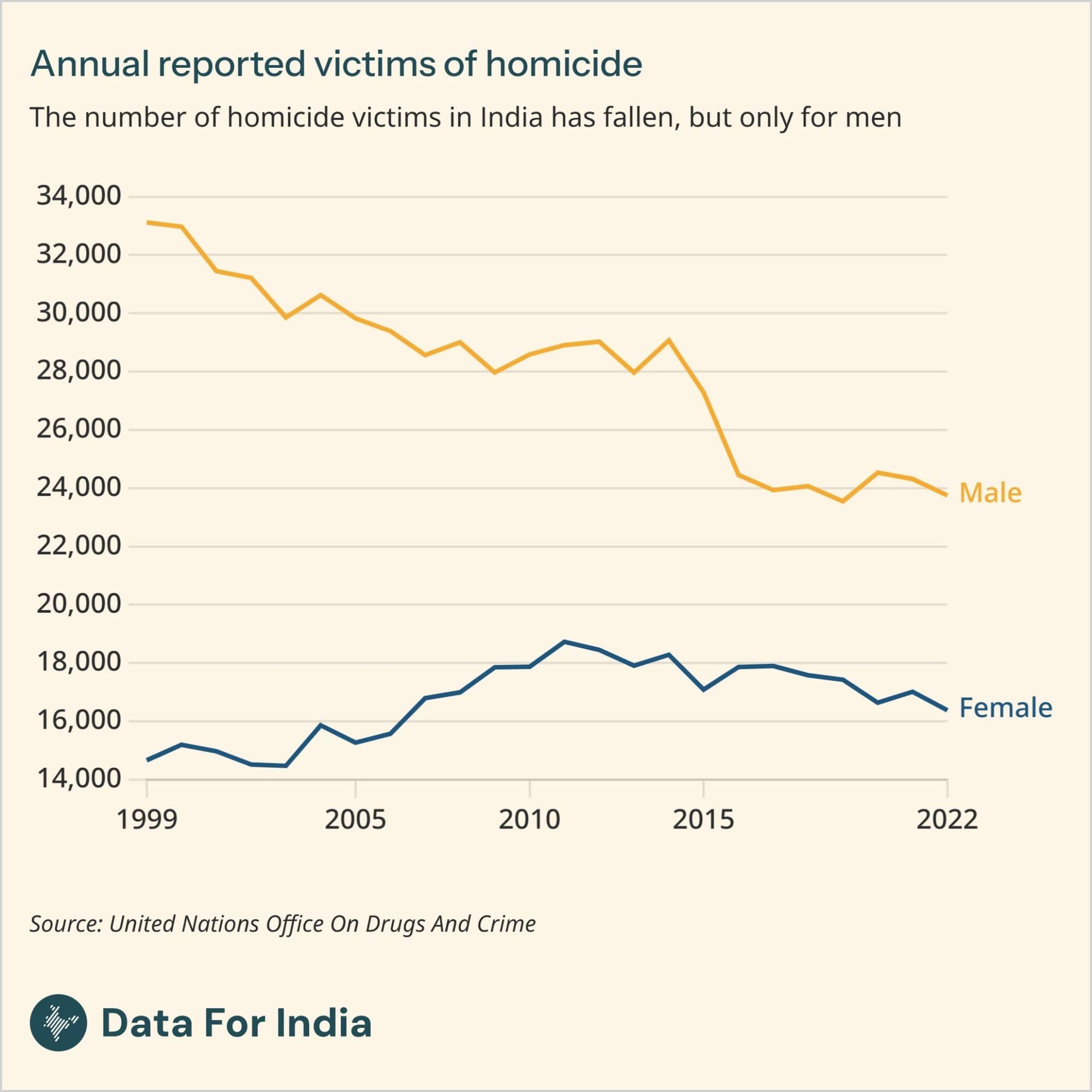
    Since 1999, when gender disaggregated numbers were first made available, the number of male victims of intentional homicide has reduced by nearly a third, from 33,000 to 24,000 in 2023.

    On the other hand, the number of women victims has not declined in a similar way. From 14,000 deaths in 1999, the number of female victims of intentional homicide climbed to 19,000 in 2011 before declining to 16,000 in 2022, a number still substantially higher than it was in 1999. Of the 16,000 deaths, 6500 deaths are dowry deaths.

    This suggests that the decline in homicides and homicide rates in India has largely been driven by a decline in homicide rates among male victims only, and not for female victims.

    Read about the reported causes of intentional homicides in India.


    Law
    Copy citation
    1. The number of homicide victims in India has fallen, but only for men by Ameya Bokil, Data For India (July 2026): https://www.dataforindia.com/data-bytes/the-number-of-homicide-victims-in-india-has-fallen-but-only-for-men/

  • July 2026

    July 2, 2026

    Five states contribute to 96% of court cases older than 20 years

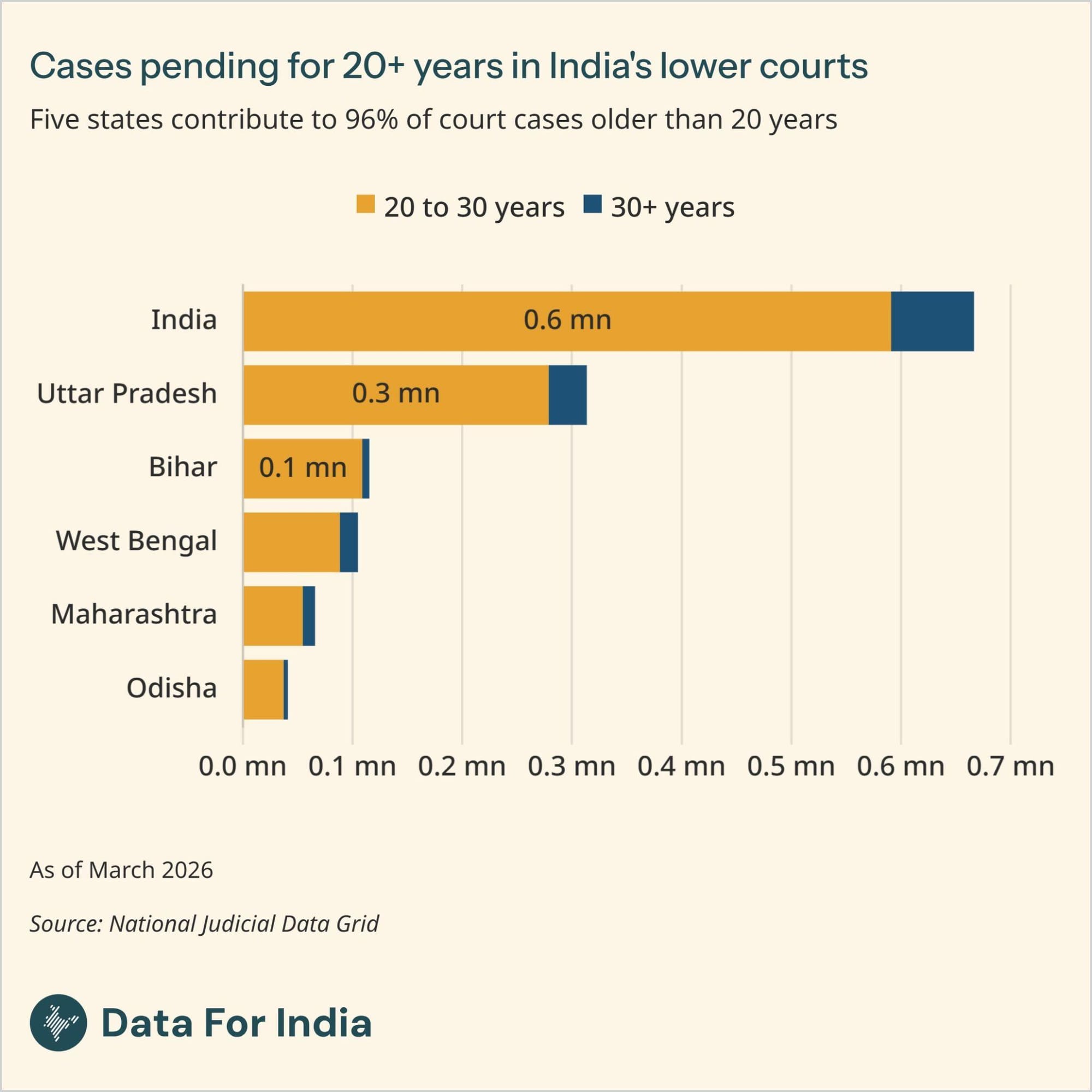
    India's district and subordinate courts, the first rung of the judicial hierarchy, had 48 million pending cases as of March 2026. Of these, over 650,000 cases were pending for over 20 years, and over 75,000 were older than 30 years.

    Five states - Uttar Pradesh, Bihar, West Bengal, Maharashtra and Odisha - are the major contributors to India's oldest court backlogs, accounting for 96% of all cases older than 20 years in lower courts.

    Pendency in these five states is high not just at the level of lower courts, but also at the High Court level. These five states together account for 46% of India's population, but for 56% of all pending cases.

    India's Supreme Court in 2024 recommended a detailed strategy for a phase-by-phase reduction of pendency, prioritising the disposal of cases older than 30 years, 20-30 years and 10-20 years, in that order. For these five states, the plan called for complete disposal of cases older than 30 years by June 2025, and the disposal of all cases in the 20-30 years bracket by December 2025.

    However, these states have not been able to meet the target. Nationally as well, the number of cases in the 20-30 years bracket increased by 20% since 2022.

    Read more about the types of cases that clog India's courts here.


    Law
    Copy citation
    1. Five states contribute to 96% of court cases older than 20 years by Ameya Bokil, Data For India (July 2026): https://www.dataforindia.com/data-bytes/five-states-contribute-to-96-of-court-cases-older-than-20-years/