One of the reasons that we spend so much time and effort constructing historical time series at Data For India is because we really do want to make sure that what we're capturing are truly big shifts. Shorter-term changes in the data sometimes resolve themselves over time for multiple reasons. And sometimes that surprising change in the data is neither a big shift, nor a small shift, but a problem with the data itself.
When the data for the 2023-24 Periodic Labour Force Survey, India's annual employment household survey, came out in 2025, it looked like two strange things had happened - there appeared to be an unexpectedly big increase in the number of reported workers in India over just one year, and changes in the number of male and female workers had taken place in particularly unexpected ways.
When my colleagues Pramit Bhattacharya and Nandlal Mishra set out to investigate what was going on with workforce participation, and workforce participation among women in particular, they discovered an immediate red flag. Almost all of the change could be traced to changes in the state of Assam alone. And it's not just the workforce numbers that looked off in Assam - the overall male and female population numbers for the state too appeared to have gone through a short, shocking shift.
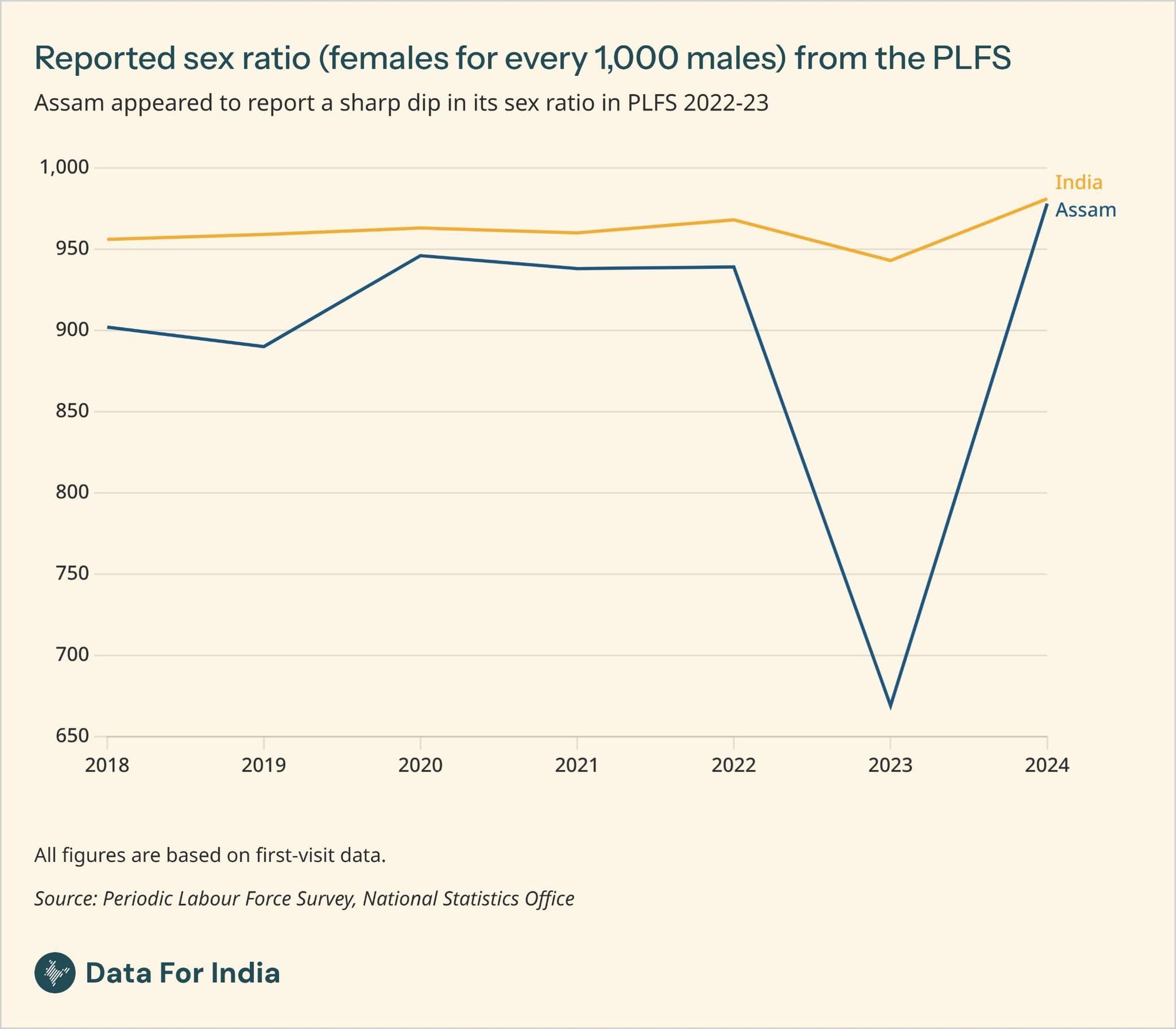
The sex ratio is not an indicator that typically moves like this year-on-year, so Pramit and Nandlal went through the data village by village to figure out what was happening. And the answer lay in village 10386 in the South Salmara-Mankachar district.
The PLFS is a nationally representative survey. As in other large-scale surveys, weights or multipliers are used to make the sample representative of the entire population, Pramit and Nandlal explain. Each sampled unit in a sample survey represents not just itself but a group of other units in the population; a sampled village, for example, is meant to represent a group of similar villages. The final weight assigned to a sampling unit represents the total number of units in the population that unit is supposed to represent.
In the 2022-23 PLFS, one village - number 10386 - was mistakenly assigned a weight 650 times the average weight assigned to other villages in the district, Pramit and Nandlal found. As a result of this error, the unusual characteristics of that single village, given its outsize weight, skewed workforce and demographic estimates for the district, state and country. The village happened to have more males than females, very few working females and a high proportion of children, lowering the number of reported females and female workers. Removing the problematic village from the survey restored the numbers to a more gentle, and expected, trend, both for Assam and for India. (India's National Statistics Office too now, after this work, recommends dropping that village for the PLFS for that year.)
People often ask me why we trust India's public data. And my answer always is that trust is the wrong label - we work with data that we know is good, by engaging deeply with it, and calling it out when there are issues. Even if that means finding that there was no shift at all.