The two decades from 2020 to 2040 are shaping up to be the most momentous period in Indian demographics. First, India's Total Fertility Rate fell below replacement levels (below 2.1) in 2020 or so, signalling the beginning of the end of population growth. Then, India's youth population began to decline in absolute terms around 2026. Here's another: sometime over the next ten years, India's dependency ratio will begin to rise for the first time in 70 years or so.
The population dependency ratio is the ratio of dependents in the population to the working-age population. That numerator is made up of two parts - children and the elderly, and in India, these two lines are moving in opposite directions.
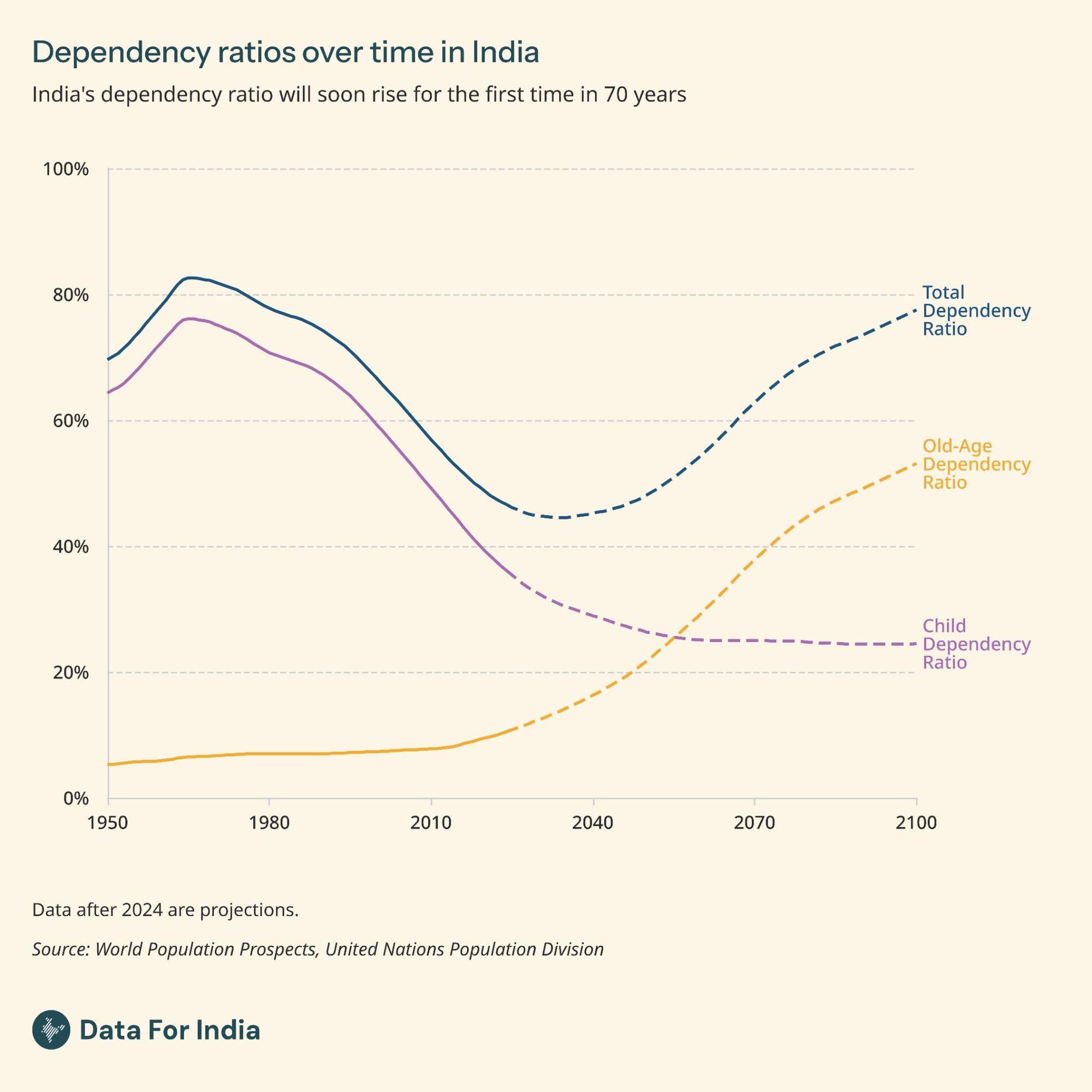
In the first two decades after Independence, India's dependency ratio was growing, but this was because its child population was then growing rapidly. For the last 70 years, India has had the benefit of a continuously falling dependency ratio, as a result of its child population growth slowing, and its elderly population growing only gradually. That, in many ways, was the essence of the promise of the demographic dividend.
But that window is now firmly closing.
India's dependency ratio is set to rise again, this time propelled by a rising old-age dependency ratio. What a higher dependency ratio means in economic terms is that there are fewer economically productive citizens for more dependents. This means that a country needs to increase its spending on welfare measures like education, childcare, eldercare and pensions, while having a smaller base of people who can produce the wealth that is needed to fund such a safety net.
This is, in some ways, what the problem with `getting old before you get rich' is; extreme poverty has, no doubt, fallen rapidly in India, but that's not quite the same as being well-off enough to take care of your dependents. The rest of these two interesting decades will be defined by how well that goes.